
 Support ZN.ua









An 800 Billion Plan: What Can Be Offered to Investors Besides Made in Ukraine Label?
EU’s €90 Billion Loan: New Opportunities and New Challenges
 Reader Survey
04 february, 2026, 11:30
Share

On 14 January, the European Commission adopted a package of legislative proposals to transfer €90 billion to Ukraine to cover its financial and military needs in 2026–2027. The funding will be raised through borrowing on capital markets, with the obligations backed by the EU’s budgetary reserve. Disbursement of the funds will be conditional on meeting a number of requirements—reforms in public administration, the energy market, anti-corruption efforts and others.
EU assistance will be structured as follows: roughly two thirds, or €60 billion, will be allocated to military support, while one third, or €30 billion, will go to budget support. The latter will be organized in the same way as financing under the Ukraine Facility.
ВАС ЗАИНТЕРЕСУЕТ
In the course of using the EU’s €90 billion loan, Ukraine will inevitably face the following challenges:
- budget support of €30 billion will help offset this year’s fiscal gap, but if the war continues it will cover less than half of next year’s international financing needs;
- military assistance of €60 billion will secure Ukraine’s basic defense needs at levels comparable to previous years but will require a radical overhaul of the military procurement system and logistical support for the Armed Forces under requirements prioritizing the purchase of military products within the EU;
- Ukraine’s military-industrial complex (MIC) must demonstrate readiness for accelerated growth and integration into the EU’s defense and technology base, prove the effectiveness of its own R&D, and scale up production with a view to building the manufacturing backbone of a joint European defense supply system.
Thus, the inflow of approximately €15 billion in EU budget support in 2026 under the new loan will almost certainly meet the annual external financing needs of the budget. When approving the 2026 budget, the Ministry of Finance estimated international budget support needs at $46 billion. Together with planned EU financing from the Ukraine Facility, proceeds from the ERA Loan (secured by income from Russian assets) and a loan from the UK government, the new EU loan will close the external financing gap for 2026 that had existed until recently.
However, next year the problem of insufficient external budget financing will become acute. The United States has fully ceased providing financial assistance to Ukraine and continues military aid only at minimal levels. Residual funds from the ERA Loan and the Ukraine Facility will bring about $10 billion into Ukraine in 2027. Assuming that in 2027 the new EU loan replenishes the non-military part of Ukraine’s budget by only €15 billion, the shortage of external financing will become critical.
If the war continues, this situation will compel the government to seek new sources of external funding, consolidate budget expenditures and increase the tax burden. A restrictive fiscal policy would, in turn, have a destructive impact on the country’s economic resilience and exacerbate negative demographic trends.
The terms of the new EU loan stipulate that military assistance funds will be allocated based on principles already applied under the EU’s joint defense procurement framework, SAFE. In particular, EU military aid must be used to purchase weapons, equipment and systems produced in the EU, Ukraine and EU partner countries within the European Free Trade Area and free trade agreements. Only if the weapons Ukraine needs are not manufactured either in the EU or in partner states may they be purchased from other countries—the United States, the United Kingdom or Korea.
A number of factors make Europe’s dependence on US supply chains quite risky, both politically and operationally, prompting the EU to impose these requirements while simultaneously addressing the task of expanding its own military-industrial capacity.
ВАС ЗАИНТЕРЕСУЕТ

Previously, EU countries’ adherence to the “buy American” principle promised not only superior military equipment and faster delivery but also US security guarantees for the continent. Unfortunately, recent political developments in the United States have disrupted this arrangement.
At the same time, the inability of the US industrial base to meet growing global demand for weapons has become evident. Delays in deliveries of key American systems—HIMARS, F-35s, Patriot systems and infantry fighting vehicles—have become commonplace since 2022. Going forward, rising risks of escalation in Asia may further worsen conditions for weapons supplies from the US to Europe.
European manufacturers and political institutions also face challenges related to strict US export controls and restrictions on the use of American weapons under the International Traffic in Arms Regulations (ITAR). Through ITAR, the US government can dictate how, where and when US-made weapons are used and can control arms flows between two or more countries. Within the EU, concerns are growing that the United States could impose limitations on the use of its weapons in repelling Russian aggression on EU territory. The restrictions imposed on Ukraine under the Biden administration clearly point to the danger of such a scenario.

Among EU countries, Germany has moved most decisively to isolate its defense procurement from the US factor and to direct state orders toward expanding domestic industry. Having taken political decisions to rebuild internal manufacturing capacity, the government is already implementing a 2025–2026 military procurement plan that allocates only 8% of the budget to American systems. At the same time, the bulk of military spending is financing the production and supply of European F127 frigates, Eurofighters and IRIS-T SLM air defense systems.
Nevertheless, it must be recognized that Europe’s defense industry—with annual turnover of €190 billion and 600,000 jobs—has significantly less potential than that of the United States. Moreover, Europe’s rearmament program is progressing slowly under the influence of entrenched structural constraints.
Furthermore, a certain technological dependence of the EU defense industry on the United States persists. European armed forces will continue to rely on American platforms, technologies and supply chains in aerospace, command and control, precision strike planning, missile defense and other areas. US funding for defense research and development, at $150 billion per year, far exceeds comparable EU spending of €11 billion.
Even now, in times of unprecedented challenges, EU efforts are largely focused on weapons procurement rather than innovation. Unlike the United States, which spends roughly as much on defence R&D as on weapons purchases, European governments do not set themselves the task of closing the long-term technological gap with the US.
As a result, Ukraine will gradually be forced to reorient towards a European catalogue of military goods (in parallel with increased production volumes within the EU), while American weapons and air defense systems will retain dominant positions only in those segments where European alternatives do not exist.
Ukraine’s MIC, as the material foundation for countering Russian aggression and a bridge between European security and Ukraine’s defense capability, will also have to meet new challenges. There will be an urgent need to scale up leading military production within Ukraine, establish joint ventures with EU partners, increase procurement of components and finished products from EU manufacturers, undertake technology transfers and share battlefield experience.

Unfortunately, the significance of the MIC for Ukraine’s economy remains limited. According to expert estimates, in 2025 the MIC accounted for 10 percent of industrial output and about 2 percent of GDP. It should be noted, however, that during the war the MIC’s share in industrial sales tripled (from 3% to 10%) and in GDP rose from 0.7 to 2 percent.
Currently, around 200,000 people are employed in Ukraine’s MIC, representing 4 percent of total employment. Among industrial sectors, the DIC ranks fourth after food processing, power generation and metallurgy.
Despite the high intensity of military confrontation with the aggressor and the considerable length of the frontline, growth in real MIC output between 2022 and 2025 amounted to only 34 percent (including 100% over 2023–2025).
At present, Northern and Eastern Europe play the leading role in defense-industrial cooperation with Ukraine. Countries in this region are successfully demonstrating how, under new conditions, demand can be pooled, equipment standardized, and Ukraine integrated into the European security system.
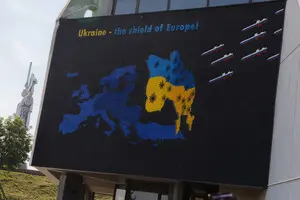
Denmark has proposed a practically meaningful model of direct financing for Ukrainian manufacturers to supply systems used on the battlefield. This enables expansion of production of critically needed weapons and the establishment of long-term industrial ties between Ukraine and Denmark.
From the EU’s perspective, defense-industrial cooperation with Ukraine is viewed as a long-term investment in European security. Such cooperation is particularly valuable amid the gradual withdrawal of US troops from Europe and the reassessment of US security guarantees within NATO.
Ukraine has already become an integral part of the European SAFE plan, whose objectives include accelerating defense-industrial integration between Ukraine and the EU. SAFE is a €150 billion EU financial mechanism designed to provide member states with low-cost financing for defense-industrial projects and to mobilize large-scale investment while encouraging the participation of Ukrainian companies.
On 16 December, Regulation No. 2025/2643 of the European Parliament and the European Council was adopted, establishing the European Defense Industry Program (EDIP) and framework measures for the production and supply of military products. It sets the foundations for defense cooperation among EU members, introduces incentives for joint procurement, enshrines the “buy European” principle and outlines vectors of interaction with Ukraine.
The logic behind EDIP stems from the fact that the defense industry cannot function under classical market conditions. Demand for its products comes exclusively from the state, which also controls all defense procurement, technologies and exports. Under such conditions, defense companies typically do not make investments that later pay off through market sales; they do so only when receiving reliable and substantial government orders. In addition, the defense sector faces persistent barriers to financing, including co-financing, due to specific risks. All of this underscores the critical importance of public investment and state incentives in expanding defense production capacity.
EDIP will operate with a budget of €1.5 billion for 2025–2027 and includes a dedicated component—the Ukraine Support Instrument (USI). It is aimed at supporting and modernizing Ukraine’s defense-industrial base and ensuring vital defense supplies for the country. Funding is also provided for joint projects, production expansion, and the integration of Ukrainian companies into the European defense ecosystem.
The planned budget of the Ukraine Support Instrument is €300 million through the end of 2027. However, EU member states, various EU bodies and agencies, third countries, international organizations and others may make additional contributions. The USI is intended to encourage EU member states to cooperate with Ukraine and Ukrainian MIC entities, facilitating procurement of defense products from Ukraine’s defense industry.
Overall, the outcome of the Russo-Ukrainian war and the future development of the Ukrainian state will largely depend on our ability to respond adequately to new challenges and to seize the opportunities offered by economic and politico-military cooperation with the European Union.
Noticed an error?
Please select it with the mouse and press Ctrl+Enter or Submit a bug
Stay up to date with the latest developments!
Subscribe to our channel in Telegram
 Follow on Telegram
Пожалуйста выберите один или несколько пунктов (до 3 шт.) которые по Вашему мнению определяет этот комментарий.
Пожалуйста выберите один или больше пунктов
Нецензурная лексика, ругань
Флуд
Нарушение действующего законодательства Украины
Оскорбление участников дискуссии
Реклама
Разжигание розни
Признаки троллинга и провокации
Другая причина
Отмена
Отправить жалобу
ОК
 Login with Facebook
 Login with Twitter
 Login with Google