
 Support ZN.ua








Arakhamia’s First Government? Why President’s Office Is Recalibrating the Levers of Power

Changing the prime minister and the government is the bird in the hand that Volodymyr Zelenskyy has been forced to settle for, in place of the election still circling somewhere in the autumn sky. The stars aligned. Europe released the money. Refineries and Russian tankers are ablaze. The owners of apartments, rooms and hotels on Crimea’s southern shore, who bled dry every Soviet, then Ukrainian and finally Russian citizen who came their way, have been severely punished. And the Poles, toward whom feelings have always been mixed, got a stern rebuke from the president. Every electoral group got its own energy drink, and all of them at once, instead of resigning themselves to a peace bought with compromises, took wing on the idea of peace through victory.
The pollsters confirmed the public mood, and the survey results landed on the president’s desk with a note attached: “The trends right now are the best they have ever been, everything is rising.” According to the Rating Group, in June 45 percent of Ukrainians confirmed that the country is developing in the right direction, whereas in February the share who were sure of that was 6 percent lower. 78 percent of our citizens look to Ukraine’s future with hope—up by 5 percent over six months. 68 percent of Ukrainians approve of President Volodymyr Zelenskyy’s performance, and 32 percent of all respondents are ready to vote for him in the first round of a presidential election.
This is the plateau of the leader “who will carry us through the war” (despite serious corruption scandals in his innermost circle, the problems of mobilization and the rest): a year ago, Zelenskyy had virtually the same figure, but back then Zaluzhny had 25 percent, and now he has 16 percent. It was on this wave that the readiness to go to the polls was built. After all, holding a vote under martial law would have concentrated administrative, financial, security and media resources in a single pair of hands.
But to rule out any surprises and win convincingly in the first round, Zelenskyy had two matters to settle. The first was to clear the serious rivals out of the way: the sitting ambassador to Britain, Valery Zaluzhny; the head of the President’s Office, Kyrylo Budanov; and the defense minister, Mykhailo Fedorov. Fedorov disavowed any claim to the presidency at once, announcing as much not only to his own team but publicly, in his recent much-discussed interviews. Zaluzhny gave everyone to understand that it was not so clear-cut. And Budanov stated outright that if Zaluzhny was running, then he simply had to run as well—the argument being that Zaluzhny’s votes flow not to Zelenskyy but to Budanov. The president, of course, saw through the ploy and realized that, should the race take place in the autumn, he would not be rid of either Zaluzhny or Budanov.
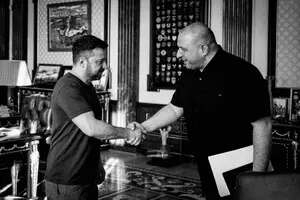
The second, insurmountable difficulty was that the amendments to the election law were not ready. And David Arakhamia, having consulted the deputy speaker responsible for drafting them, Oleksandr Korniienko, informed the president that they could not possibly be prepared before mid-October. So the festival of the popular will has most likely been moved to the spring.
The folder marked “Elections under Martial Law” sits permanently on the president’s desk for one more reason: his principal rivals are not even Zaluzhny and Budanov, but time and the ratings. Social psychologists are convinced that as long as the war goes on, voters judge Zelenskyy as commander-in-chief and guarantor of their security—and that time works for the president. But the same time will present its bill once the war ends and society begins to assess not a war leader but a politician with a great deal to answer for. All the more so if the terms of peace prove difficult and unjust for Ukraine. Political engineers in the presidential staff understand this perfectly well, and Zelenskyy is always ready to gamble for the sake of keeping and consolidating power. And not only with elections.
But the cards are falling his way! And if you can’t play poker, why not play the fool’s game? Ratings, after all, can be converted into a stronger government, which is meant to become one of the pillars on the road to a future re-election. Surely, we are not expected to believe that the government is being replaced in order to prepare for winter more effectively? Is the first deputy prime minister and energy minister, Denys Shmyhal, not enough for that—a man who is an old hand at dealing with donors and knows the energy complex like the back of his hand? What can a fine specialist and admirable white-collar man like the sitting head of Naftogaz, Serhii Koretskyi, add to him here? With his deep but rather narrow expertise. Or will the government be strengthened by a policeman as defense minister? By an “executioner” at the Security Service of Ukraine? By the untouchable head of the State Financial Monitoring Service, Pylyp Pronin, staying exactly where he is? Still, it makes for a bit of action!
On Sunday, with no warning and no hesitation, the president announced a change of government. And yesterday parliament duly voted to dismiss Prime Minister Yuliia Svyrydenko, who had been brought to the post by the former head of the President’s Office, Andrii Yermak. Under the law, every minister has become an acting minister, and in the coming days the Rada plans to confirm a new prime minister, the Cabinet as a whole, and two ministers—foreign affairs and defense—whom the president submits to deputies personally. There are still no votes for the appointment of the Security Service chief.
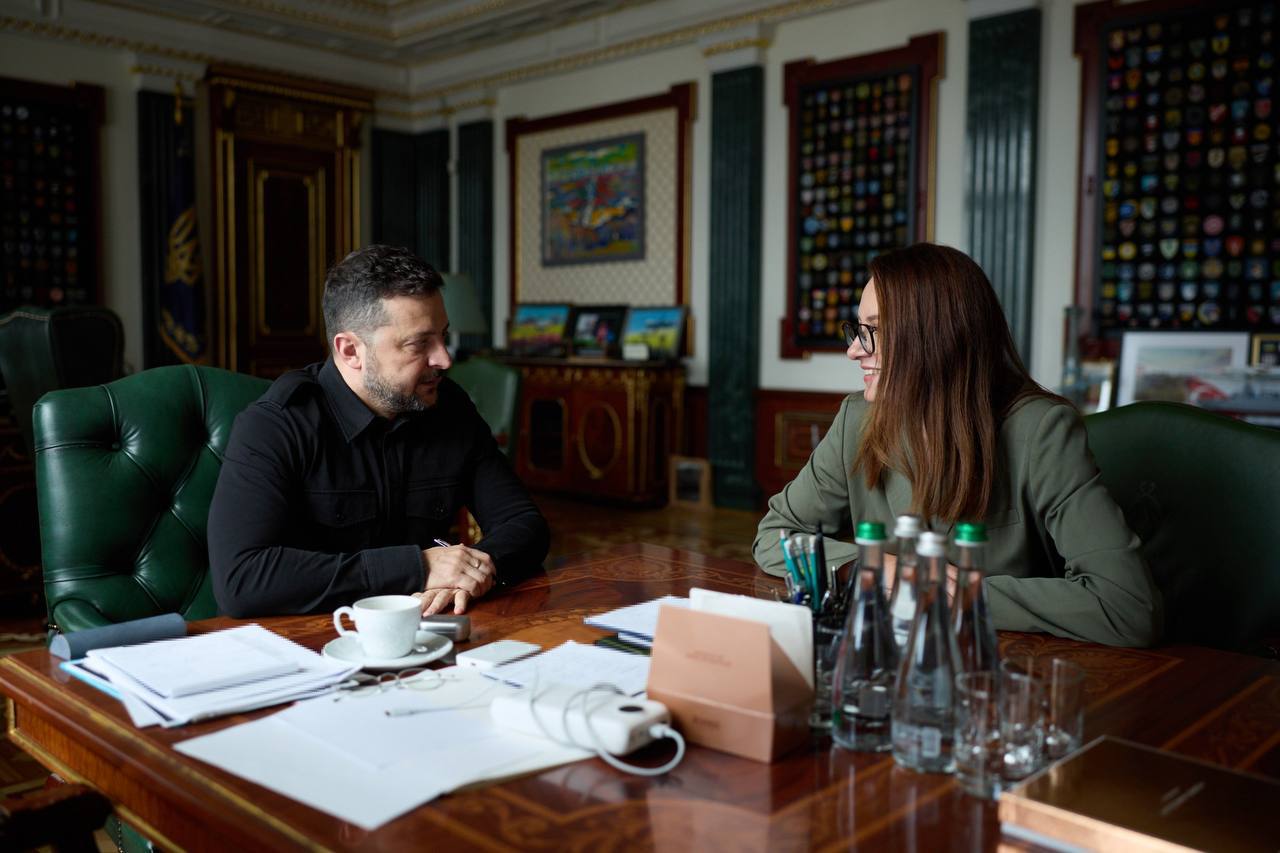
The decision to dismiss the government was taken in an extraordinarily narrow circle. Even the head of the President’s Office was kept well away from the details—unlike David Arakhamia, Rustem Umerov and Yermak, who joined remotely. The decision was of course Zelensky’s, but the key role in preparing the move belonged to the head of the Servant of the People parliamentary faction, David Arakhamia. This man, once a commercial infection whose vigorous spread was entertaining to watch, has turned into the president’s new pillar of support. The former head of the President’s Office, Andrii Yermak, has stepped back from active involvement in shaping the daily agenda of power. He is still beside the president, but no longer at his elbow. And the collective “Yermak,” parceled out among Umerov, Budanov, Lytvyn, Tatarov, Poklad et cetera, is uncomfortable for the president to work with. Each has his own role, but a team cannot be a master key. Arakhamia can.
Budanov had no desire to take over the shadow portfolio that Yermak had spent years wrapping around himself, like the countless leaves of a cabbage. Arakhamia did. Only six months ago, he was caught between Scylla and Charybdis. On the one hand, the president could not bear to hear his name, because he considered him a traitor. Arakhamia had indeed led the fronde (Budanov, Shmyhal, Maliuk, Tatarov, Fedorov, Svyrydenko) that seized on NABU’s searches at Yermak’s place to move against him. But he was fighting for his own place in the sun, answering Yermak’s ceaseless intrigues. Yermak did not merely lean on him: for a time, he squeezed Arakhamia out of the tax service, at colossal cost. On the other hand, Arakhamia is regarded as the organizer of the illegal payments to members of parliament. NABU was preparing a notice of suspicion against him. The upshot could still be 12 years in a room of his own with no weed he campaigned to legalize, no vinyl and no Balenciaga. How did he wriggle out of it? By making himself so indispensable to the president that Zelenskyy was obliged to ask NABU to take into account Arakhamia’s exceptional and irreplaceable importance to the negotiation process and to the Rada’s stable functioning in wartime. What a clever boy!
It cannot be said that Arakhamia has become the new Yermak. Because he is a different animal. The difference between Yermak and Arakhamia is the difference between dead water and living water. Yermak built a vertical with a single man at its summit. Arakhamia works horizontally, circulating endlessly among people, interests and conflicts. Yermak was at the president’s side 24/7, and he cared for nothing but the president’s comfort, the president’s pleasure and the president’s power, which he used to build Zelenskyy’s monarchy. Everyone else could go hang. Arakhamia, by contrast, is alive: he walks the chamber, the corridors and the choicest offices on his own two feet, solving problems and creating them. He is a kind of Doctor Aybolit, the storybook vet: he can put drops in your ears, keep the parasites off you—and sew a fifth leg onto somebody else’s business at the same time.
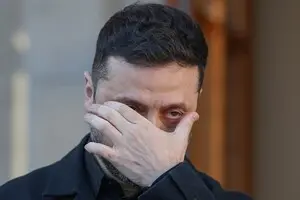
He is connections incarnate, and he can be relied upon. He solves problems not because he runs the system but because he knows how to stitch its parts together. When Yermak was still there, Arakhamia did all the same things—he was simply, objectively, smaller. But with his quick brain, his sincere failure to grasp any limits (the law included), his boundless sociability and his singular commercial streak, Arakhamia has filled every inch of the space vacated when the elephant was led out of the president’s china shop. And when you are present (for reasons nobody can fathom) at every one of the president’s meetings, the international ones included, you automatically acquire the mandate of a tax farmer, and from the back office of the tax service you multiply it across virtually every sphere in the country where there is money.
And what does the president get out of all this? Zelenskyy cannot be alone; he needs a companion. And Arakhamia is a convenient henchman, here and right now. Quick, honey-bearing, easy company, cynical. Indecently multitasking: from negotiations with the United States and Russia to cold-calling witnesses in the Nord Stream case as part of the campaign to discredit Valery Zaluzhny. Above all, he has convinced Zelenskyy that he holds the parliamentary majority irreplaceably and can assemble it in a variety of configurations. Zelenskyy has no time for deputies. He finds the word itself distasteful to pronounce. But he understands that without the support of a parliamentary majority he will lose the Cabinet of Ministers, and with it his monarchical power.
Arakhamia, for his part, has already tasted the monetization of running a parliamentary majority, and he understands perfectly well that in the next parliament neither he nor Zelensky will be handed such a single, unbroken canvas to paint on. But nobody intends to surrender, and if a whole cloth cannot be had, then a patchwork quilt will have to be sewn.
To make this scenario work, Arakhamia, together with a soldier of the “Monaco battalion,” Ihor Abramovych (do not confuse the Kharkiv oligarch with the Russian one), has for several years now been running a party incubator staffed with rather good organizers and political consultants. They have already offered their services to a range of politically active people. Need to assemble squads for a parliamentary election? Easy. The appearance of Kharkiv mayor Ihor Terekhov and the head of the Mykolaiv regional military administration, Vitaliy Kim, in the Association of Frontline Cities is Arakhamia’s handiwork.
And these are by no means one-off political errands. Arakhamia is building his own infrastructure of influence. He knows that under Zelenskyy’s backstage patronage one can plant and nurture the shoots of political projects for every significant slice of the electorate: nationalists, the military, the pro-Russian crowd, liberals, the technocratic managers, the anti-corruption campaigners and the rest. Zelenskyy will grant him the patent, the openings and the resources, and he will assemble for Zelenskyy a majority in the future parliament—one that he personally will be able to work on. It is a kind of shared destiny. He will find no one better than Zelenskyy. And Zelenskyy will find no better Ostap Bender. But where Zelenskyy needs a single chair, Arakhamia needs 226.
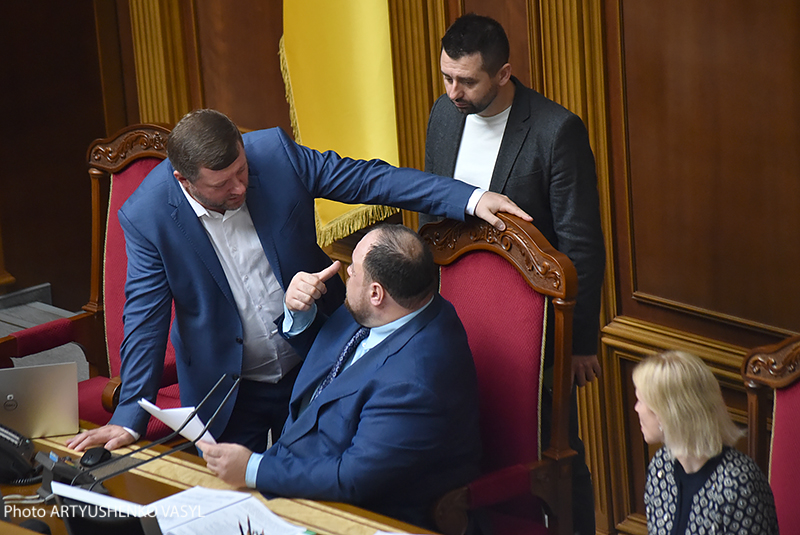
A whole series of prerequisites is needed to accomplish this. And a Cabinet that can be steered properly is one of them. Which is why Arakhamia is taking the liveliest part in putting it together. Whenever the president cuts someone from the list of ministerial candidates, it is swiftly amended with other contenders proposed by the same Arakhamia. The governing principle of every substitution is responsiveness to requests from senior comrades.
The leading candidate for prime minister, Serhii Koretskyi, is not Arakhamia’s priority. One of the boys through and through, Shmyhal would of course have been better, as would the eminently predictable Terekhov. Koretskyi, brought into government by former deputy head of the presidential staff Rostyslav Shurma and patronized by Andrii Yermak (who may well have reminded the president of him), is not Arakhamia’s avatar, but neither is he a problem. Koretsky has not been tempered in political battles. Beside him stands Valerii Pysarenko, a Portnov-and-Tatarov man, who will teach him nothing good and will not shield him from the big players. The candidate-to-be does not steal from his own, but he carries out instructions. It was not for nothing that Yermak and former deputy prime minister Oleksii Chernyshov put him in charge of Naftogaz after Chernyshov moved to the Ministry of National Unity. A loyal, professional, understanding man who will unfailingly pick up when “David Arakhamia” lights up his phone.
Yuliia Svyrydenko, for one, stopped picking up. Because every call from Arakhamia demands an answer with nine zeros after it. So Arakhamia is assembling a Cabinet of people who take his calls and understand that they cannot say no. The investigators certainly will not need to work out who is whose godfather, brother, partner and so on. Godfathers fall out, relatives kill one another over inheritances, mistresses become tiresome, former colleagues get above themselves… The new operator of the presidential console simply reads human psychology. Arakhamia is a dog handler with an eye for which beast is untrainable and which will take to the leash.
One other thing is common knowledge: David Arakhamia never lets anyone take a bite of the sandwich for free. Political brokerage ceased to be his only sphere of influence long ago. Arakhamia today is everywhere—and businessmen know it, as do the makers of counterfeit cigarettes and vodka, the importers of medicines, the tax officials, the owners of gambling operations, certain drone manufacturers and others. It seems we had every reason to call him the “tsar of money” in this country.
But it does not work with everyone. With Fedorov, for instance, it did not. This is an old antipathy going back to the days of the CRGL (Commission for Regulation on Gambling and Lotteries) and PlayCity. In the battle for the gambling regulator, Arakhamia has won for now: the PlayCity state agency has been taken out from under the Ministry of Digital Transformation and now hangs in the airless void of no oversight at all. With the defense industry (the weapons budget and the weapons business) things have gone rather less well. Arakhamia’s battle with Fedorov coincided with Zelensky’s own wariness toward his defense minister. Many believe that the shuffling of beds in the Cabinet has essentially been staged so that the din would mask the removal of Mykhailo Fedorov.
Defense Minister Mykhailo Fedorov is locked in a savage and irreconcilable conflict with the commander-in-chief of the Armed Forces, Oleksandr Syrskyi. Even before Fedorov’s appointment (and rumors that he might become defense minister were circulating long before he did) there was a very strong likelihood that the generals would not let him into their fiefdom. But Zelenskyy, as part of the cosmetic operation “post-Midas,” not only freshened up the President’s Office with Budanov’s reputation but also installed Fedorov at the MoD.
For six months the defense minister solved problems as far as his powers allowed, trying not to get lost in the labyrinth of military bureaucracy and building alongside it a parallel ministry in the shape of a digital tower. He drafted a reform of the army (the military themselves met it with hostility, but it was the first real step toward serving soldiers) and did not disown the problems of mobilization (the minister said he would take them on in the second stage of the reform). He promoted capable commanders. He created a synergy around drones, tying the grandees of global military technology to Ukraine as a proving ground, on terms advantageous and important to us. He spoke of putting order into the ministry’s procurement and of his constant resistance to pressure from the corruption clans that have been taking shape in the defense sector for years.
And the only question was how long the patience of the president would last—the president who, by Fedorov’s own account, backed him and told him to “follow his conscience.” Right. Less than two weeks after the minister’s high-profile interviews, the whole country is discussing his imminent dismissal. President Zelenskyy has preferred a general running on vacuum tubes to a minister running on digital. Besides, nobody intends to leave the tens of billions coming to us from the EU and NATO for weapons without “supervision.” And Fedorov is certainly not the character to turn a blind eye while other people crudely take money out of the budget and carry it home. We do not think Fedorov is a saint. But he has no taste for the crude, and his high efficiency is a priority for the country today.
At the same time, Zelensky understands perfectly well that although Fedorov is no revolutionary today, no one knows what may get into his head tomorrow if the successes of the drones and of the other changes he has begun—changes whose results are genuinely visible on the battlefield—continue to be associated with him. All the more so since Fedorov, for all the political statements the president needed to hear, has not disbanded his team of political consultants. And who needs this visionary civilian candidate for president? Zelenskyy—certainly does not. So he has to be strangled in the cradle.
The president could have stopped the smear campaign against Fedorov unleashed in the pro-government Telegram channels. He chose not to.
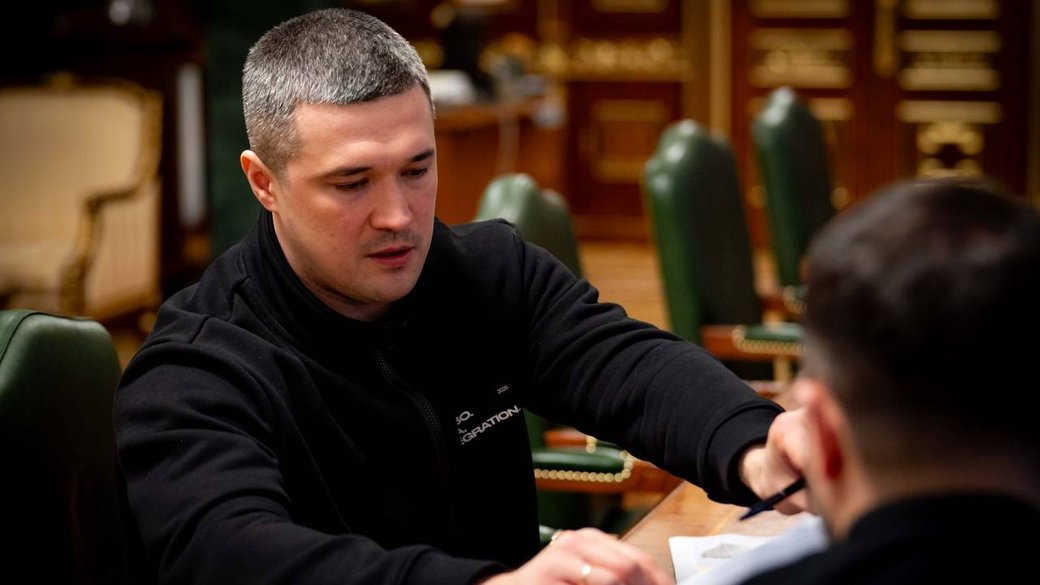
Fedorov is a thorn in everyone’s side: Zelenskyy’s, Syrskyi’s, Arakhamia’s, Budanov’s, Yermak’s. Which is why, in this situation, the interests of the state interest no one—pardon the tautology. And Fedorov will most likely be moved out of government. What could stop the president? International partners; drone manufacturers; the military, who are hardly delighted by the start of the reform but are encouraged by the changes that have begun to seep through even to the front line. To say nothing of the enormous number of civilians who consider it their duty to post on Facebook in Fedorov’s support. But all of this only raises the likelihood that Zelensky will decide to sweep Fedorov off the political board. And even if Mykhailo Fedorov keeps his post, the president will not forget all this protection.
The Fedorov story matters not because it is about one minister. It shows that when the next Cabinet is reshuffled, the basic settings of the instruments of power remain unchanged: competence has never been the main criterion, and independence remains as dangerous as ever.
And who is being brought into power and strengthened in the process? As we said at the very outset, as of today there are no votes in the Rada for a new head of the SBU. The man in question is Oleksandr Poklad, the service’s sitting first deputy head, a man whose name is spoken in a whisper in informed circles. Zelensky has long wanted to see Poklad as the chief guardian of his power’s inviolability. To tame rivals, political opponents, independent journalists and activists. But above all, to neutralize NABU and the SAPO.
And although the deputies voted as one only a year ago to trim the powers of the anti-corruption bodies, many of them understand the risks of such an appointment. While giving Poklad his due as a specialist in very active measures, people are simply afraid to hand him and the team he has assembled uncontrolled command of an instrument as formidable as the Security Service of Ukraine.
It should be said that, by our information, standing in the way of this fateful vote are not only deputies unwilling to take such responsibility before history upon themselves, but also the sitting head of the President’s Office, Kyrylo Budanov. Between him and Poklad lies a long-standing and ferocious enmity over their differing readings of the circumstances and causes of the death of Denys Kireiev, a member of Ukraine’s negotiating delegation in Belarus in 2022. The dots over the i’s in that story have yet to be placed, but, by our information, Kyrylo Budanov says quite openly to everyone around him, the president included, that he will leave the team if Poklad is appointed head of the Security Service.

…And what, in the end, will we get in the coming days? Another carve-up of ministries, as damaging and as pointless as every previous carve-up and merger during the war? Will we quietly lose Kuleba? On the principle of “it wasn’t me and the corruption isn’t mine.” Will we get a prime minister without the range of expertise a head of the executive requires? The Cabinet, after all, is not only about energy. A justice minister ringed by Tatarov’s deputies? Will we be rid of Pronin, who is dragging down our standing at the FATF while blocking NABU’s investigations and going blind whenever bail money needs checking? Will there finally be even one visionary in the economic bloc and in education? Or perhaps a capable head of the Foreign Intelligence Service? A foreign minister with agency of his own? An independent and competent head of the tax service?
What will change for us?
Or will they simply swap one set of overseers—gnawing, chewing and sucking the last juices
Please select it with the mouse and press Ctrl+Enter or Submit a bug
 Follow on Telegram
 Login with Facebook
 Login with Twitter
 Login with Google