
 Support ZN.ua








Russia’s Newest Target: Ukraine’s Petrol Stations, 200km Behind the Frontline

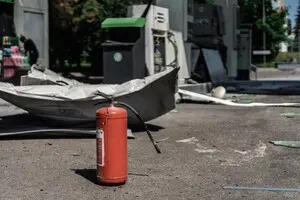

Of late, the Ukrainian media has been dominated by reports of successful strikes by Ukraine’s armed forces on Russia’s fuel infrastructure and the shortages these have caused at Russian filling stations. That is truly gratifying.
Out of shot, however, lies another problem: Russian attacks on Ukraine’s own fuel infrastructure. Having first knocked out oil refineries large and small, and then storage depots, the Russians are now hunting filling stations. And the number and geography of these strikes leave no room for doubt: this is a new, deliberate Russian tactic.
By various estimates, as many as 200 filling stations in frontline regions have been damaged over the past two months. The early strikes hit the frontline belt, leaving some district centers without a single working filling station—as the mayor of Trostianets, Sumy region, reported. Large-scale attacks on filling stations in particular district centers of the Kharkiv region are also on record.
The enemy has now begun striking at distances of 100 km, and even 200 km, from the combat zone.
On 1 July, for example, it hit three filling station complexes at once—WOG, UPG and BRSM—on the Dnipro–Reshetylivka highway (a key route to Kyiv). That is roughly 100 km from the border with the Donetsk region and more than 200 km from Kharkiv.
An enormous problem is the absence of effective means of countering enemy drones: FPVs, Lancets, Molniyas and even Shaheds. (One of the latter recently destroyed an OKKO complex outright on the Kherson–Mykolaiv highway; sadly, lives were also lost.)
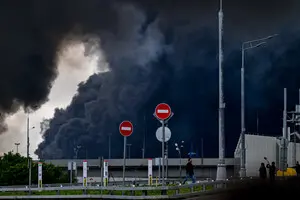
Among the short list of measures to protect filling stations, the most effective are gabions—metal cages packed with sandbags—used to screen the operators' booths and the pumps.
“There are a few half-measures … We’ve tried anti-drone netting. It helps against FPVs, but it’s no defense against Shaheds and Lancets,” says Vasyl Danyliak, chief executive of OKKO Group, who believes the strikes will go on.
In his view, there is no alternative to closer coordination with the military—not least in order to react quickly to airborne threats and move staff and customers clear of the stations. OKKO also argues that the idea of private air defense simply does not work for filling stations, since hundreds of sites are involved.
“We need to tackle protection all together—not of individual stations, but of entire areas, cities in particular. We are ready to take part in projects of that kind,” said OKKO vice president Vasyl Dmytriv, who, among other things, oversees the company’s cooperation with the Come Back Alive foundation, including its weapons-related projects.
Active consultations are currently under way between the retail chains and government officials over possible measures to counter Russia’s campaign of terror. Against that backdrop, the Cabinet of Ministers’ initiative to urgently launch a system of minimum oil and petroleum product reserves looks decidedly odd. The overwhelming majority of market participants have been left baffled by the move, given that oil depots have been priority targets for the enemy since the very first days of the full-scale war. That hunt is still going on: in May and June, around a dozen oil depots were attacked, both on the left bank of the Dnipro river and in the west of Ukraine.
About the only rational aspect is the emphasis on the need for underground fuel storage. For now, though, there are no operational facilities of the kind. Even so, the state has pledged to provide the necessary volume of tank capacity by the end of the year. Private companies are also reported to be designing underground storage facilities.
As for the filling stations themselves, operating in frontline regions will only become harder, and many will probably be forced either to close or to move to intermittent working hours.
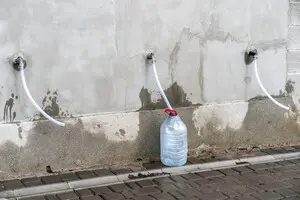
There is a separate problem with fuel tankers, too, as drivers are increasingly refusing to make runs into frontline zones. This also makes the idea of mobile filling stations (in effect a tanker fitted with a dispensing hose) look imperfect, although it could work if such stations were housed in enclosed industrial premises. The use of mobile filling stations has yet to receive regulatory approval in any case, as they are currently banned.
Either way, both the staff and the customers of filling stations in danger zones need to pay close attention to air raid warnings and avoid lingering inside or near these sites.
Please select it with the mouse and press Ctrl+Enter or Submit a bug
 Follow on Telegram
 Login with Facebook
 Login with Twitter
 Login with Google