
 Support ZN.ua








Having It Both Ways: How Russian Universities Back the War Yet Stay in Global Rankings and Keep Their International Ties
 Document
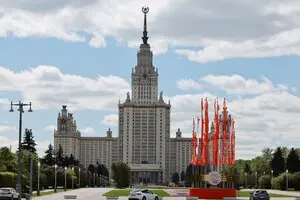



On the homepage of Russia’s Higher School of Economics (HSE University)—one of the country’s most prestigious and best-known higher education institutions—the Russian Defense Ministry advertises contract service in the unmanned systems forces. Future drone operators are promised combat experience and “competitive skills,” from programming to data analysis.
At the same time, despite the sanctions imposed on Russian science and education, students at this university are taking part in international academic mobility programs: this fall, 237 HSE students will travel to study at 57 foreign universities in Japan, South Korea, Serbia, Israel, Brazil, Mexico, India, Indonesia, Kazakhstan and other countries.
And HSE is hardly the only such case. We analyzed the activities of leading Russian universities that appear in the three most authoritative global rankings—QS World University Rankings (QS), Times Higher Education (THE), and the Shanghai Ranking (ARWU)—in order to establish their public position on the war. For the analysis we selected universities that appear in at least two of the three leading global rankings, and in the highest positions. These, in other words, are the cream of the crop among Russian universities, the ones with the widest international presence. The list includes eleven of them:
|
University |
Rankings it appears in |
|
Lomonosov Moscow State |
QS, THE, ARWU |
|
Bauman Moscow State |
QS, THE |
|
HSE University (National Research |
QS, THE, ARWU |
|
Moscow Institute of Physics and Technology |
QS, THE, ARWU |
|
Novosibirsk State University |
QS, ARWU |
|
Ural Federal University |
QS, ARWU |
|
National Research Nuclear University MEPhI |
QS, THE |
|
Patrice Lumumba Peoples’ Friendship |
QS, THE |
|
Peter the Great St. Petersburg |
QS, THE |
|
Kazan Federal University |
QS, THE |
|
Tomsk State University |
QS, THE |
Our findings show that all of these universities publicly support Russian aggression against Ukraine—and that all of them are at the same time intent on remaining part of the international academic world.
How Russian universities support the war
The universities' own websites, their press releases, and media coverage all show that this support for the war is not confined to the occasional statement or symbolic gesture. It is systematic and takes in a range of activities. We have singled out several principal forms.
Public support for the aggression
Right at the outset of the full-scale invasion, on March 4, 2022, the Russian Union of Rectors published an address in support of the war against Ukraine. The letter contains the standard set of Russian propaganda narratives—“demilitarization,” “denazification,” the “bombing of Donbas”—along with a call to support Putin, who, in the letter’s words, “has made what is perhaps the most difficult decision of his life, a hard-won one but necessary.” The letter was signed by more than 260 rectors of Russian universities.
Public letters and statements to much the same effect have been issued by the Russian Academy of Sciences, individual universities and research institutes. To take one example, 276 staff members of the Lebedev Physical Institute (FIAN) publicly endorsed the so-called special military operation, and signatures are still being collected for that letter to this day.
Higher education institutions also brainwash their students, arranging meetings with combat veterans, holding "patriotic" forums and publishing material that glorifies a war of conquest.
Practical assistance to the Russian army
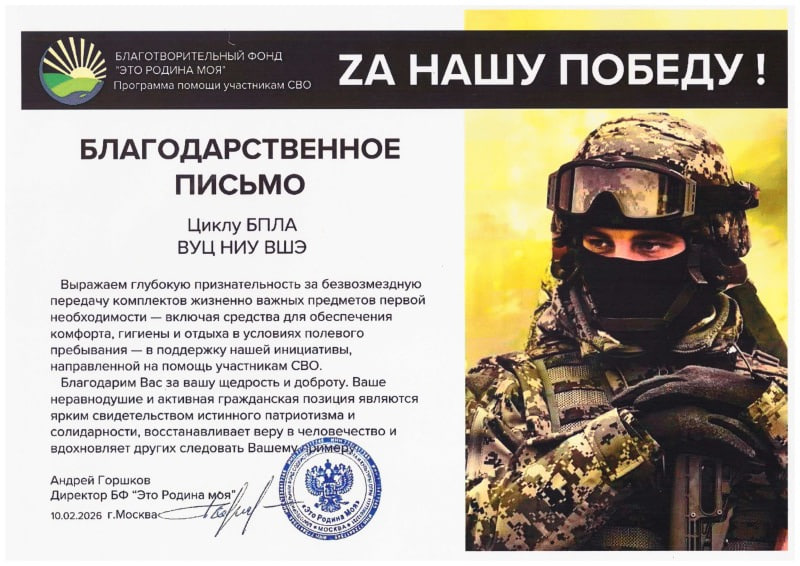
Russian universities support the occupying forces financially and materially—collecting humanitarian aid for them, helping with recruitment and opening preferential study programs for participants in the “special military operation” and their families. The website of Lomonosov Moscow State University, for instance, has published a note of thanks to staff of the Faculty of Mechanics and Mathematics for taking part in a charity drive in support of Russian “fighters battling the aggression of unfriendly Western countries and the United States.” And here is an example of a “letter of gratitude” to HSE’s Military Training Center for donating supplies to Russian troops free of charge.
Russian universities are also involved in developing military technology, work on the rehabilitation of wounded soldiers, and patent new designs for the army’s needs.
Legitimizing Annexation and Taking Part in the Russification of the Occupied Territories
Russian universities use their academic standing to legitimize the annexation of Ukrainian territories and their subsequent Russification. They publish scholarly work that presents occupied Crimea, Donetsk Oblast, and Luhansk Oblast as part of the Russian Federation. A case in point a RUDN study on the “shift in constitutional cycles” in Crimea.
A distinct and deeply insidious aspect of Russian universities’ activity is their part in the assimilation of Ukrainian citizens and Ukrainian territory. Students are drawn into rallies and exhibitions marking the “day of reunification” of the new regions with Russia. Beyond that, Russian universities help absorb schools, universities, teachers and officials from the seized territories into the Russian educational space by running training courses, providing teaching materials and setting aside places for applicants.
All of the conclusions set out here are based on open sources.
As the study showed, all 11 universities systematically display various forms of support for Russian aggression. Among Russia’s most respected universities—the ones the global academic community still shakes hands with, sanctions notwithstanding—we have not found a single exception.
Despite the sanctions
After the full-scale invasion began in February 2022, Russian universities were largely cut off from the Western academic world. The European University Association (EUA), for one, suspended the membership of every Russian university shortly after the full-scale war began.
As of mid-2026, however, those ties have not been broken off entirely. Some Russian universities remain members of international organizations and associations—the Eurasian Universities Union (EURAS), for instance. Beyond that, certain forms of international cooperation remain open to Russian higher education, among them academic mobility programs, scholarly conferences, and grant projects. The Stipendium Hungaricum scholarship program, set up by the Hungarian government in 2013, is still prepared to take Russian students for tuition-free study in Hungary, with a monthly stipend, a place in a dormitory or a housing allowance, and health insurance. Russian universities run open competitions for their students to take part in the program. The competition page on the HSE website shows that the program is active for Russian students in 2026–2027.
This might have been written off as a very particular case, a product of the close relations between Hungary and Russia under Orbán. Unfortunately, it is typical. The academic mobility of HSE students described above is a striking illustration of the same thing.
What Ukraine and its international partners should do
Since Russia’s leading universities are not detached observers of the war but active participants in it, the question of international cooperation with them reaches far beyond academic rankings or scholarly achievement. It becomes a question of the international academic community’s own responsibility.
In part, the survival of such cooperation can be put down to international partners knowing too little about the role Russian universities play in supporting the aggression against Ukraine. The findings of this and similar studies should therefore be circulated as widely as possible among international universities, academic associations, research foundations, and other organizations.
Ukraine—above all the Ministry of Foreign Affairs, the Ministry of Education and Science, and other state institutions—needs to press harder to curb international cooperation with Russian universities. One practical step would be formal approaches to their foreign partners setting out the documented evidence of support for the war and urging them to review or end that cooperation.
Please select it with the mouse and press Ctrl+Enter or Submit a bug
 Follow on Telegram
 Login with Facebook
 Login with Twitter
 Login with Google