
 Support ZN.ua








The Emperor Has No Clothes: Who Is Protecting American Assets Abroad?

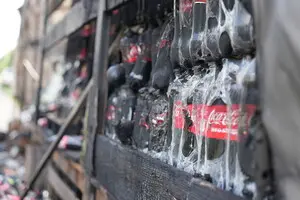

Russia is deliberately destroying American assets in Ukraine, and Washington says nothing. The myth that the presence of major American corporate assets in a country restrains the aggressor lies in ruins. No, the White House does not defend the interests of American business abroad. No, the White House does not react more forcefully when the threat concerns American legal entities. The White House does not react at all—and the Kremlin takes that as encouragement.
The strange reaction of the White House to Russian attacks on the assets of American companies in Ukraine first became an issue in May this year. As our colleagues at The New York Times wrote, Trump administration’s muted response had raised concerns. A very diplomatic formulation. Facilities belonging to Bunge, Philip Morris and Mondelez had been attacked within four weeks. In reply, Washington “urged both sides to refrain from targeting US business interests.” Both sides, of course…
Given the fairly modest presence of American business in Ukraine, the pattern of Russian attacks on it is not hard to trace. It looks like this. In May and June 2022, Russia damaged only two assets, hitting the administrative building of the Philip Morris factory outside Kharkiv and destroying the Bunge grain terminal in the port of Mykolaiv. Neither looked like a targeted attack: the port was being destroyed wholesale at the time, with literally everything under fire, while the Philip Morris factory, by contrast, took a single strike on a non-production building and, more to the point, had not been operating since 24 February 2022. Then came a long pause—apart from the debris of a downed missile falling on the PepsiCo plant in Vyshneve, American assets suffered no damage at all until the summer of 2025. A reminder, simply for the record: the president of the United States changed in January 2025.
After is not the same as because of, but… in June 2025, during a missile and drone attack on Kyiv, the office and engineering center of Boeing were damaged; by then, the company had already signed a memorandum with the state-owned Antonov company on cooperation in unmanned systems. Did Trump and Putin discuss that in Anchorage on 15 August? Hardly, since on 21 August two Kalibr missiles struck the Flextronics plant in Mukachevo, effectively destroying it. Andy Hunder, president of the American Chamber of Commerce in Ukraine, called on Trump to stand up for American business in Ukraine, to stand up for the values America was built on and to show Putin that the United States protects its own. Trump replied tersely that he was not happy. Well, if you are not ready to bare your teeth, lick your wounds.
The Mondelez International plant in Trostianets has survived three attacks by missiles and drones since February 2026 and is now working only partially. Philip Morris has taken two more attacks since January 2026, with both the production line and the finished-goods warehouse destroyed.
In February 2026, Hunder did manage to mobilize a bipartisan group of senators in defense of American business and to shake a resolution out of them, one that referred explicitly to targeted attacks on American companies operating in Ukraine. It changed nothing.
In May 2026, the Russians attacked the Neptune grain terminal belonging to the American company Cargill; seven drones caused substantial damage to the port’s logistics infrastructure. The Oleina plant, owned by the same Bunge Ltd, was attacked twice this year; there were deaths, sadly, and the plant has stopped working. In August, it was no longer falling debris but purposefully aimed Shaheds that wrecked the PepsiCo plant in Mykolaiv oblast, damaging both production and warehouses. The Russians hit the Coca-Cola plant in Kyiv oblast only on the third attempt, in September 2026; before that, the drones either landed somewhere very close by or were shot down by air defenses. Coincidence can be ruled out here as well—the plant stands in the middle of a field, far from any other facility. It is now gradually resuming work, since the attack damaged only the warehouse buildings.
For the moment, the only American asset in Ukraine that has not been attacked by Russia is the Jabil Inc. electronics plant in Zakarpattia. It was their components for satellite systems that were reaching Russia through third countries and being used by the Russian military. After the investigation by Slidstvo.Info was published, the company naturally gave assurances that it had halted all supplies to questionable customers. But you have to admit the coincidence is an interesting one.
Throughout all this time, the White House has not produced so much as a dry “not happy.” Not its interest. For the personal business of Donald, son of Fred, or that of his numerous relatives and realtor friends, this administration would put B-52s in the air. But some American corporations or other are not worth a kind word.
Tellingly, the American “victims” themselves are usually in no hurry to tell the public about the drone and missile attacks. Yes, in reply to a media enquiry they will certainly confirm that a fire broke out on their premises, that the infrastructure damaged was indeed theirs—but if nobody asks, they say nothing. They are not the first to express outrage, they do not announce the losses, they do not disclose the scale of the repair work or how long it will take. They evidently understand that Uncle Sam will not rush to rescue them, or even to offer moral support. So why frighten investors, hasten the fall in the share price and add to head office’s troubles? They do not trust their own people. Quite a signal, that.
For us above all, because there is no denying that we spent years here clinging to the conviction that the presence of American assets was a guarantee, literally body armor against Russian aggression. Let us hand the United States our mineral resources, our assets, first refusal on contracts and anything else they ask for, thirty virgins if they like, so long as the American presence guarantees us a safe future! Not a chance. It is no guarantee whatsoever.
And where is our joint investment fund? How is that progressing? It is not. From time to time we are informed of plans to launch three investment projects in 2026. It is September outside, and the portfolio holds a single project, signed back in March. Where are the results from the committee that searches for projects and supposedly meets every month? What became of the eight projects with a declared “high degree of readiness” worth $1.2 billion in investment? And where, for that matter, is any news at all on the fund’s website after 10 March 2026? It seems serious investors have finally assessed the risks correctly. They have no immunity from Russian attacks, with or without the spirit of Anchorage. The Trump administration will not lift a finger to protect their investments, not even to wag a finger at Putin. So there will evidently be no investments either.
We are not the only ones whose eyes have been opened to the real capacity of the United States to protect its entrepreneurs’ assets. China, we may be sure, has noticed too.
Unlike Ukraine, Taiwan hosts a far wider American business presence—and all of it star quality. There is Google, with a vast data center and large research facilities. An internet-of-things innovation hub run by Microsoft. Engineering offices and laboratories belonging to Apple. Engineering divisions of NVIDIA and AMD. Several advanced fabs operated by Micron Technology. The largest American banks, the logistics hubs of FedEx and UPS, and the offices of the defense giants Lockheed Martin, Northrop Grumman and Raytheon. Until now, all of them were confident of the security umbrella of the mother country. All of them have now lost that confidence—as have their colleagues working at plants and offices across the Middle East.
The one truthful book from the pen of Donald Trump would have to be called The Art of Devaluation. He is confidently devaluing everything the good old United States was once famous for—geopolitical weight, diplomacy, democratic values and a show of integrity, influence in world trade, military might and, finally, the guaranteed protection of American interests. Their misfortune is not ours. Ours—and our partners’—is that the many-sided weakness of today’s United States is still being ignored at every turn.
The emperor has no clothes, but the procession moves on, the crowd marvels at the exquisite costume, and the chamberlains hold up an imaginary train.
Please select it with the mouse and press Ctrl+Enter or Submit a bug
 Follow on Telegram
 Login with Facebook
 Login with Twitter
 Login with Google