
 Support ZN.ua









Storing Ukraine’s Fuel Abroad Is Doomed to Fail: Why the Law Does Not Work
Trump Blames Kyiv for Expensive Diesel: Who Is Really Shaking the Market, and What Ukraine Should Do

17 september, 2026, 11:21
Share


Donald Trump’s call to halt strikes on Russian refineries concerns a real but secondary factor in the diesel shortage. It does not prove that Ukraine is what caused record prices in the United States. The war in the Middle East is having a far stronger effect on the market, driving down exports from the Persian Gulf, pushing up freight costs and depleting stocks.
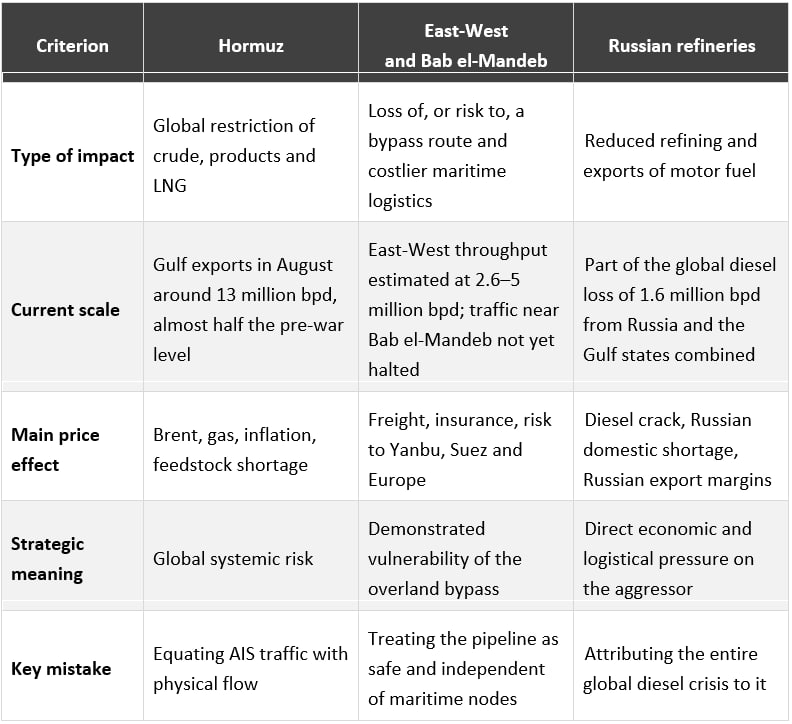
The present oil crisis is being shaped by three distinct factors. The first is the sharp restriction of flows through the Strait of Hormuz. The second is the military risk at Bab el-Mandeb and the vulnerability of Saudi Arabia’s East-West pipeline, the main overland bypass of Hormuz. The third is the fall in Russian refining caused by Ukrainian strikes. These factors act on a single market, but they differ in scale and in consequences.
An energy truce could be useful to Ukraine before winter only on certain conditions: reciprocity, independent verification and accountability for violations. A unilateral renunciation of strikes would deprive Kyiv of one of its most effective levers of pressure on Russia.
1. A new geography of energy risk
At the start of September the central question was whether overland routes could quickly replace the Strait of Hormuz. The events of 11–14 September showed that bypass infrastructure has limited capacity and can itself become a target. The market is now pricing the whole chain of risk—Hormuz, the Saudi pumping system to the Red Sea, Bab el-Mandeb and the Suez Canal.
Hormuz remains irreplaceable
Before the war, roughly a fifth of global flows of oil and liquefied natural gas (LNG) passed through the Strait of Hormuz. On 12–13 September four cargo vessels left the Gulf and ten entered it. Until 28 February, some 125 large commercial ships crossed the strait every day.
These figures show the scale of the fall in traffic, but not the precise volume of cargo. Some vessels switch off their AIS signals, and tanker capacities vary.
According to an assessment by the International Energy Agency (IEA), in August the Persian Gulf states exported around 13 million bpd of oil—almost half the pre-war level. Crude exports fell by a little under 45 percent. Exports of petroleum products were almost 60 percent below the February level, a drop of 3.7 million barrels per day (bpd).
The Bab el-Mandeb factor
Bab el-Mandeb is the southern gateway to the Red Sea and the key route to the Suez Canal and Europe. After the Houthi attacks of 2024, oil flows through the strait fell to an average of 4.0 million bpd over January–August, against 8.7 million in 2023.
In the second quarter of 2026 flows recovered to around 8.1 million bpd. In June they stood at about 7.4 million bpd. One of the reasons was the rerouting of Saudi oil to Yanbu. In September the threat rose again. The Houthis stepped up their attacks on Saudi infrastructure and have probably taken control of Perim island in the strait itself.
On 12–13 September, 24 and 27 vessels passed through the strait—roughly the ten-day average. There is no complete blockade. But a Houthi presence on the island could make it easier to monitor traffic and to use drones, missiles or naval strike systems. Even without a blockade, this drives up insurance and freight costs.
East-West is no longer a safe bypass
On 11 September, drones launched from Iraqi territory hit facilities along the 1,200-kilometre East-West pipeline, also known as Petroline. Saudi Arabia reported the damage and shut the system down as a precaution. Satellite imagery captured fires near pumping stations close to Medina. Baghdad has opened an investigation.
The technical capacity of East-West reaches 7 million bpd. Estimates of how heavily it was loaded before the shutdown vary: Reuters cited a figure of 4–5 million bpd, while Associated Press, citing Rystad Energy, gave 2.6–4 million bpd from late August. The discrepancy is explained by different time frames and estimating methods. Preliminary data suggest the damaged system may remain largely unavailable for three to five weeks.
The pipeline carries Saudi crude from Abqaiq to Yanbu, bypassing Hormuz. Beyond that point, however, cargoes depend on the safety of Bab el-Mandeb or have to go through the Suez Canal to the Mediterranean. East-West, then, does not remove geopolitical risk; it transfers it to pumping stations, the Yanbu terminals and another maritime strait. On 14 September the price of Brent approached $108 a barrel, reflecting the combined risk of several routes narrowing at once.
2. Russian refineries in the global diesel balance
Strikes on Russian refineries create a different type of risk. They do not reduce global crude supply, since Russia redirects some of the unrefined feedstock to export. The main effect shows up on the fuel market. Damage to refineries cuts output of diesel, petrol, jet fuel and blending components. Inside Russia this causes local shortages, export restrictions and costlier logistics. In other regions, above all in Europe, refining margins rise.
At the start of September the middle distillate market was extremely tight. The IEA put the price of diesel in the United States at more than $200 a barrel—almost 94 percent above the pre-war level. In August net exports of diesel and gasoil from the Persian Gulf fell to 390,000 bpd, slightly more than a quarter of the February level.
Combined losses of diesel exports from the Persian Gulf and Russia came to around 1.6 million bpd against February. Before the war these two sources accounted for almost 45 percent of the world’s seaborne diesel trade. Strikes on Russian refining aggravate the shortage to some degree, but they are not its main cause. A far larger fall in diesel supply has been recorded in the Persian Gulf. It was also the problems with the Middle Eastern straits that caused refining runs in Asia to fall, transport costs to rise and global stocks to shrink by 507 million barrels between the end of February and the end of August.
3. Donald Trump’s statement on diesel
On 13 September this year Donald Trump called on Volodymyr Zelensky to halt strikes on Russian facilities connected with diesel fuel. Ukraine, he said, is “causing a diesel shortage”, even though there are “plenty of other targets” in Russia.
At that point the average retail price of diesel in the United States had reached $6.06 a gallon, against $3.71 a year earlier. Since the start of the American-Israeli war with Iran it has risen by more than 60 percent.
An objective assessment of this statement has to separate fact from political interpretation.
- There is a factual basis to it. Russia is a large exporter of diesel, and damage to refineries together with export restrictions reduces global supply. In a market this tight, even a relatively small loss of volume pushes wholesale prices up noticeably.
- The causation is oversimplified. Prices rose against the background of the war with Iran, restricted flows through Hormuz, the loss of Middle Eastern petroleum products, costlier freight and falling stocks. Ukrainian strikes are an important factor, but not the main one. By my own rough expert estimate—which should be read as a scenario rather than a statistically verified apportionment of impact—strikes on Russian refineries could account for no more than 15 percent of the overall rise in diesel prices. The rest was linked mainly to the fighting in the Middle East and the logistical constraints it has produced.
- The statement has a domestic political High fuel prices have become a problem for the US administration ahead of the midterm elections. Putting the emphasis on Ukraine’s actions pushes the consequences of Middle Eastern escalation into the background.
- For Ukraine, the price of giving up strikes on Russian refining is high. Russian refineries supply fuel for military logistics and generate export revenue. A pause without an equivalent concession from Russia would weaken Ukrainian economic pressure.
Trump’s statement, then, is not entirely without foundation, but it exaggerates Ukraine’s role beyond any justification. Strikes on Russian refineries somewhat deepen a distillate shortage created above all by the Middle Eastern war. If the United States is demanding a pause, it has to offer Ukraine equivalent security guarantees on halting strikes against Ukrainian energy and other civilian infrastructure.
ВАС ЗАИНТЕРЕСУЕТ
4. An energy truce and Ukraine’s interest
On 14 September, Donald Trump said that Russia and Ukraine had supposedly agreed to stop striking energy infrastructure. He released no details, and Moscow has not formally confirmed any such understanding. Volodymyr Zelenskyy said only that Ukraine was ready to halt strikes if partners secured a genuine end to Russian attacks on Ukrainian critical infrastructure. There is therefore no truce in force. There is a political statement and a possible framework for talks.
Why such an agreement could be useful
Ahead of the heating season, Ukraine’s civilian power system is particularly vulnerable. Russia can attack power plants, substations, gas production, storage facilities and heat supply all at once. Millions of people feel the consequences directly. A guaranteed pause for the heating period would provide time to finish repairing part of the damaged infrastructure, to build up equipment and fuel, to strengthen protection and to reduce the risk of a humanitarian crisis.
Why a mutual halt to air attacks without guarantees is dangerous
The two sides are vulnerable in different ways. For Ukraine, energy is what keeps cities and critical services alive. For Russia, refining and export infrastructure matter, but they are not its only sources of revenue or fuel. Ukraine has not yet achieved physical parity with Russia in the number and power of its long-range strike systems. Its advantage lies elsewhere—in systematically selecting the most vulnerable and most important nodes of the Russian economy, and in deliberately choosing and developing the means to hit them.
This approach is the practical embodiment of military deterrence: continuing the aggression should impose a predictable and steadily rising economic price on Russia. Among the most sensitive targets are the large refineries. They supply fuel for military logistics, sustain the domestic fuel balance and generate export revenue. Restoring them takes time, sophisticated equipment and considerable expenditure.
Russia could use a pause to repair its refineries and accumulate strike systems, then deliver a concentrated winter blow. The short pause in January 2026 did not prevent attacks on Ukrainian energy from resuming. That demonstrates the weakness of verbal understandings without verification and accountability.

A separate risk is the differing interpretation of the term “energy infrastructure.” Moscow may demand protection for its refineries, ports and fuel depots while describing Ukrainian CHP plants or substations as military facilities. The agreement must therefore contain a single list of protected facilities, identical for both sides.
Civilian facilities should be distinguished from infrastructure that directly supports military operations. Under international humanitarian law, dual-use facilities enjoy no automatic immunity. At the same time, every strike requires an assessment of military advantage, proportionality and precautions.
Minimum conditions for an acceptable agreement
- A joint written list of protected facilities, with precise categories and geographical coordinates.
- Independent monitoring based on satellite data, partner intelligence, operators’ reports and the trajectories of strike systems.
- Prompt determination of violations and the right of Ukraine to resume the relevant operations after a confirmed Russian attack.
- A limited term—30 days, for instance. Extension only after compliance by both sides has been confirmed.
- A package of guarantees: additional air defence systems, interceptors, repair equipment, financing for stocks, and sanctions for violations.
- A ban on using the agreement to legitimize the occupation or to restrict Ukraine’s lawful operations against military targets.
5. Comparing the three channels of shock
Conclusions
- The global oil shock has become a network shock. East-West does not remove dependence on maritime straits; it creates new points of vulnerability.
- The main driver of higher oil and diesel prices is the war in the Middle East and the large-scale loss of exports from the Persian Gulf. Ukrainian strikes on Russian refineries deepen the distillate shortage, but they do not explain it on their own.
- Trump is right to point to the strain on the market, but he exaggerates Ukraine’s role. A unilateral pause would help Russia and would not guarantee lower prices in the United States.
- An energy truce serves Ukraine’s interests only with clear rules, independent verification, consequences for violations and material guarantees from partners.
- Ukraine does not yet have physical parity in long-range systems. Its advantage lies in systematically identifying vulnerable nodes of the Russian economy and developing effective means of hitting them. Large refineries are among the principal targets of such deterrence.
- Kyiv can discuss a pause only in exchange for effective guarantees protecting Ukraine’s electricity system, gas system, heat supply and other civilian infrastructure through the winter.
- Should Russia refuse to provide effective guarantees that attacks on Ukraine’s critical infrastructure will cease, the Defence Forces would be well advised to intensify strikes on Russian refineries. A strategic benchmark would be to bring refining runs down to 2.0–2.5 million bpd and hold them below 2.5 million bpd for at least six to eight weeks. By my own scenario estimate, it is precisely that level which pushes the Russian fuel system into a zone of extreme cascading breakdown.
Noticed an error?
Please select it with the mouse and press Ctrl+Enter or Submit a bug
Stay up to date with the latest developments!
Subscribe to our channel in Telegram
 Follow on Telegram
Пожалуйста выберите один или несколько пунктов (до 3 шт.) которые по Вашему мнению определяет этот комментарий.
Пожалуйста выберите один или больше пунктов
Нецензурная лексика, ругань
Флуд
Нарушение действующего законодательства Украины
Оскорбление участников дискуссии
Реклама
Разжигание розни
Признаки троллинга и провокации
Другая причина
Отмена
Отправить жалобу
ОК
 Login with Facebook
 Login with Twitter
 Login with Google