
 Support ZN.ua








Ukraine Without Water: The Scenario People Keep Ignoring. But It Is Close
 Reader Survey
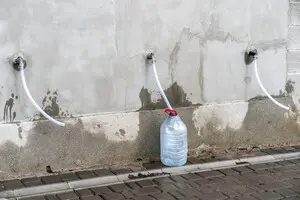

January. Twenty below zero outside. Morning. We wake up. The socket is dead, darkness everywhere. Familiar. And by now, everyone more or less knows what to do. Out comes the flashlight, the inverter, the battery and, where possible, the generator. And off we go. Life goes on. Now imagine the same thing, except it is not the socket that shows no sign of life, but the tap. Something like that has happened here and there, but only briefly, and it was connected to the blackouts. Then the local water utility companies switched on generators and the tap came back to life. But what if it does not come back to life for a day or two, a week or a month? On March 25, President Zelenskyy passed along another warning from intelligence agencies: the aggressor wants to strike not only energy facilities, but the water network too.
Has anyone followed up on it? Has there been any response to the warning? None. The issue has been left hanging somewhere between “maybe” and “it’ll somehow sort itself out.”
Utilities without water
Everyone has grown used to thinking about the war through the lens of electricity: if it is there, life goes on; if it is not, there is a problem. But water is something else entirely. It is not an inconvenience. It is a basic need that can truly shut civilization down in any major city. Right now, for example, Iran’s threats to bomb desalination plants in the Middle East are making headlines. Experts are already sketching out apocalyptic scenarios. Nothing surprising there: much of the region is desert. But we should not think that here, where rivers and ponds are close at hand, water disappearing from the tap would mean anything different.

You do not need much imagination to understand what a water-out looks like. Real-life cases are enough. And, frankly, they read like spoilers for our possible future:
- Cape Town, 2018. The city came within a step of Day Zero, when the taps were supposed to run dry. People counted liters the way they count cash in a crisis and learned to live on two buckets a day—for showers, food, and everything else. All because of an extreme drought.
- Jackson, Mississippi, 2022. By contrast, an exceptionally severe flood knocked out the city’s water system for an extended period. It suddenly turned out that even in a country with space-age technology, water can vanish just like that, and a city can slide into street fights over bottled water.
- Chennai, 2019. A water apocalypse hit this Indian megacity as well. Four million people spent weeks surviving by standing in enormous daily lines for tanker trucks just to fill bottles. Water was rationed, most of the city’s businesses stopped operating, and private water delivery prices shot up many times over.
- And very close to home—occupied Donetsk. The water shortage there did not arise because of shelling, but because of the occupiers’ helplessness. The old source remained in non-occupied territory, and in more than twelve years of occupation no replacement has been found.
What happens if Kyiv or Kharkiv “dries up”? And what if it happens in winter?
There is an illusion that losing water means little more than, “Fine, we’ll wash later.” In reality, it sets off a domino effect, with each problem worse than the last. Imagine Kyiv, Kharkiv, or Dnipro without water for even a few weeks. And if it happens in freezing weather, the impact multiplies several times over. First, heating goes down. Most heating systems rely on circulating hot water and need to be topped up. No water, no heat. Then physics takes over: the water left in the pipes freezes and ruptures the system. The entire infrastructure turns into a sieve.
At the same time, another, less dramatic but equally critical crisis unfolds: sewage. Without water, it stops functioning as a system and becomes a problem. Before long, the city begins to smell as though it has been thrown back several centuries.
There is another point people are reluctant to spell out: human behavior. A person without water is not a calm citizen reading the news, but someone trying to survive. And survival means queues, conflict, and the rapid breakdown of “polite society.”
To understand how real such a scenario is—and whether anything is being done to protect water supply facilities from shelling, whether equipment reserves exist, and so on—I contacted the water utilities of Ukraine’s largest cities. Information requests were sent to Kyiv, as well as to utilities in Kharkiv, Dnipro, Odesa and Lviv.
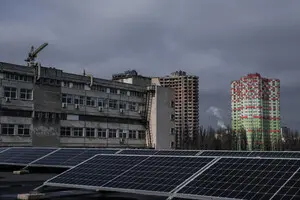
It proved easier to get information from the security services than from a municipal utility. Most of the water utilities ignored the request. Two replied in much the same vein: keep your nose out of our business, it’s wartime, we’re not telling you anything. And anyway, everything is under control—we know what to do. Even though the questions had been framed so they could be answered with a simple yes. For example: is the utility doing anything to protect water supply facilities?
So, in effect, nothing is known. Which means city residents would do well to think about their own water security.
Fortunately, the Ukrainian Association of Water Supply and Sewerage Enterprises, Ukrvodokanalekolohiia, proved far more interested in seeing the issue of running water discussed more widely in the public sphere. As it turned out, the sector contains far greater risks—ones that could cause serious damage even without enemy missiles. The association’s president, Dmytro Novytskyi, puts it plainly: if hostile hackers gain access to the SCADA system that controls the water valves, catastrophic hydraulic shocks could destroy the infrastructure. Digital security, then, requires separate and urgent attention.
“Why is a water-out more complicated than a blackout? Comparing the vulnerability of water systems and the power grid is not straightforward. Water utilities are a vast underground organism made up of thousands of kilometers of networks. They are hard to destroy with a single strike, but extraordinarily difficult and time-consuming to restore. We see a direct correlation with scale: the larger the city, the harder it is to provide it with alternative water. For a megacity, a system shutdown is a far greater challenge than for a small community. Although clean-water reservoirs give us a certain amount of time, the real Achilles’ heel is sewage. If wastewater pumping stations stop, we risk an immediate overflow of sewage onto the surface, with the threat of a public health disaster,” Dmytro Novytskyi explains.
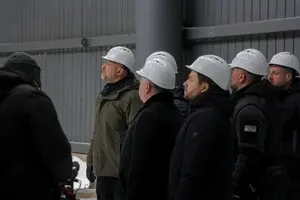
The association said efforts are being made to solve the issue of energy independence for water utilities. Local networks are receiving generators so they can maintain pressure in the water mains when needed. At the same time, so-called autonomous clusters are being developed—buvettes and mini-treatment stations that will be able to operate independently of the main system, so that at least drinking water and basic sanitary needs can still be met. What severely hampers this is chronic underfunding and a shortage of equipment.
“Current tariffs cover only 70–75 percent of actual needs. That drains working capital: in 2024, water utility losses exceeded UAH 5 billion, and in 2025 we expect the figure to reach UAH 12.7 billion (the calculation is still underway). According to the World Bank’s RDNA5 report, the sector’s total economic losses exceed $14 billion. To do more than simply patch holes—to restore the system on a Build Back Better basis—we need about $17.5 billion over ten years. The situation is made worse by the fact that most critical equipment is not produced in Ukraine,” Dmytro Novytskyi noted.
What kind of autonomy is possible
Here again, the private sector has it easier. If there is a well or a borehole and a pump, there will be water. In a megacity, things do not work that way. Some cities do have residential complexes supplied by local boreholes. For them, everything comes down to whether there is electricity. But most people rely on the central water supply alone.
If water starts being supplied on a strict schedule, the way electricity was this past winter, specialists advise installing a small hydroaccumulator in the apartment. Essentially, it is a 100-200 liter tank with a diaphragm inside that maintains water pressure. It “charges” within minutes whenever the central supply is on. A simple setup with a few taps and a valve makes it possible to store 100 liters or more. When water stops coming through the mains, that stored reserve will keep flowing from the taps, filling the toilet cistern, or even feeding the dishwasher. It is far more convenient than filling the bathtub and then washing dishes and hands with a scoop. Used sparingly, it may last a day or two.
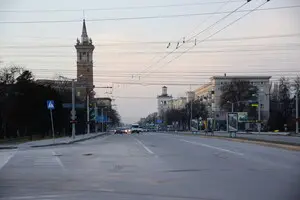
It is hard to recommend anything more ambitious. Steps such as drilling a borehole for a single building or residential complex involve a mountain of paperwork—permits, approvals, assessments and so on. That is something a homeowners’ association or a similar structure would have to handle. It is time-consuming and expensive. If it is going to be done, it needs to start now.
The strangest thing in this whole story is not the risks. They are obvious. The strangest thing is the silence around them. Water is not a high-profile issue. It does not flare up the way a blackout does, nor does it trigger instant panic. For now, it is still there, and it seems as though it always will be. It is like air: no one talks about its stability. Yet that apparent simplicity is precisely where the real complexity lies.
You can buy a generator—and off you go. But water is infrastructure, engineering, logistics. This is not the kind of problem you solve by ordering something online and calling it done. There is psychology at work here too, the same old formula: it’ll sort itself out somehow. But it is worth saying plainly: if nothing is done, the consequences will not be symbolic. They will be very concrete. They will look like cold radiators, dry taps and cities that cease to be comfortable places to live.
Please select it with the mouse and press Ctrl+Enter or Submit a bug
 Follow on Telegram
 Login with Facebook
 Login with Twitter
 Login with Google