
 Support ZN.ua








Neutrality for Sale: Israel’s Grain Skullduggery with Russia

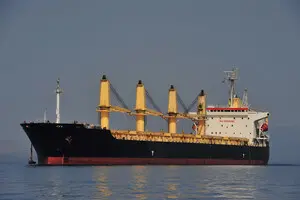

Everything that comes into contact with blood becomes non-kosher.
Ukrainian grain from occupied territories is blood-soaked from seed to husk: grown by people living under occupation at risk to their lives, seized by force and sold with a single purpose—to fuel the aggressor and multiply human suffering. This is not challah for a celebration.
And yet, on April 12th, Israel allowed the Russian bulk carrier ABINSK—carrying 43,700 tonnes of wheat taken from occupied Ukrainian territory—to enter the port of Haifa. On April 14th, Ukrainian Foreign Minister Andrii Sybiha raised the matter with his Israeli counterpart Gideon Sa'ar and made clear that such trade was unacceptable. It made no difference. On April 27th, a second vessel, the Panormitis, arrived at Haifa carrying, according to SeaKrime data, more than 6,000 tonnes of wheat and 19,000 tonnes of barley looted by the occupiers from Ukraine.
At that point, Ukrainian Foreign Ministry spokesperson Heorhii Tykhyi went public, telling Ukrinform that Ukraine had sent “dozens” of messages to Israel through closed channels on this issue. The response he described was staggering. To quote Tykhyi directly: Israel “does not intend to take any action regarding these cargoes or Ukraine's concerns and considers the information Ukraine has provided to be insufficient.”
The reason Ukraine has taken this dispute public is not the ten-plus previous private messages, nor the actual number of shipments of stolen grain that Israeli buyers have purchased. It is Israel's attitude to the problem—an attitude that unambiguously deserves public scrutiny.
Not two ships
Russia has no need of Ukrainian grain for its own consumption. It is consistently among the world's top three wheat producers. But occupied land yields harvests regardless of whose boots are trampling it, and turning that windfall to Russia's budgetary advantage is the most obvious play.
In the early days, Russia tried selling Ukrainian grain openly, without concealing its origin, shipping it directly from occupied Ukrainian ports. That approach quickly ran into a wall: buyers willing to be that unprincipled were harder to find than expected. A scheme was needed. Grain seized from Ukrainian producers—mostly through coercion and intimidation—began moving overland into Russia, where it was blended with Russian wheat and sold as Russian. By some remarkable coincidence, Russian wheat exports grew from 39 million tonnes in the 2020–21 marketing year to 55 million tonnes in 2023–24. Moscow has since officially announced shameless plans to increase that record by 50 percent by 2030. Take a guess at whose expense.
But blending is slow and expensive, and the grain kept piling up. At some point, Black Sea port warehouses simply ran out of space, and Russia began using large vessels anchored in the Kerch Strait as floating grain depots. According to an investigation of the Israeli outlet Haaretz, at any given moment at least five such ships were permanently at sea, waiting alternately to load and unload.

No blending is required for this operation. A buyer's vessel approaches the floating depot near the Kerch Strait, switches off its tracking system (AIS), takes on cargo incognito, falsifies the documents mid-sea and emerges from open water carrying “non-Ukrainian” wheat from a “non-Ukrainian” port—as if from nowhere.
Respectable countries don't buy this way. For them, a vessel switching off its AIS mid-route is already a red flag, let alone suspicious documentation. Regrettably, not every country is so principled—particularly when the reward for looking the other way is a discount of 20 to 40 percent off market value. Demand exists.
Haaretz investigators, citing Russian administrative documents, identified 120 shipments of stolen Ukrainian grain sold between November 2022 and June 2023 to Syria, Egypt, Turkey, Libya, Saudi Arabia, Tunisia—and Israel. Thirty shipments to Israel alone, totalling 90,000 tonnes, and that covers only the first half of 2023.
Sources in the maritime shipping industry confirm both the findings of that investigation and the existence of the scheme.
Sources in diplomatic circles—who draw on intelligence data rather than media reporting—describe precisely this scheme in the cases of the ABINSK and Panormitis. The shameful practice did not end in 2023. It continues to this day and, by all appearances, troubles Israel not in the least.
Undiplomatc diplomacy
In both recent cases, Ukrainian diplomats received intelligence from our law enforcement agencies and responded immediately—providing Israeli counterparts with satellite imagery and all supporting documentation showing that a cargo of stolen Ukrainian grain was heading for Haifa. The reply was a dry: “noted, awaiting your formal request for legal assistance.” The request duly followed, delivered in person by Israeli Ambassador M. Brodsky. And then everything went quiet.
According to a ZN.UA source, while the ABINSK spent two days unloading in port, the Israelis were saying they were “reviewing the matter.” Very well—Ukraine submitted another request, which costs us nothing, this time concerning grain that had already been unloaded and would remain in port storage free of charge for another ten days.
Instead of temporarily detaining a suspect vessel still within Israeli internal waters and examining its documents. Instead of sampling the grain in port storage and testing its origin—modern analysis can determine the year and location of harvest from chemical composition alone. Instead of simply conducting the standard verification any civilised country would carry out, Israel rejected Ukraine's request on the grounds that it had been submitted—wait for it—too late. For heaven's sake, we first sounded the alarm when the ABINSK was still en route to Haifa.
Then, to “smooth the conflict over,” the Israeli Foreign Ministry had the audacity to accuse the Ukrainian side of leaking classified information.
Gentlemen, it is no longer a secret to anyone that you are buying stolen goods.
One incident is not a pattern—but a second followed soon after. Unfortunately, our intelligence services, and therefore our diplomats, only spotted the Panormitis after it had already passed through the Bosphorus, not as it was leaving port. They contacted the Israeli side immediately and were met, again, with silence. Insufficient evidence, no legal confirmation, they were told.
As a ZN.UA source in diplomatic circles explains, gathering evidence is not a diplomat's job, and no exhaustive checklist of required proof exists in such cases. One party presents all available information; the other party is expected to pass that information to its investigative authorities for verification. Our source has reasonable grounds to doubt that, in either of these cases, the materials Ukraine provided were passed on to anyone at all—or that any investigative body so much as glanced at them. It would hardly be fair to accuse Israeli intelligence of incompetence: they have both the expertise and their own satellite capability to verify the data Ukraine supplied. Had they wished to establish the origin of that grain, it would have been straightforward. The wish to unload the ships and let them sail out of port simply prevailed.
Why? Imagine importing a large consignment of goods of dubious origin on falsified documents. Would you take that risk without friends in high places? There's your answer.
The seniority of those friends can be gauged from the following vignette. A senior Ukrainian and a senior European diplomat met and agreed on a joint démarche over the flagrant violation. The European diplomat formally requested an explanation from the offending party—to verify the facts and prepare a coordinated response—and was met with silence. The démarche ended up being a solo performance. And it became clear to us that blood-soaked Ukrainian grain is worth more to Israel than good relations with Europe.

What happens next
Ukraine has now submitted another request for legal assistance to the Israeli Foreign Ministry and Justice Ministry simultaneously, while Ukrainian lawyers have filed a separate request directly with Israel's Attorney General. We await a response—one that, given the public nature of the confrontation, the media resonance, and the protests already announced in Israel outside the offices of grain importers ZENZIPER GRAINS AND FEEDSTUFFS IMPORTERS LTD and DIZENGOFF TRADING COMPANY 1952 Ltd., can no longer be brushed aside. The companies themselves, according to a ZN.UA source, have already formally asked the Israeli Foreign Ministry whether they may import this specific cargo—and any future grain of this kind. This time, silence is not an option.
In the worst case, the owner of the Panormitis—currently queuing for port entry—will simply cut and run. The noise surrounding this affair has grown too loud, and arrest, despite whatever prior “arrangements” may have been in place, is becoming uncomfortably real. A partial victory, of sorts. The owner is unlikely to return the cargo to Russia under consumer protection law. A comparable situation arose in Lebanon, where a judge—acting on Ukraine's request—detained a vessel carrying stolen grain from occupied territories for 48 hours. The ship promptly changed its mind and sailed off to unload in Syria.
Full victory would mean the vessel being impounded together with its cargo for Ukraine's benefit—or financial compensation paid to Ukraine for the seized goods.
And let us not forget the grain from the ABINSK, which has in all likelihood already sailed on. It has almost certainly been sold—but that offers no protection from criminal liability. There is full documentation of who purchased it, where it was taken after leaving port, and how and at which stages every party involved misrepresented the facts. Here too, Ukraine must press for the maximum—if only to ensure that no one dares bring such a cargo into these ports again.
Beyond these specific cases, the scale of the problem demands that we speak at full volume about dismantling Russia's shadow grain fleet. According to a ZN.UA source, lists of offshore companies, shipowners, importers and intermediaries helping Russia sell Ukrainian grain are already compiled, and all of them will face sanctions—from both Ukraine and the EU. The tanker saga has shown that sanctions alone are only the beginning: for every blacklisted shipowner, two more will appear as replacements. But doing nothing is equally not an option.
Israel's official position has yet to be stated. Gideon Sa'ar's social media activity can hardly be considered one. The delay is understandable. Politically, Israel's situation is deeply uncomfortable. These actions sit poorly with Netanyahu's stated policy of equidistance—it is rather too obvious whose side is closer. But to be buying stolen grain from Russia—which actively backs Iran and officially accuses Israel of aggression—in the middle of a war with Iran is a staggering act of short-sightedness. No discount of 20, 40 or any other percentage justifies it. Russia and Iran have a “comprehensive strategic partnership.” Russia has a comprehensive interest in seeing the Middle East war burn indefinitely and the Strait of Hormuz sealed shut. Every day of that conflict is another dollar for Russia's war in Ukraine, and Russia will exert every effort—political, at minimum—to keep the show running. Western intelligence agencies are currently recording only Russian intelligence support for Iran. But is that not already cause for caution? While the Panormitis was entering Haifa, a plane carrying Iran's Foreign Minister was landing in St. Petersburg—and one assumes he did not travel there to exchange unpleasantries. It is long past time to start asking what flour the matzo is made from.
Please select it with the mouse and press Ctrl+Enter or Submit a bug
 Follow on Telegram
 Login with Facebook
 Login with Twitter
 Login with Google