
 Support ZN.ua








The Shield Must Be Cheaper Than the Sword: How War Is Changing the Philosophy of Artificial Intelligence



In June this year the Ministry of Digital Transformation held the first meeting of its working group on the legal regulation of artificial intelligence. Over the course of 2026 the group is to draft a law that, as the ministry puts it, will align our legal framework with the rules of the European Union.
The intentions are good. The problem lies elsewhere.
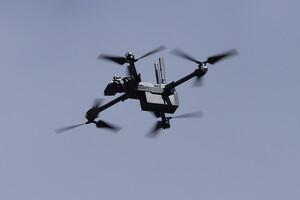
The European law was written for a world in which artificial intelligence picks your music, scores your loan application and sorts résumés. Ukrainian artificial intelligence does something else. It guides a drone onto a convoy of trucks a hundred kilometers from the front line, picks out the target by itself over the final few hundred meters, at the point where jamming no longer works and holds a target in the sights of a remote-controlled turret.
In other words, we are about to describe in someone else’s words a phenomenon of which we ourselves are the original source.
To see what those borrowed words are missing, it is worth looking at how the people building artificial intelligence talk about its future. And then at one answer that can barely be heard in that chorus. The answer that suits Ukraine best.
Nine promises
Over the past five years, the head of every major artificial intelligence company has explained to the world where he is taking us. Not in a report to shareholders—in a manifesto essay. The genre has settled into shape.
Sam Altman (OpenAI) promises an age of abundance: machines will make everything cheaper, and superintelligence, in his words, will be ours “in a few thousand days.” To make sure the fruits reach everyone, he proposes taxing capital and land rather than labor.
Dario Amodei (Anthropic) promises a “compressed 21st century”: within five to ten years, powerful artificial intelligence will give medicine what would otherwise take a hundred—a doubling of the human lifespan. The political corollary is an alliance of democracies that holds its edge over dictatorships through control of the chip supply.
Demis Hassabis (Google DeepMind), a Nobel laureate, speaks the language of science: the machine as a universal instrument of discovery, and the elimination of most diseases.
Mark Zuckerberg (Meta) bets on openness: if anyone can take the technology for free, no one ends up with a monopoly.
Mustafa Suleyman (Microsoft) made a point of stepping out of the race in November 2025, announcing a course toward “humanist superintelligence”—bounded systems in which the human stays at the wheel.
Yann LeCun, one of the field’s founding fathers, says everyone else is wrong: today’s language models are a dead end, because they have no conception of the physical world. In November 2025 he left Meta, and in the spring he raised more than a billion dollars behind his own idea.
Now read that list again and look for what they have in common.
They argue about the destination. Not one of them questions who is holding the wheel. Abundance is handed out by OpenAI. The compressed century arrives in Anthropic’s laboratory. Meta’s openness means openness to whatever Meta has decided to open.
This is not hypocrisy. It is a property of the genre: the manifesto is written by whoever owns the laboratory. But that property comes with a blind spot—and it is precisely there that the tenth answer takes aim.
The tenth answer
Its author is Vitalik Buterin, the creator of Ethereum. In November 2023 he published the essay My techno-optimism, and his position differs from the other nine in that he is not selling anything.
Buterin proposes sorting technologies not into “good” and “bad” but by a different criterion: some make attack easier, others make defense easier. Gunpowder and the cruise missile work for the attacker. The castle wall, the vaccine, the mine plow, encryption—these work for the side that is defending.
And then comes the central claim, the one that makes the whole essay worth reading.
A world in which defense is cheaper than attack is not merely safer. It is a world in which freedom survives more easily.
The war in Ukraine is already supplying plenty of examples. If an AI-guided interceptor drone costs a few thousand dollars and the missile it destroys costs a million, attacking becomes far less worthwhile.
Buterin illustrates the idea with Switzerland. This is a country where most of the power lies—with the cantons, where key questions are settled by referendum and where locals often cannot recall the president’s name. How has such a construction survived every European catastrophe? Partly thanks to politics. But partly—thanks to the mountains. For centuries the mountains made it a natural fortress: defending the country was far easier and cheaper than conquering it. So no need for a strong central government ever arose here. And where there is no such need, room appears for democracy.
Hence the name of the approach: defensive acceleration. Not to slow progress down and not to charge ahead blindly, but to invest deliberately in the technologies that make defense cheaper than attack.
What does this mean in practice? Four directions
Buterin proposes developing, along four lines, technologies that make society more resilient without demanding that people’s rights and freedoms be curtailed for the sake of security.

Resilient infrastructure. In a nuclear war, most people die not from the blast and the radiation but from broken supply chains. A generator, a stand-alone boiler house, satellite communications—these are defensive technology.
Protection against epidemics. Not compulsory lockdowns, but infrastructure: ventilation and air disinfection in buildings, cheap tests, vaccines that can be manufactured locally. The logic is simple: the faster a vaccine can be made, the less need there is to shut people up at home.
Cyber defense. The same formula applies here: the better protected people’s computers and money are, the fewer pretexts the state has to climb into private life in pursuit of every individual wrongdoer.
Protection against falsehood. Lies are better held in check by tools of independent fact-checking than by censorship. Buterin gives the example of Community Notes on the social network X, where an explanation becomes visible only once users of differing views judge it useful. It is a way of countering false information without handing the state or the platform’s owner the right to determine what is true.
The common denominator of all four directions: defensive technology is a way of not paying for security with freedom.
Why this is not an abstraction
Buterin has a personal stake in Ukraine. On February 24, 2022, a few minutes after the “special operation” was announced, he called it a crime against the Ukrainian and Russian peoples and added a phrase that has since become a quotation: Ethereum is neutral, but I am not.
In the autumn of 2022, after the start of the full-scale invasion, Buterin traveled to Kyiv and met the minister of digital transformation, Mykhailo Fedorov. Fedorov said at the time that the first drones and a substantial share of the ammunition had reached Ukraine thanks to cryptocurrency. Buterin replied: “We love Ukraine… For the blockchain community itself, this was the first opportunity to make a real difference with blockchain and cryptocurrency.” For him this became proof that digital technology can be more than a business tool and that it can genuinely shape the course of a war.
But that is not the most important part. Buterin notes that the enthusiasm of technological optimists for new military developments makes him uneasy. And he explains why.
These technologies are created mainly by the United States, and they help Ukraine defend itself against Russian aggression. That makes them easy to regard as an unqualified good. But such an attitude, he warns, rests on the assumption that the state that leads in technology will always remain on the side of good—both today and in the future.
This is not a doubt about our right to weapons. Nor is it a call to give up the support of allies. It is a doubt about whether long-term security policy can be built on the assumption that the strongest will always be our ally. For a country that has spent four years dependent on other people’s decisions about the range at which it may use its own weapons, the point is painfully well made.

Four caveats
First: who will decide which technology is defensive and which is offensive?
It is not always possible to draw a clear line between the two. The same drone, for instance, can shoot down enemy UAVs and can equally well strike targets on the adversary’s territory. So is it a defensive technology or an offensive one?
Who is to decide this, and on what criteria? If it is an official, we are back to the omnipotence of the state—the very thing Buterin is warning against. If it is the market, the decisive criterion becomes profit.
Second: the kill switch. Buterin proposes a mechanism for a global “soft pause”: if the development of extremely powerful artificial intelligence gets out of control, the world would be able to cut computing capacity temporarily by 90–99 percent, buying time and lowering the risks. Yet such a “kill switch” means that someone would be able to bring the world’s computation to a near-total halt. It is probably the most centralized instrument imaginable. Who would hold it?
Third, and to my mind the most important: what is defensive or offensive is not the technology itself but the way it is used. Buterin writes about attack and defense as though these were properties of the hardware. Ukrainian experience says otherwise. The recognition software that steers an interceptor drone onto a Shahed and the software that guides a strike drone onto a column of enemy vehicles are one and the same program. The difference lies not in the algorithms but in who presses the button and under what rules. It follows that what the law should govern is not the technology but the rules for using it.
Fourth: who will be answerable for putting this doctrine of “defensive acceleration” into practice? Behind each of the nine manifestos discussed above stand companies or organizations with budgets, lawyers and executives who can take on commitments and answer for their decisions. “Defensive acceleration,” by contrast, is promoted by a community of like-minded people. But a community cannot sign international agreements, adopt rules binding on everyone or bear legal liability. So it is unclear who is supposed to turn this idea into real policy.
What to do about it
For all these caveats, it is Buterin’s concept that could, to my mind, prove the most useful for Ukraine. Not because it is flawless, but because it points to three important principles worth taking into account as Ukrainian AI policy is shaped.
First. A Ukrainian law on artificial intelligence should distinguish between technologies according to which way they shift the balance—toward attack or toward defense. That is harder than the simple European pyramid of risks, but fairer to a country at war.

Second. Defensive digital technologies are a public good, not a commodity. They cannot be treated merely as a way of making money. They matter for the security of society as a whole. But if such technologies are made open and available to all, companies will find it harder to recoup what they spent developing them. That is precisely why Ukraine should create separate mechanisms of state funding and support for such projects.
Third, and most important of all. In developing defensive technologies, we cannot allow them to turn into an instrument of total state control. In the past, the power of rulers was naturally limited by distance and by a lack of information. There was good reason for the saying “heaven is high and the tsar is far away.” Today the situation has changed. Cameras, vast data sets and algorithms give the state the ability to watch millions of people and to control them in ways that were once impossible. That is why the limits of such control must now be set by law. It must define clearly what the state has the right to do and what it does not, and provide for liability when those rules are broken.
What Ukraine’s AI law should look like
Simply translating the European AI Act into Ukrainian will not solve our problems. Its approaches can serve as the basis only for the foundational sections of a future law—general principles, definitions and the system of state regulation. And that is all!
Beyond that, Ukraine as a self-sufficient state can and should bring into its legal framework AI as legal persons, AI as representatives of public authorities, and AI as regulators of education and science, healthcare, energy, logistics and other key fields. There is no need to gesture at Brussels and say, “but the EU doesn’t have this.” The EU will not have it for another ten years, but the digital world will. And so it should exist in our legislation too.
That is precisely why Ukraine needs not only a law on artificial intelligence but a modern digital code. Its main task is not merely to establish what citizens are permitted to do, but to draw a clear boundary around state power: what the state has no right to do to its own citizens, even when technology makes it possible.
The nine manifestos promise us different futures and one and the same disposition: they build, we use. The tenth promises nothing—it only asks a question: we are accelerating, but toward what exactly?
For the authors of the other nine, defensive acceleration is a subject for a panel discussion. For us it is what the country does every night when the air defenses are working. And what will have to be translated into the language of law.
Please select it with the mouse and press Ctrl+Enter or Submit a bug
 Follow on Telegram
 Login with Facebook
 Login with Twitter
 Login with Google