
 Support ZN.ua








Cogs in War Machine: How Russian Academy of Sciences Helps Create Weapons and Technology for War



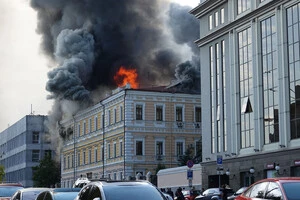
Russian drones recently struck the building of the National Academy of Sciences of Ukraine in the very heart of Kyiv. People were killed and injured.
This is not the first strike on Ukrainian science. Since the start of the full-scale invasion, Russian attacks have destroyed a dozen institutes of the National Academy of Sciences of Ukraine (NASU), from the institutes of biochemistry and archaeology to those of literature and philosophy. The unique observatory of the Institute of Radio Astronomy was looted and destroyed during the occupation of Kharkiv region. And, sadly, the list is far from exhaustive.
Yet while Russian weapons physically kill Ukrainian scientists and destroy research centers, international institutions cling to the myth that “science is above politics” and cooperate with the aggressor state at the highest level. They do so despite repeated calls for unity from Ukrainian scientists (the latest of them dated 28 September 2026).
On 17 July 2026, for example, UNESCO’s Paris headquarters hosted the award ceremony for the UNESCO-Russia Mendeleev International Prize in the Basic Sciences, funded by the Russian government. (Why does it even still exist?) Russia’s minister of science and higher education, Valery Falkov, attended in person.
International institutions often justify continued cooperation with their Russian counterparts by arguing that the war is one thing and Russian science, beyond politics, quite another. But Russian scientists do not operate in a sterile vacuum. So, against the backdrop of yet another attack on the National Academy of Sciences of Ukraine, we analyzed what really lies behind the “Russian science” label and what the Russian Academy of Sciences (RAS) is actually doing while its country wages a war of annihilation.
Annexing Ukrainian institutions
The notion of science beyond politics collapsed as early as 2014, when the Russian Academy of Sciences formally absorbed stolen Ukrainian research institutions. In all, we counted seven Ukrainian institutions incorporated directly into the RAS. (The occupiers in fact seized far more institutions, but for whatever reason did not attach them to the RAS.)
1. Crimean Astrophysical Observatory (Nauchnyi settlement, near Bakhchysarai).
2. Kovalevsky Institute of Biology of the Southern Seas (Sevastopol).
3. Nikita Botanical Garden (Nikita settlement, near Yalta).
4. Vyazemsky Karadag Scientific Station (Kurortne settlement, Feodosiia district).
5. Marine Hydrophysical Institute (Sevastopol).
6. Institute of Archaeology of Crimea (Simferopol) (before the occupation, the Crimean branch of the Institute of Archaeology of the National Academy of Sciences of Ukraine).
7. Magarach Crimean Research Centre for Viticulture and Winemaking (Yalta) (before the occupation, the Magarach Institute of Vine and Wine of the National Academy of Agrarian Sciences of Ukraine).
The Crimean Astrophysical Observatory deserves particular attention, since its infrastructure is now, predictably enough, being put to military use. For example, the RT-22 radio telescope operates “in the interests of GLONASS”—Russia’s counterpart to GPS.
Although GLONASS is a dual-use system, it is mostly used by the Russian military to guide weapons onto Ukrainian cities. GLONASS-enabled microchips are found in at least the following weapons: Orlan-10 and Shahed-136 drones, Tornado-S and Smerch multiple rocket launchers, Iskander, Kalibr and Kinzhal missiles, and the Kh-101, Kh-555, Kh-38, Kh-59MK and Kh-31 air-launched and cruise missiles.
Sanctions imposed by the civilized world against RAS institutes
As of autumn 2026, Russia has been hit with more than 26,500 sanctions of various kinds. The US leads the world in the number of sanctions imposed on Russia. And although sanctions are concentrated mainly in the economic sphere, they have not spared the aggressor state’s science either.
We took as our basis the official justifications given by the US, the EU and Canada for listing RAS institutes. Inclusion on such lists requires a detailed examination of an institution’s activities by the relevant government and regulatory bodies, often drawing on intelligence and export-control data. In other words, research institutions are not sanctioned merely for being registered in Russia. They end up on the lists only where there is substantial evidence of their complicity in the war and their support for the military-industrial complex.
In total, 42 RAS units are under sanctions imposed by at least one jurisdiction: the US, the EU or Canada. The full list of institutions, with excerpts from the official justifications, is here:
We identified seven main reasons why these institutions were sanctioned. Some, moreover, were listed on several grounds at once.
1. Developing military technology and innovation. Under sanctions: 31 RAS institutes. A few examples.
Scientists at the Khristianovich Institute of Theoretical and Applied Mechanics are involved in developing hypersonic missiles.
The Ishlinsky Institute for Problems in Mechanics conducts research on military aircraft.
The Trapeznikov Institute of Control Sciences, in partnership with Russia’s Ministry of Defense, develops jet propulsion technology and control systems for aircraft gas turbine engines.
Scientists at the Joint Institute for High Temperatures study combustion, detonation and explosion processes.
The Shirshov Institute of Oceanology builds autonomous robotic instruments that make up systems for the reconnaissance and targeting operations of the Russian navy’s underwater and surface forces.
The Lebedev Institute of Precision Mechanics and Computer Engineering and the Institute of Applied Physics even hold an official Russian government licence to develop, manufacture and test weapons and military equipment.
2. Smuggling Western technology for Russia’s military-industrial complex — 13 RAS institutes.
With Western export controls having cut Russian defence plants off from legal imports of microelectronics, the Russian authorities use research institutes as a front for smuggling. Under the guise of equipment for basic research, these institutes try to buy Western components that then end up in Russian missiles, radars and control systems.
The US Bureau of Industry and Security (BIS) tracks such shadow schemes and blocks illicit procurement. According to the BIS’s official justifications, all these institutes were penalized for purchasing, and attempting to illegally acquire, US-origin goods, components and technology for Russia’s armed forces.
One more RAS unit was sanctioned by the BIS for obstructing inspections. Put simply, it bought Western technology ostensibly for scientific purposes but flatly refused to show US inspectors where that technology had actually gone.
3. Involvement in cyberwarfare — 5 RAS institutes.
The Lebedev Institute of Precision Mechanics and Computer Engineering, for example, develops tools for Russia’s security services designed to store and manage vast arrays of information obtained through espionage.
The Ivannikov Institute for System Programming was sanctioned for working with Russian military and intelligence bodies to support the Russian government’s objectives in cyber-intelligence.
4. Developing chemical and biological weapons — 4 RAS institutes.
RAS biologists and chemists, too, have found their place in Russia’s war machine alongside the engineers. All four institutes face the same charge: researching, producing and attempting to procure materials in support of Russia’s state chemical and biological weapons programme.
5. Propaganda — 1 RAS institute.
The scientific (!) Institute of State and Law of the RAS was placed on Canada’s sanctions lists for spreading false narratives and propaganda, dressed up as objective “expert opinion,” to legitimize Russia’s unjustified violation of Ukraine’s sovereignty and territorial integrity.
Revealing statistics
Which scientific fields serve the military-industrial complex?
In all, the sanctioned institutions belong to eight different RAS departments.

Almost 70 percent of all sanctioned institutions are concentrated in just three fields: physics, IT/nanotechnology and mechanics/mechanical engineering. These are precisely the areas that supply the hardware, software and missile and aviation components for Russia’s military-industrial complex.
What share of RAS institutions is under sanctions?
Admittedly, working out what percentage of all RAS institutions the 42 represent tells us little, since the agricultural department of the RAS alone, for example, comprises more than 200 institutes. So let us calculate the percentage by field.
|
Department |
Sanctioned institutions |
Total institutions |
% sanctioned |
|
Mathematics |
3 |
17 |
17.6 |
|
Physics |
13 + 1 (Crimean Observatory) |
40 |
35 |
|
Nanotechnology and information technology |
9 |
29 |
31 |
|
Energy, mechanical engineering, |
7 |
38 |
18.4 |
|
Chemistry and materials science |
3 |
42 |
7.1 |
|
Biology |
4 + 3 in Crimea |
67 |
10.4 |
|
Earth sciences |
2 + 1 in Crimea |
78 |
3.8 |
|
Social sciences |
1 |
32 |
3.1 |
These figures speak volumes. The highest shares of sanctioned institutions are in physics (35%) and IT/nanotechnology (31%). In other words, one in three physicists working at the RAS is involved in Russia’s military-industrial complex. Likewise, one in three IT specialists in the RAS system works for the Russian war machine and its cyber-intelligence.
Why a lab coat does not absolve anyone of responsibility
We invite anyone who, for whatever reason, still believes that science is above politics to reflect on the statistics above. We also stress that the institutions placed under sanctions are those whose work for Russia’s military-industrial complex has been proven. There may be many more, since military research is often conducted under the “state secret” classification. The FSB keeps a close watch to prevent any data leaks, and it is precisely its regular arrests of scientists for treason that prove the point: secret military programmes often hide behind the facade of civilian research at the RAS.
It is time for the global academic community to grow up and recognize that modern war has long ceased to be about tanks and machine guns. It is a technology race. And technology is created not by people in uniform, whom everyone finds it easy to hold responsible for the war, but by highly educated people with academic degrees. People who work in the RAS system or at Russian universities.
The international community must stop deceiving itself and acknowledge the obvious: those who sit in laboratories in Moscow or Novosibirsk developing technology for Russia’s military-industrial complex bear the same responsibility for the bloodshed as the generals on the battlefield. An academic degree must not serve as an indulgence absolving anyone of responsibility for terror.
Please select it with the mouse and press Ctrl+Enter or Submit a bug
 Follow on Telegram
 Login with Facebook
 Login with Twitter
 Login with Google