
 Support ZN.ua








Swiss Quality in Russian Propellant: Who Supplies Components for Russian Missiles
 Document
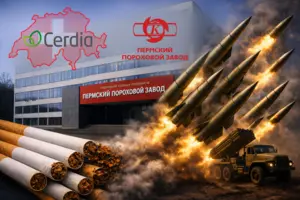


Russia’s missile production remains dependent on foreign chemical raw materials which, despite sanctions, still have to be imported due to lack of domestic substitutes. Documents reviewed by StateWatch indicate that cellulose acetate produced by the European company Cerdia was purchased, through intermediaries from the tobacco business, by a Russian plant involved in the production of missile systems.
One of Russia’s key missile manufacturers is Novator Design Bureau JSC, part of the Almaz-Antey concern, which produces cruise missiles, including the 3M-54 Kalibr.
Kalibr cruise missiles, which Russia regularly launches from ships and submarines in the Black Sea, have become one of the main instruments used in strikes on Ukrainian cities and critical infrastructure.
In the production chain of the Kalibr manufacturer, the Perm Powder Plant plays an important role as a supplier of rocket fuel. In a letter from Novator Design Bureau JSC to the Perm Powder Plant concerning the fulfillment of the state defense order for the supply of these missiles, the company notes the need to use foreign-made products because there are no Russian equivalents, including cellulose acetate.
Cellulose acetate is a highly purified cellulose derivative produced using complex chemical processes and specialized raw materials. Russia does not have large-scale production of such products at the required quality, forcing enterprises to rely on imports.
Although cellulose acetate is widely used in the cigarette industry, it belongs to a broader class of cellulose-based materials that are critically important for the production of powders and rocket fuel.
According to the documents, cellulose derivatives are used in the production of a wide range of Russian weapons—from KAB-500 and KAB-1500 guided aerial bombs to S-300, Buk and Tochka-U missile systems, as well as Yars strategic missile complexes and Kornet anti-tank missiles.
And, as documents in StateWatch’s possession show, materials purchased from European manufacturers ultimately ended up at the Perm Powder Plant and were then incorporated into the production of missile systems.

Cellulose acetate appears both in customs data and in companies’ internal contracts. In particular, at least 30 tons of the substance were purchased from the European manufacturer Cerdia.
Cerdia is one of the world’s leading producers of cellulose acetate for cigarette filters, with facilities in Europe, the United States and Asia. The company’s website still contains a reference to its presence in Russia.
A letter from Cerdia concerning the supply of cellulose acetate in the form of flakes—basic raw material for further processing—was found in the Perm Powder Plant’s records.
Although, according to its official operating program, the Perm Powder Plant has a full technological cycle for producing rocket fuel, the documents point to the enterprise’s dependence on imported chemicals. In particular, this concerns cellulose derivatives purchased from Cerdia because due to the absence of Russian equivalents.
The companies’ internal documents point to the key role of intermediaries in these supplies. In particular, the contracts name A2 GROUP LLC as the supplier of foreign-made products to the Perm Powder Plant.
Minutes of a meeting of the Perm Powder Plant’s procurement commission dated March 14, 2025, explicitly record the purchase of French-made Rhodia Acetow (Cerdia) cellulose acetate. The document defines the subject of the contract as the supply of this product, with a maximum contract value of €840,000 and a completion deadline by the end of 2025.

The same minutes record the decision to make the purchase from a sole supplier—A2 GROUP LLC—selected following market analysis.
Thus, the document directly confirms that foreign-made Cerdia products are being procured for a Russian military-industrial enterprise through an intermediary under a formalized procurement procedure.
A2 GROUP LLC does not appear to be a specialist supplier of chemical products. In open sources, the company presents itself as a supplier of electrical equipment. Nonetheless, it is precisely through this company that European-made cellulose acetate is being purchased for the Perm Powder Plant.
In customs data, A2 GROUP LLC does not appear as the importer. Instead, cellulose acetate is brought in by other companies, including ones tied to the tobacco industry—the main civilian consumer of this product. It is these entities that appear in the supply chain leading to the Perm Powder Plant, pointing to a multilayered scheme in which importation, intermediation and end use are split among different legal entities.
According to customs databases, from the start of the full-scale invasion through March 2025, products from Cerdia’s German division were imported into Russia in an amount of at least $7.3 million. The two main recipients were two Russian companies—Gulbakhar Rus LLC and Sertov LLC.
Gulbakhar Rus LLC received more than $5.7 million worth of Cerdia products. The company operates in the tobacco segment, which is the main civilian market for cellulose acetate, and thus shows the commercial channel through which this product enters Russia.
At the same time, Sertov LLC appears to be the key link between civilian imports and enterprises in Russia’s military-industrial complex. The company received at least $1.6 million worth of Cerdia products and, at the same time, has documented ties to Russian defense-industry enterprises.

In particular, in 2016 Sertov signed three contracts with the Perm Powder Plant worth nearly 11 million rubles, and in 2016–2018 it supplied cellulose acetate to the Scientific-Research Institute of Polymer Materials (NIIPM JSC)—a research institute engaged in the development of munitions and rocket fuel and located at the same address as the powder plant.
Taken together, the customs and contract data point to a multilayered supply structure: foreign-made products enter Russia through civilian-profile companies and are then, through intermediaries, integrated into the production processes of defense-industrial enterprises.
Despite sanctions, foreign-made products continue to be supplied through a network of intermediaries and civilian-profile companies, making it possible to incorporate them into missile production. This supply structure not only makes the chains harder to trace, but in effect ensures the uninterrupted production of weapons used in the war against Ukraine.
Oleksandr Frolov, a partner in the dispute resolution practice at the Kinstellar international law firm, notes that the European Union operates an export-control system for military and dual-use goods designed to restrict their transfer to Russia. If a company knew or should have known about the possible military use of its products, or failed to ensure proper control over their end use, this may indicate an evasion of export restrictions and may give rise to liability.

“Under international practice, sanctions may be imposed not only on military-industrial enterprises, but also on manufacturers of dual-use goods if their products are used in weapons production. This category includes companies whose goods may contribute to the waging of war. In particular, such companies may face restrictions on the export and import of dual-use products,” Oleksandr Frolov explains.
StateWatch sent an official inquiry to Cerdia asking it to explain possible supplies of cellulose acetate to Russia after 2022, as well as its ties to intermediary companies and its controls over the end use of its products. As of the publication date, the company had not responded to these questions.
This material was prepared as part of a collaboration between the StateWatch think tank and UNITED24.
Please select it with the mouse and press Ctrl+Enter or Submit a bug
 Follow on Telegram
 Login with Facebook
 Login with Twitter
 Login with Google