

 Support ZN.ua








EU to Ban Russian Gas by 2027: Why This Is Not a Breakthrough
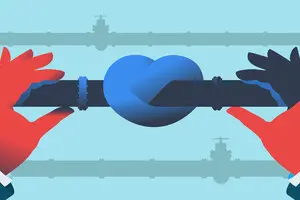

The European Union’s decision to gradually prohibit imports of Russian gas by the end of 2027 looks headline-grabbing only at first glance. In reality, it codifies what has already been done rather than ushering in a new reality. Most importantly, it comes too late and with transition periods that are far too long to be considered “a turning point.”
The EU publicly declared its intention to phase out Russian energy as early as May 2022, launching REPowerEU in response to Russia’s full-scale invasion of Ukraine. Since then, the bloc has adopted 19 sanctions packages against Russia. Yet supplies of Russian oil and gas to the EU have continued, despite a significant decline—simply in smaller volumes and often through a “grey zone” of exemptions, transition periods and political compromises. In 2025 alone, gas exports to the EU brought the Kremlin €15 billion.
What exactly was adopted—and why this is not an immediate shutdown
The current decision envisages a phased ban, with imports of Russian LNG to end on 1 January 2027 and pipeline gas imports to cease on 30 September 2027 (with a possible shift of the final deadline to 1 November 2027 under certain conditions). Brussels’ logic is understandable: avoid price shocks and give countries time to restructure contracts and infrastructure. But this very logic is what makes the decision unremarkable. Even now, it would be technically possible to halt gas imports into the EU altogether; what is lacking is political will. When the deadline is pushed one and a half to two years into the future, it becomes a political signal rather than an instrument of rapid economic pressure.
Moreover, the adoption of this document has demonstrated that internal resistance within the EU has not disappeared. Slovakia and Hungary opposed the measure and declared their readiness to challenge the approach in court. This means that even after a formal decision, we still face the risk of delayed implementation, carve-outs and political backtracking, depending on how the war and domestic politics in Europe evolve.
The decline in Russia’s share of gas: sanctions or geopolitics of routes?
Yes, Russia’s share in EU gas imports has fallen sharply—from over 40 percent before the war to around 13 percent in the first half of 2025. But it is critically important to be honest about the reasons for this decline. Much of the reduction did not occur because the EU abruptly “turned off the tap” through sanctions, but because Russia itself and developments around key transit routes made gas flows physically or politically impossible.
Russia unilaterally halted or sharply restricted supplies along major corridors. In 2022, Gazprom effectively stopped deliveries via Nord Stream 1, announcing an indefinite suspension. In September 2022, Nord Stream was sabotaged, removing this route from the equation altogether. At the same time, in April 2022 Gazprom cut off gas supplies to Poland and Bulgaria over disputes concerning payment terms.
Transit through Ukraine was a separate story. Under the five-year 2019 “ship-or-pay” agreement, Gazprom was obliged to pay for transit of at least 225 bcm: 65 bcm in 2020 and 40 bcm annually in 2021–2024. In reality, by the end of 2024 transit volumes had already shrunk to a shadow of pre-war levels—about 15 bcm per year—while Gazprom continued to pay for 40 bcm. From 1 January 2025, transit via Ukraine ceased following the expiration of the contract. Once again, this was not due to an EU decision, but to Ukraine’s principled position.
Russia used gas supply cuts as a means of blackmailing Europe, seeking to force the EU to reduce its support for Ukraine during the war. This blackmail failed. In my view, this is the key context: Europe largely “weaned itself off” Russian gas not because of decisive EU sanctions, but due to the destruction and closure of routes and Russia’s own actions. Over several years, the EU proved unable to fully halt purchases—primarily because of its internal decision-making mechanisms and internal obstruction.
Why the EU did not cut off Russian gas earlier
EU sanctions traditionally require political unity, and on energy this unity was consistently fractured. There have always been countries within the bloc that openly or quietly slowed down the toughest steps. Hungary and Slovakia did so publicly, citing “economic risks” and a “lack of alternatives,” while some other players (Austria, Italy and Greece) acted more discreetly but with the same interest: preserving transit, contracts and traders’ margins.
Here I would like to underline another uncomfortable point. Had Ukraine not terminated transit after the contract expired, despite intense pressure from Slovakia and Hungary, parts of the EU would have continued to find arguments to “wait” and “not rock the market”. That would have meant steady cash flows into Russia’s budget during wartime. This is precisely why I am sceptical of claims about a “final rupture” based solely on documents with a 2027 deadline.
There is enough gas on the market—and 2026 will add more supply
Stripping away political rhetoric, Europe already has the technical capacity to fully abandon Russian gas today. First, Russia’s share is already low (around 13 percent), and second, the market is well supplied, with global LNG availability set to grow rapidly in 2026. In this context, the argument that “it cannot be done quickly because there is not enough gas” looks increasingly weak. This is precisely why I interpret the long transition periods as “buying time”—for governments, national companies and traders who continue to profit from reselling cheap Russian gas while politics still allows it.
The weakest link: enforcement and loopholes
Even if political will holds, the document contains serious risks of circumvention via blended flows, swaps, storage facilities and manipulation of origin documentation. Analysts are already warning about the potential for laundering—effectively “washing” Russian gas through complex supply chains and rebranding. In particular, Turkey’s BOTAS has already announced plans to create a Turkish gas blend, which could allow Russian gas to be “repainted” as Turkish.
Focus not on headlines, but on interests and potential negotiations
I believe that in the medium term the decisive factor will not be the text of the ban itself, but possible political scenarios around ending or freezing the war. The Kremlin will consistently seek to make the lifting of sanctions — especially energy sanctions — a central condition of any agreements, because energy exports remain one of Russia’s few stable sources of foreign currency revenue. Europe, thinking pragmatically, may also be tempted to partially “bring back” Russian gas—not as a dominant source, but as one element of market balancing and as a tool to prevent Russia from becoming fully vassalised by China.
I am not saying this will happen automatically. But the window until September 2027 is long enough for the “impossible” to return to the negotiating table. That is why I do not see the current ban as an irreversible point of no return. It is rather a framework that can be strengthened—or, under certain political conditions, rewritten to fit a new reality.
Conclusion
A sober assessment of the EU’s decision to ban imports of Russian gas is this: it matters as a signal, but it is weak as an instrument of rapid economic pressure. It is delayed, includes lengthy transition periods, leaves room for circumvention and depends on the political will of member states—including those already demonstrating readiness to block or slow the process.
For Ukraine, the key takeaway is simple: the 2027 deadlines are not a guarantee of a final break with Russian gas, but rather a political compromise that can still be diluted by exemptions, court proceedings and weak national-level enforcement. Kyiv’s task, therefore, is not to applaud dates, but to demand mechanisms that make the ban real: strict verification of origin, unified entry controls, transparent rules on blended flows and meaningful penalties. Otherwise, part of the Russian resource will continue to enter the EU under different labels—and with it, money will continue to flow into Russia’s budget.
Read this article in Ukrainian and russian.
Please select it with the mouse and press Ctrl+Enter or Submit a bug
 Follow on Telegram
 Login with Facebook
 Login with Twitter
 Login with Google