
 Support ZN.ua








Billions Found, Whereabouts Unknown—Two Years of ARMA Reform
 Infographics



A factory, a luxury villa or thousands of hectares of land has been seized from a corrupt official or an accomplice of the Russian regime. What happens next? Logically, that property ought to be preserved: either by being transferred into management or, where it is losing value fast, by being sold at a transparent auction. The body in charge of this process is the Asset Recovery and Management Agency (ARMA).
But is it living up to its mission?
On the face of it, 2024–2025 should finally have changed something for the Agency. New laws, loud promises and attempts to establish transparent rules of the game. The team at the Institute of Legislative Ideas’ analytical center looked behind the scenes of the body’s public work and carried out a thorough analysis: the Shadow Report on the Activities of ARMA.
Reform on paper
Over two years the state has finally overhauled the procedures for selecting asset managers and delivered on one of Ukraine’s commitments under the EU’s Ukraine Facility.
Most of those changes, however, took effect only in late 2025 or not until this year. In practice, then, the reform is still stalling, and even cautious optimism founders on reality.
Why did the reform stall out of the gate?
- A leadership vacuum: the first competition for the post of ARMA head failed, and a repeat competition was announced only recently. The body has thus gone almost a year without permanent leadership.
- A staffing shortage: one position in four at central headquarters remains vacant, and the regional offices are short of specialists.
- A funding gap: just UAH 3 million was allocated in 2026 to value and safeguard every seized asset in the country, when several times that sum is needed.
The assets have been traced—what happens next?
Tracing assets is something ARMA does well. Here the figures really are striking:
- in 2024, it processed 5,449 requests from law enforcement;
- in 2025, the figure rose to 5,562.
In a single year the Agency’s staff identified more than 47,000 items of real estate, 20,000 vehicles, tens of billions of hryvnia and corporate rights worth more than UAH 50 billion.
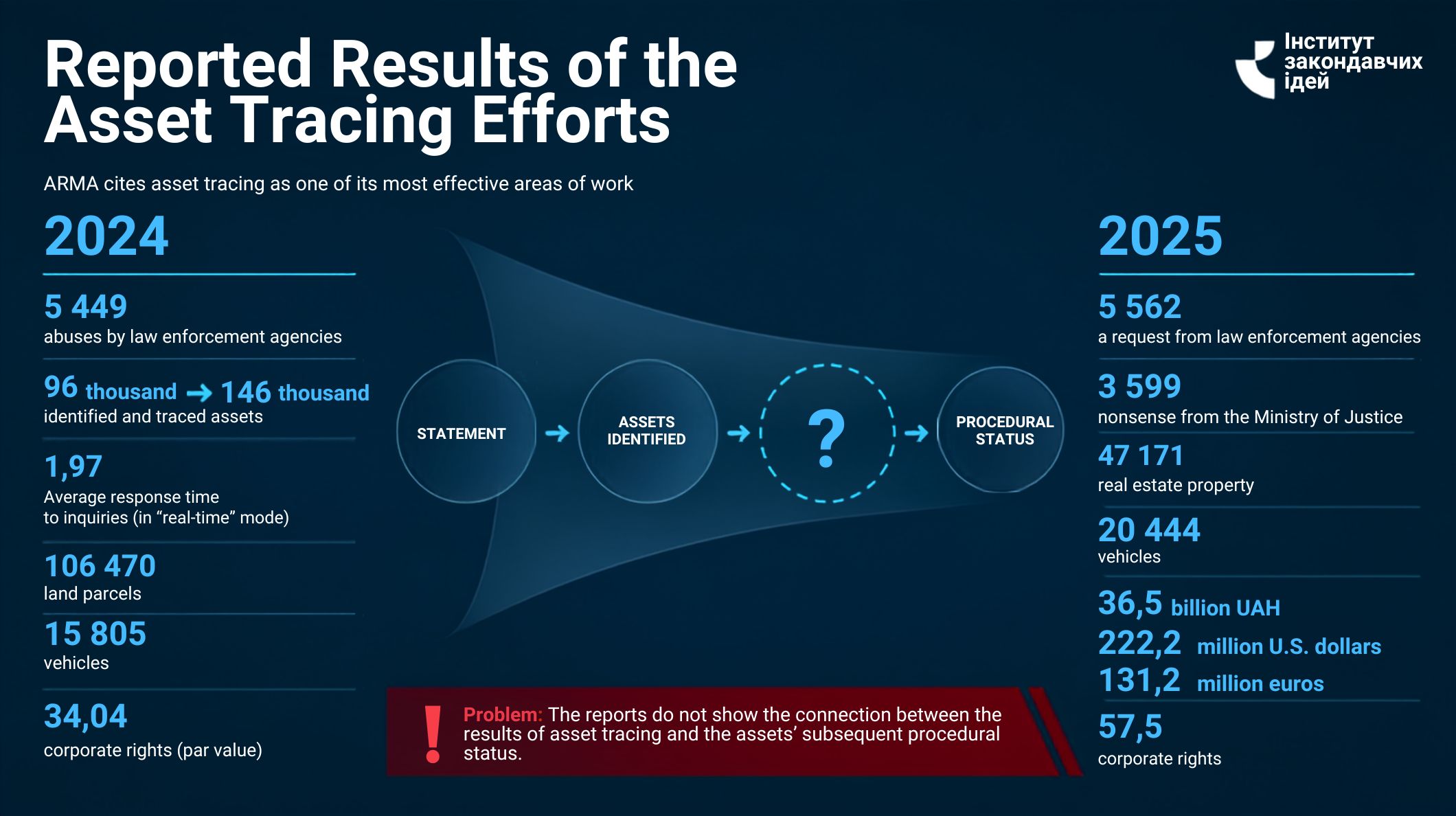
This, though, is where it gets interesting. The moment an asset is found, its onward trail goes cold. State reporting is built in such a way that an ordinary citizen has no chance of learning how many of the assets identified were seized, how many were transferred into management, and how many were confiscated and sold.
The absence of clear statistics makes it impossible to establish at which stage the system loses an asset, or which body is responsible for the delay.
In an ideal world, state reporting would cover the entire chain, along these lines: identified → seized → transferred into management → sold or confiscated → economic return obtained.
Records of that kind should become the basis both of public reporting and of interagency coordination.
Billions for the budget: a victory or a statistical sleight of hand?
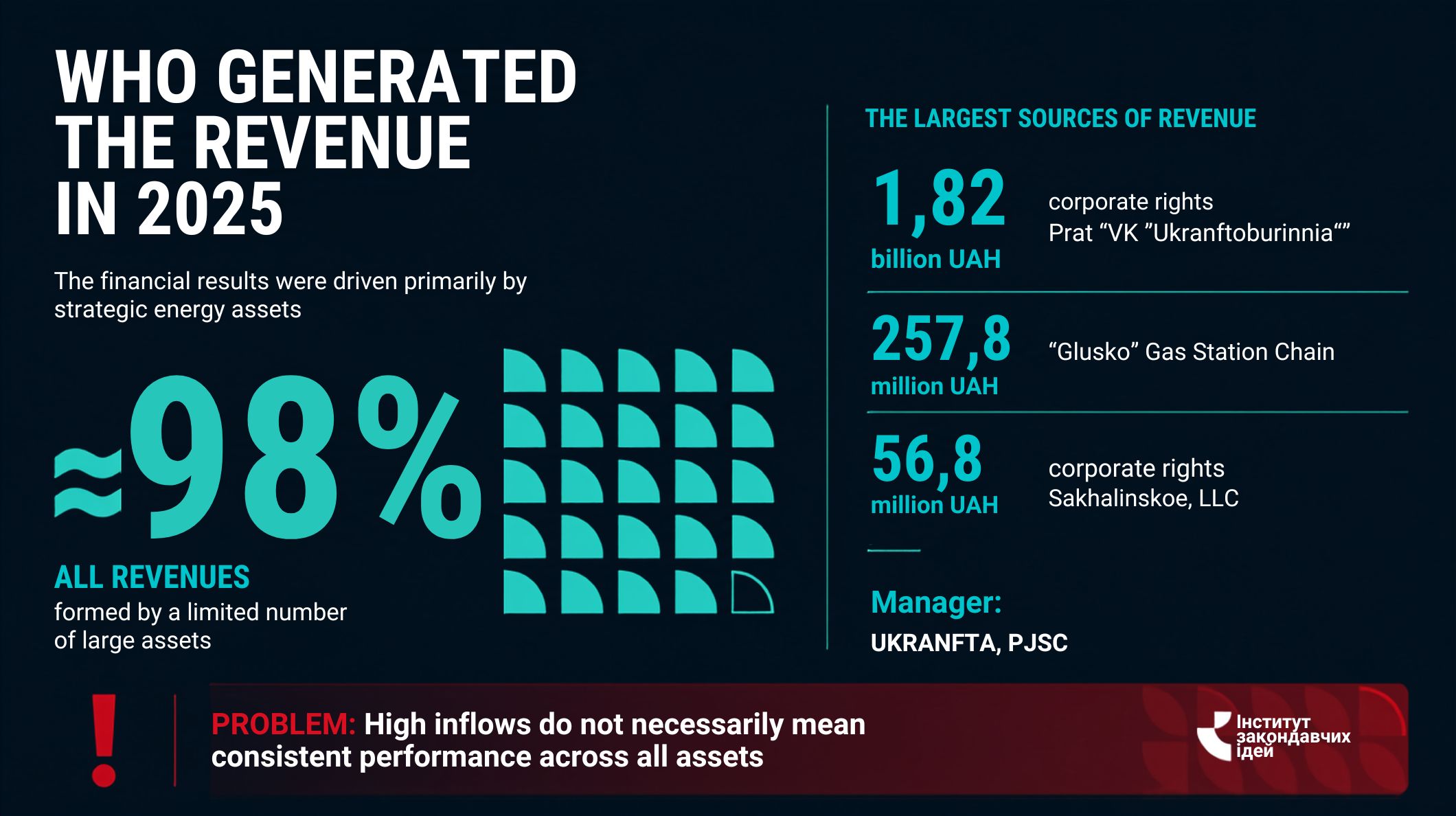
In 2025 ARMA reported record revenue from asset management—UAH 2.178 billion (against UAH 1.5 billion in 2024). It sounds like a victory, yet the composition of that sum is enormously lopsided.
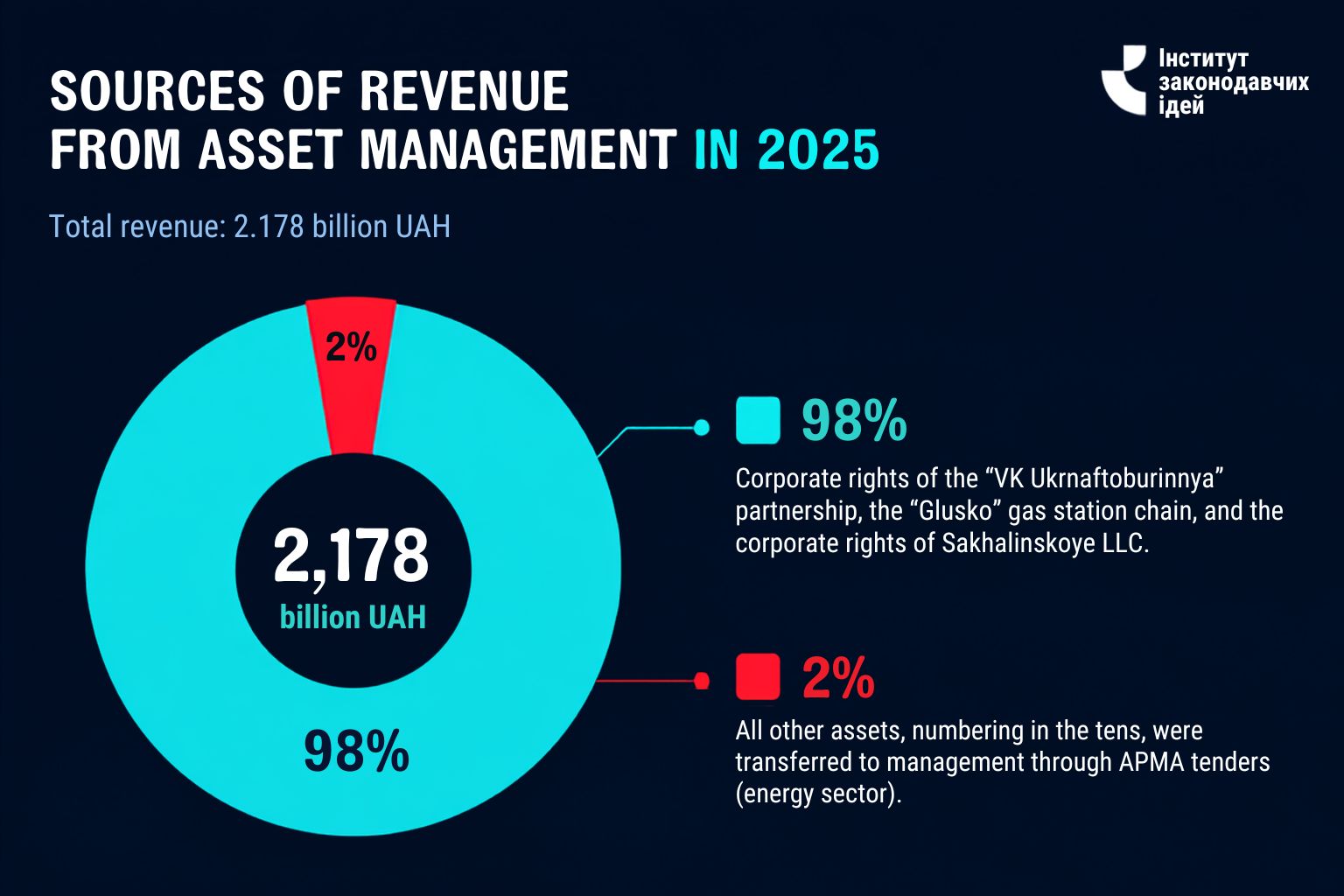
It turns out that the financial result was delivered not by transparent tenders and effective management on ARMA’s part, but by a handful of large oil and gas assets that the Cabinet of Ministers handed over, under a special procedure, to managers designated by the state.
By ARMA’s own account, at least 20,000 assets could be transferred into management; instead they stand idle or bring the budget a pittance.
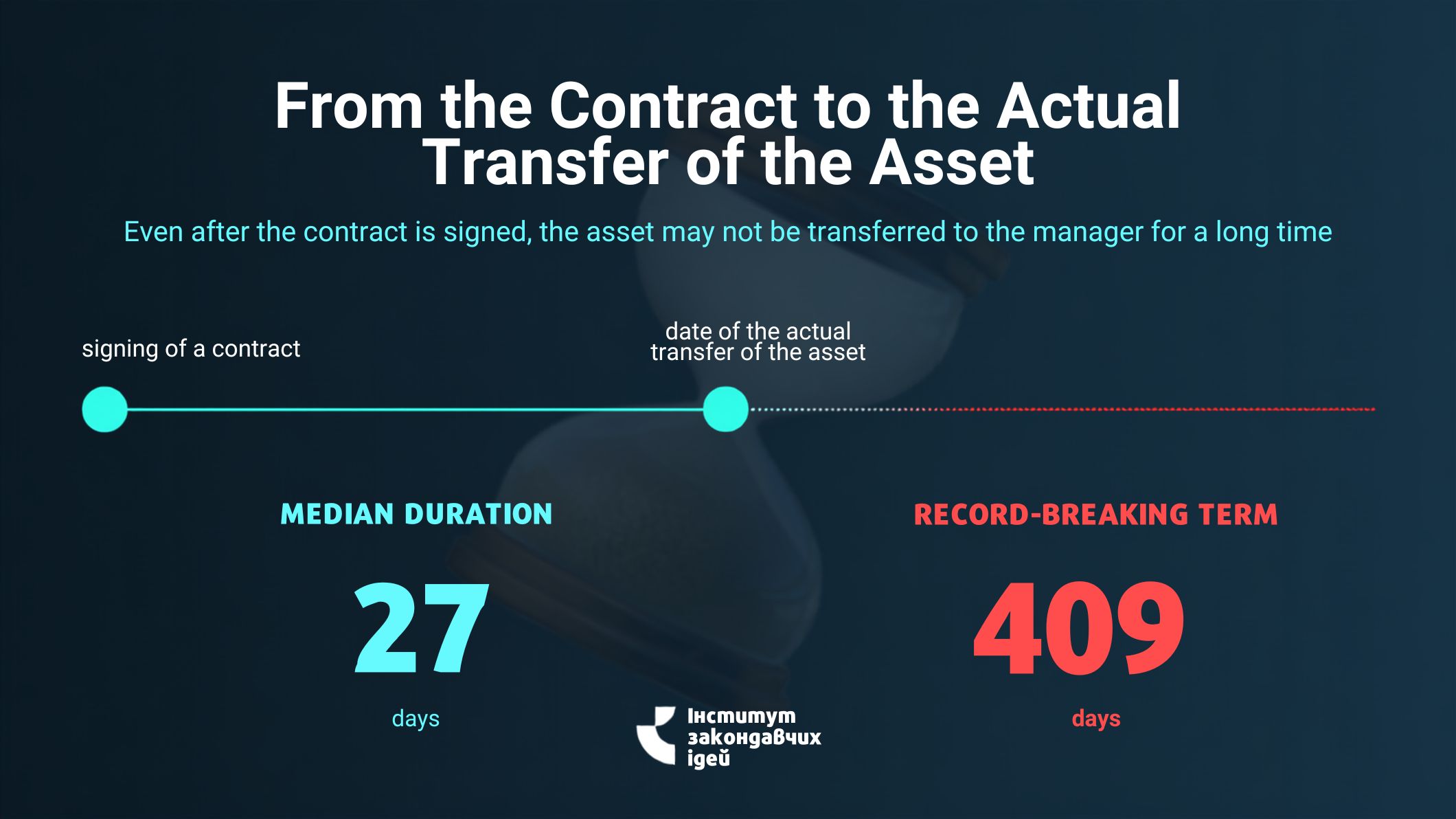
What is more, even once contracts with managers have been signed, property often goes months without being physically handed over. The average wait is around a month, but there are egregious cases too. Handing over one non-residential property on Pavlivska Street in Kyiv, for example, took 409 days!
In some cases ARMA’s representatives simply cannot get onto the premises. They were refused entry to the estate of former interior minister Vitalii Zakharchenko, they were blocked from accessing the Trade Union Building, and the competition over Kyiv’s well-known Gulliver shopping center dragged on for more than a year and ended in nothing.
Auctions: only one lot in five sells
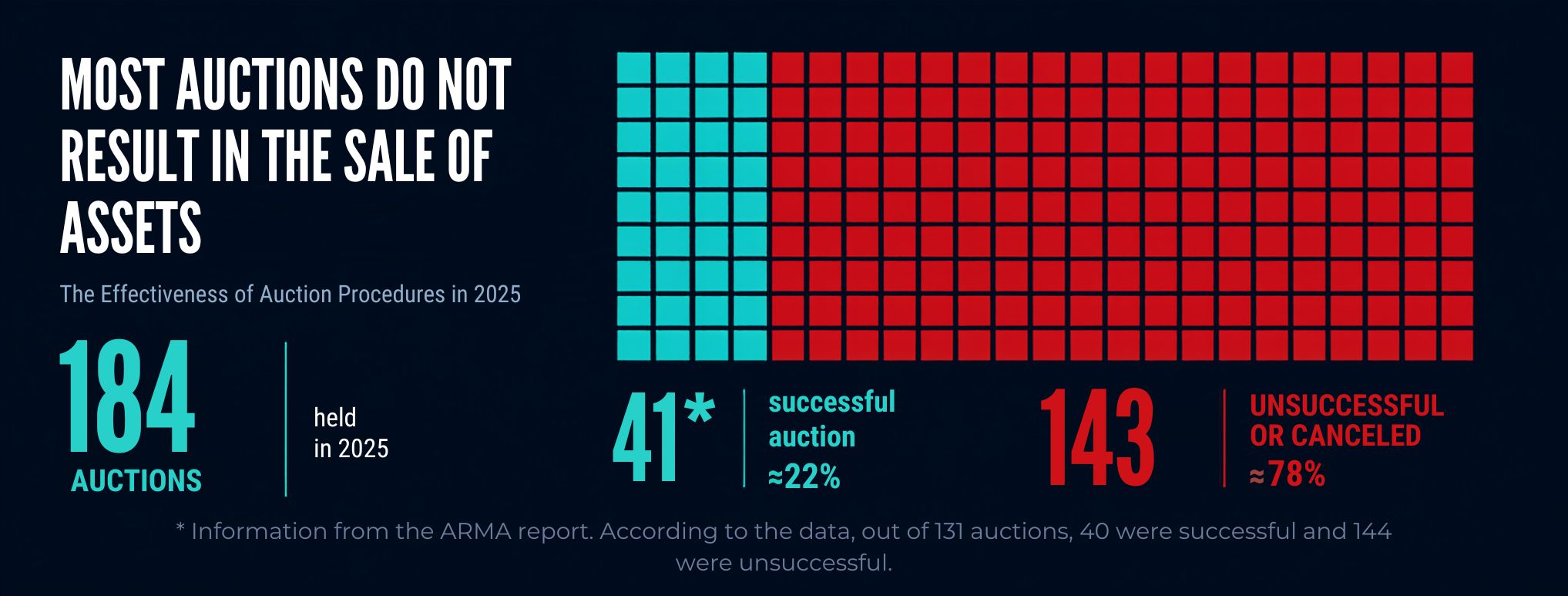
The sale of seized property is another sore point. In 2025 ARMA reported 184 electronic auctions that raised UAH 411 million. But the success rate came to a modest 22 percent, since only 41 auctions ended in a completed deal.
The remaining 143 attempts came to nothing, for want of buyers or because they were canceled. On top of that, thanks to constant relisting, those 184 sales concealed only 100 genuinely distinct lots.
Competition is almost nonexistent—as a rule, only one bidder turned up. The most vivid example is the epic saga of the sale of 460 hectares of land in Zakarpattia. The auction was announced nine times! And when the land was finally sold, the result had to be annulled because the buyer was potentially linked to the corrupt former owner.
A digital dead end and villas abroad
The Unified State Register of Assets Seized in Criminal Proceedings lists more than 421,000 items and assets. Yet this vast database still does not work as a full-fledged monitoring and control system. ARMA cannot even count automatically how much property the courts have released from seizure, or how much money is actually frozen in accounts at present.
The picture is much the same internationally. The Agency has reported finds abroad: in 2025 it identified 16 bank accounts holding more than $6 million, along with villas and stakes in foreign companies. But how much of that money has actually been confiscated and returned to Ukraine? Public statistics are silent on the point, because the mechanism for repatriating funds has still not been put on a legal footing.
The upshot is that the system works better at the tracing stage than at the closing stages of recovery.
In summary: what needs to be done to make the system work?
The ARMA reform of 2024–2025 has laid a reasonable foundation on paper. Without a change of approach, however, it risks turning into a show of frantic activity. If seized property is to be of use to a country at war, the following recommendations are critical.
- Complete the personnel reform: choose a head of ARMA and appoint deputies so that the body can discharge all its functions properly.
- Put funding on a sound footing: secure adequate budget funding from the state, taking account of the positive results ARMA has achieved.
- Introduce end-to-end statistics: move from reporting on isolated indicators to transparent tracking of an asset’s entire life cycle: identified → seized → transferred into management → sold/confiscated.
- Modernize the Unified Register: remove the register’s technical constraints, integrate it with other state registers and standardize the way assets are recorded.
- Streamline asset management: amend the Criminal Procedure Code to improve cooperation with law enforcement (so as to reduce the flow of irrelevant assets) and launch the selection procedure for managers of straightforward assets.
- Raise the quality of disposals: assess auctions not only by the sums raised but also by the level of competition and the reasons sales fall through. Bar anyone connected to the owners from taking part.
- Harmonize legislation and strengthen international cooperation: align the rules with EU Directive 2024/1260 and gear international engagement to the end result—the genuine recovery of assets.
Delivering most of these recommendations, and the success that would follow, rests with the Agency itself. The remainder is impossible without action by the country’s central authorities: the Verkhovna Rada, the Cabinet of Ministers, the Prosecutor General’s Office and other law enforcement bodies.
In the end, the public, the expert community and international partners will judge ARMA’s effectiveness not by the number of meetings held or auctions announced, but by its real financial results and by how much property has genuinely been put to work for the state. Whether the body’s funding rises from here—or falls—depends on that judgment.
Please select it with the mouse and press Ctrl+Enter or Submit a bug
 Follow on Telegram
 Login with Facebook
 Login with Twitter
 Login with Google