
 Support ZN.ua








“Humane Advice” From Partners May Ultimately Depopulate Ukraine



According to the latest comprehensive assessment of damage and recovery needs for Ukraine, RDNA5, prepared by the World Bank jointly with the government of Ukraine, the European Commission and the UN, total reconstruction needs are estimated at $588 billion over the next ten years. The document describes the destruction in detail: housing losses, damaged infrastructure, environmental damage. This time, particular emphasis is placed on human capital.
There is no denying the truth here: Ukraine’s most important asset is its people. Yet we are not being offered effective recipes for how to bring these people back, retain them or improve their wellbeing. The report mentions both the seven million refugees abroad and the five million internally displaced people, as well as the fact that 47 percent of veterans cannot return to their previous jobs because of physical or psychological problems. Women are also singled out as a priority category: they make up 82 percent of the unemployed registered and bear an additional burden of caring for children and the elderly.
But can the proposed remedies help all these groups if all they amount to is a list of supposedly necessary investments that in fact do not exist, and a set of reforms that certainly do not improve people’s wellbeing?

The International Monetary Fund and the World Bank are proposing what is supposedly a worker-oriented reconstruction plan. They speak of human capital, inclusive growth and social resilience, promising the return of refugees, the reintegration of veterans and greater participation by women in the economy. Yet a close reading of the document suggests that behind the mask of this neoliberal rhetoric lies intensified exploitation of workers, growing inequality and the transformation of Ukraine into an underdeveloped raw-material appendage of advanced economies and a major supplier of cheap labor.
Yes, the World Bank proposes to invest $42.7 billion in social protection and livelihoods, of which 37.9 percent would go to employment programmes and 7.1 percent to support for internally displaced persons. The IMF, in its new Extended Fund Facility (EFF) program worth $8.1 billion for November 2025 to 2029, goes further: as a mandatory condition of lending, it demands the introduction of VAT for sole proprietors, effectively dismantling the simplified taxation system, and the adoption of a new Labor Code in 2026.
The draft Labor Code, which contains 329 articles, radically liberalizes the labor market: it introduces flexible contracts, makes dismissals easier, significantly restricts the rights of workers and trade unions, and allows “zero-hours” contracts with no fixed working time. “This is not a reform but an attack on workers’ rights,” the Confederation of Free Trade Unions of Ukraine commented. The Federation of Trade Unions of Ukraine and the European Federation of Public Service Unions (EPSU) have already described similar changes as violations of International Labour Organization (ILO) conventions.
The IMF and World Bank rhetoric about removing labour restrictions is a euphemism for radical deregulation that makes labor more flexible for business. The UN expert on debt and human rights, Juan Pablo Bohoslavsky, directly criticises such approaches: 25–50 percent of IMF programs include conditions requiring cuts to wages and pensions and the weakening of trade unions (see table). As the expert stated in one of his reports, reducing labor protections does not lead to employment growth or economic growth; it only deepens inequality. In Ukraine, this already has consequences: after the reforms of 2014–2022, real wages have stagnated, while precarious employment—unstable work—has risen by 30 percent.

The historical context confirms these suspicions. Since 2014, after the Revolution of Dignity, the IMF has provided $17 billion, demanding a 50 percent increase in gas tariffs, a freeze on the minimum wage and cuts to public-sector pay. In 2020, it provided another $8 billion in exchange for lifting the moratorium on the sale of agricultural land, which led to the consolidation of landholdings in the hands of large agribusinesses and losses for small farmers. During the war, in 2022, emergency legislation (Law No 5371) allowed employers to suspend collective agreements for 73 percent of workers at enterprises with fewer than 250 employees. The IMF and World Bank not only failed to condemn this but incorporated it into their programs as an “improvement in the business climate.”
Comparison between the rhetoric and the real consequences of the “worker-oriented” approach (based on RDNA5 and IMF conditionality)
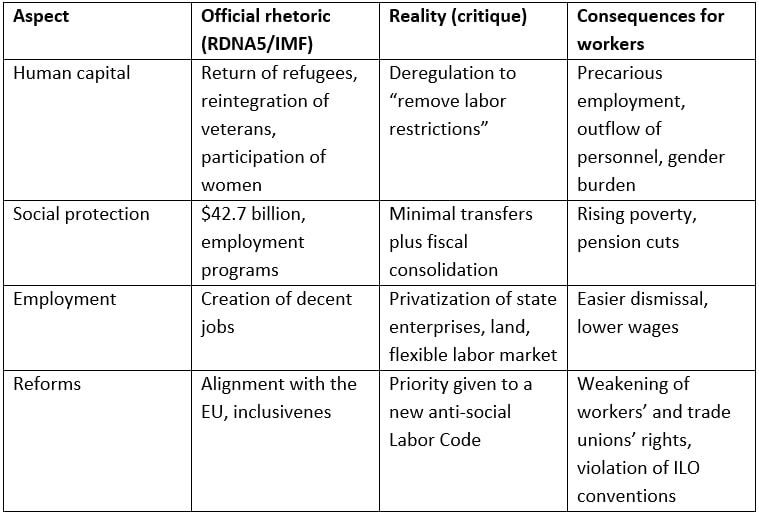
In RDNA5, the social sectors—housing ($89.8 billion), education ($33.5 billion), healthcare ($23.6 billion)—together amount to $180.1 billion. But critics from Liberation School and the Committee for the Abolition of Illegitimate Debt (CADTM) see a debt trap here. A large share of the assistance consists of high-interest loans, while austerity policies, on the contrary, cut social spending. The financing gap for 2026–2029 is $136.5 billion, which is supposed to be filled by private investment. The World Bank states outright that success depends on the private sector, which is expected to cover up to 40 percent of needs through public-private partnerships (PPP) and the privatization of state-owned enterprises (SOEs). Historically, such reforms have led to mass layoffs, lower wages and worsening labor conditions, not the reverse.
The new Labor Code, imposed as an IMF priority, contradicts not only ILO conventions but also European social standards. It allows unrestricted night work and remote work, limits the right to strike and collective bargaining. “This will turn Ukraine into a country with the worst labor standards in Europe, where workers will become cheap resources for global corporations,” the Confederation of Free Trade Unions warns. OpenDemocracy (2025) notes EU concern about these anti-social reforms, but the IMF ignores the European criticism.

The consequences for vulnerable groups are particularly grim. Women, who make up the majority of the unemployed, face gender segregation in the form of precarious service-sector employment and additional burdens of family care. Among veterans, 47 percent do not return to work because of injuries, while the employment programs on offer often amount to low-paid jobs with no guarantees. Refugees (6.9 million) and internally displaced people (20% unemployment rate) are trapped in instability. The Solidarity Center (AFL-CIO, 2022) stresses: “Support for workers’ rights is critical to Ukraine’s future, but the IMF is doing the opposite.”
The private sector as panacea is another myth. The World Bank promises that investment from BlackRock or J.P. Morgan will create decent jobs, but, first, there are still many barriers to investment and, second, the willingness to invest at all is far from guaranteed, especially in an unreformed economy.
Traditional IMF reforms, meanwhile, amount to the imposition of austerity: cuts in social spending, sweeping privatization and restrictions on the rights of wage earners. In Ukraine, this means future generations will pay for a “reconstruction” that enriches foreign investors. Critics call this a debt trap: Ukraine becomes dependent, and Ukrainians become a source of cheap labor and tax revenue. The supposedly “worker-oriented” approach of the IMF and World Bank in fact uses the war to push policies that make Ukrainians a cheaper resource for global capital.
For a truly worker-oriented postwar reconstruction, one must begin by writing off Ukraine’s war debts and reversing the anti-social reforms that only deepen inequality in a society exhausted by war. Ukraine has already lost badly to EU countries in the struggle for human capital; the situation can only be corrected by ensuring that working people have living and working conditions here that are no worse than those in Europe. With corresponding levels of wages, social protection, conditions for doing business and opportunities for self-realization. Yes, this does not fit the policy of “austerity above all,” but there is no other way to reverse the migration flow. Otherwise, the reconstruction of Ukraine will turn into the restoration of a neoliberal status quo in which Ukrainian workers once again pay the highest price.
Please select it with the mouse and press Ctrl+Enter or Submit a bug
 Follow on Telegram
 Login with Facebook
 Login with Twitter
 Login with Google