
 Support ZN.ua








Is Ukraine Ready For Another Wartime Winter: What the First Months of Resilience Plans Have Revealed



Received wisdom holds that preparations for the next heating season—much like those for an election campaign—should begin the moment the current round is over. This year, almost for the first time, that advice has actually been heeded.
ZN.UA has already written about the architecture of the comprehensive resilience plans for the regions and individual cities, approved by a decision of the National Security and Defense Council (NSDC) and brought into force by a presidential decree of 14 March this year. Here it is enough to recall that this is a large-scale system of measures to protect, back up and restore critical infrastructure, jointly financed by the state and local communities and coordinated by a dedicated government center. The cost of implementing the plans was initially put at UAH 216.3 billion, a sum that has since risen to UAH 278 billion.
Only a handful of months remain before the new heating season begins. And already the heads of regions and local communities are judging the resilience plans less by whether they are conceptually sound than through the lens of practical delivery, funding shortfalls, staffing problems and tight deadlines.
Have local communities been given enough resources to carry out the tasks set for them? Is the state capable of providing the necessary coordination and speed of decision-making? And will this winter prove a test not only for the energy system but for the ability of Ukraine’s system of government to deliver on its own strategic decisions?
The first results
On 12 June, at a meeting of the Coordination Center, Prime Minister Yuliia Svyrydenko announced that, thanks to amendments to the state budget, the government is directing UAH 67.8 billion to the regional resilience plans.
According to Oleksii Kuleba, Deputy Prime Minister for Reconstruction of Ukraine and Minister for Development of Communities and Territories, work is currently under way on more than 500 protective structures. On distributed heat generation, almost 50 percent of the required capacity has already been contracted or delivered. More than 70 percent of heat and water utilities are covered by backup power sources. In addition, 29 special water supply projects are planned across 14 regions to meet the needs of more than 15 million people, and almost 90 percent of them already have their design and cost estimate documentation ready.
Analyze these figures, and one gets the impression that Ukraine has finally managed to put together, from the center, a more or less unified system for responding to its energy challenges: funding sources and priorities have been defined, along with those responsible for delivery and the mechanisms for coordination and cooperation.
Yet it is precisely at the stage of practical delivery that the first systemic constraints begin to show. The heads of regional military and state administrations and city mayors judge the resilience plans, above all, through the lens of funding shortfalls, staffing shortages and the tight deadlines imposed by the state.
The devil is in the detail
The Association of Ukrainian Cities has summed up the arrival of these new obligations to deliver the regional resilience plans in a single phrase: “responsibility without money.” According to Oksana Prodan, adviser to the head of the association, preparations for the heating season should follow three key strands: protection against shelling (support for air defense and for the armed forces more broadly), preparation of energy companies and the roll-out of support programs for consumers and local authorities.
Prodan separately stresses the need for the state to clear its debts to local communities arising from the tariff differential, which currently stand at around UAH 72 billion.
Ukraine’s mayors also point out that central government has placed personal responsibility for delivering the plans on their shoulders while, at the same time, systematically stripping money out of local budgets – not least through the redistribution of the “military” and “security” personal income tax (PIT). They are calling on the government to pay off the multi-billion-hryvnia debts owed on the heating tariff differential, since without that money municipal utilities have no resources to co-finance large-scale energy projects.
Municipalities also complain of a staffing famine, and of the fact that the state itself sometimes slows the rapid roll-out of distributed generation through cumbersome regulatory procedures for energy equipment, cogeneration units in particular.
In short, local government has in effect been handed a large share of responsibility for delivering the resilience plans, yet has not been given the financial, staffing and regulatory resources needed to complete the tasks on time.
If for most regions the main challenges are financial and staffing-related, Kyiv is a story of its own. Unlike most other regions, signing off the capital’s resilience plan is bound up not only with technical difficulties but with problems of governance. The people we spoke to point out that in Kyiv delivery is further complicated by a clash of powers between the city and military administrations, and carries an unmistakable political charge. The situation reveals another potential problem: even where the resources exist, the effectiveness of preparations may hinge on the quality of coordination and on a clear division of powers between competing centers of authority.
How the resilience plans are delivered on the ground
In the regions, the resilience plans are judged first and foremost by how they are being delivered in practice. And although our interlocutors assess the pace of preparation for winter differently, almost all of them name the same problems: money, staff and time.
The mayor of Dnipro, Borys Filatov, told ZN.UA in an exclusive comment that not all information about preparations for the heating season can be made public, for obvious reasons. Some major heat supply projects have already been completed, he said, and several more large projects are planned, including some tied to water supply, though for now he is giving no further detail.
.jpg "Borys Filatov, Mayor of Dnipro")
“We are working quietly to make the coming winter more comfortable for people. We often do a great deal ahead of time,” the mayor says.
The total cost of Dnipro’s resilience plan is put at UAH 9 billion. To date, the city has already raised UAH 4 billion in loans from state banks, whereas central government funding so far amounts to just UAH 40 million.
“This is obviously a vast sum, and we cannot manage it on our own locally. How much more the center can allocate, and when, is a very good question. We are being promised support, but for now there is no talk of specific sums or timelines,” says the mayor, explaining that much depends on international partners and their backing.
Overall, Filatov rates the pace of delivery and the coordination of the process at every level as entirely acceptable. The main problems, in his view, are still money and staffing.
“I am eagerly awaiting the mobilization reform the government has announced because when utility workers and contractors are called up right in the middle of a job—clearing up after a strike or working on a building site—it paralyzes the entire municipal economy and makes delivering the resilience measures far harder,” the mayor stresses, adding that without people and money nothing will “get moving.”
Alongside the city, the wider region has challenges of its own. The authorities in Dnipropetrovsk region stress that here the scale of preparation is also shaped by its status as a frontline area. Oleksandr Hanzha, head of the Dnipropetrovsk regional military administration, told ZN.UA that the region’s 2026 resilience plan sets out four key strands: protecting critical infrastructure, equipping enterprises with backup power, expanding heat generation and installing additional electricity-generation facilities.

This, he said, involves hundreds of critical infrastructure sites, hundreds of megawatts of backup capacity and dozens of new generation facilities, all due to be commissioned before the autumn–winter period begins. Full delivery of the region’s plan requires more than UAH 20 billion. All the work is carried out on a co-financing basis between the state and local budgets, with local communities contributing no less than 15 percent.
According to Hanzha, the process is moving on schedule, though the realities of life near the front constantly throw up additional difficulties.
“Dnipropetrovsk region is a frontline region that suffers enemy attacks every day. This causes destruction of civilian and critical infrastructure. Rebuilding takes resources—both material and human. But we are doing everything possible and impossible to prepare for winter and to give our people heating, light and water. We are getting on with it,” Hanzha concludes.
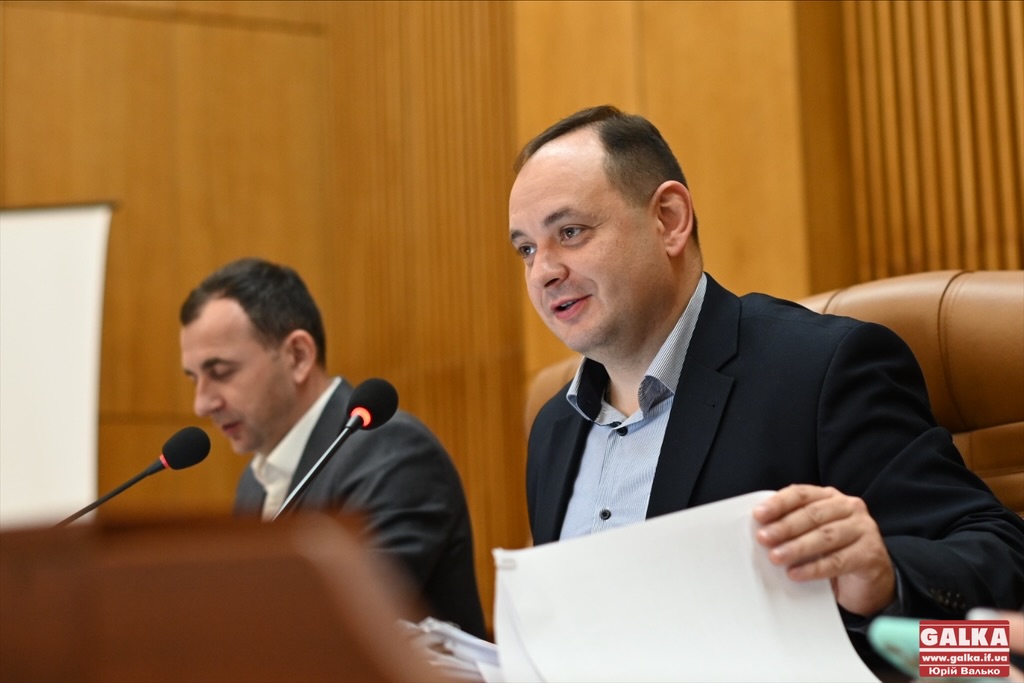
In rear area communities, the challenges are quite different. Ruslan Martsinkiv, mayor of Ivano-Frankivsk, notes that measures for the city are folded into the regional resilience plan. One of the key strands is a shift away from large boiler houses towards smaller, local heat supply systems.
“In the former STEK (Stanislav thermal power company) district, for instance, we are just completing the switch to individual heating and small boiler houses. Work is under way on several boiler houses and we have to finish on time. Carrying out this work matters a great deal to us. I am also grateful to the residents who played their part and likewise switched to individual heating in places where we could not build out the network properly. So we hope that all the work will be finished before the heating season starts. We thank the government for the six boilers provided to us to deliver the resilience plan; they are built into the design documentation for three larger boiler houses. In all, 13 boiler houses are now in progress, and they are due to come online on 1 November this year so as to heat schools, kindergartens, homes and other facilities in time,” the mayor says.
At the same time, one of the main problems Martsinkiv points to is dealing with the gas companies.
“There are serious problems with the gas operators. As things stand, we do not really understand how the gas will be switched on, in particular with Naftogaz, nor do we understand the position of the regional gas distributors—but we hope these problems will be resolved soon. We would welcome more support, so that we can carry out the president’s instructions and deliver the programs approved by the regional state administration,” the mayor of Ivano-Frankivsk stresses.
In Lutsk, the bet has been placed on installing modular boiler houses. As the deputy mayor, Volodymyr Martseniuk, told ZN.UA, the resilience plan provides for four such units with a combined capacity of 22 MW to heat the city’s most densely populated district.
“As of today, the public tender has been held and the winning bidder is now being selected, with whom a contract will be signed to supply the equipment for all four units,” he added.
A separate strand is securing a stable water supply. According to the official, work to install physical protection and backup power at the critical infrastructure sites of the municipal utility Lutskvodokanal is around 60 percent complete. Total funding for the measures in Lutsk is put at roughly UAH 200 million, drawn from the state and city budgets.
At the same time, according to Martseniuk, the main challenges are tight delivery timelines and high demand for the same equipment right across the country.
Why experts are not sure this is enough
Although the very idea of the resilience plans is generally welcomed, the experts canvassed by ZN.UA point to a series of systemic constraints that could significantly affect the results.
Hennadii Riabtsev, an energy expert, stresses that the resilience plans must keep the energy systems running in both centralized and stand-alone modes. That, he says, means commissioning a large number of small generating units at speed—cogeneration units, above all—integrating them into the existing grids and ensuring that so-called smart energy supply systems actually work.
“One of the most important elements of such plans is integrating renewable energy sources into the existing energy systems without creating conflicts. The declared aim is that all hub hospitals and water-supply sites will be equipped with stand-alone power sources backed by battery energy storage systems (BESS), so that connecting them will not reduce the resilience of the grids or of the systems as a whole,” the expert says.
An equally important task, he says, is building physical and engineering protection for critical infrastructure sites. According to Riabtsev, in the Kharkiv, Poltava and Donetsk regions alone hundreds of sites need protection and of varying degrees of complexity—from shielding against shrapnel to protection from direct missile strikes.
At the same time, the expert stresses, delivery of the plans runs up against four systemic problems.
The first is financial. Even the wealthiest communities lack the resources to deliver the plans on their own, while small communities are effectively dependent on state funding and international aid. So, despite the positive momentum in most regions, the pace of delivery remains uneven. The absence of a clear long-term lending mechanism will most likely force local authorities to divert money from other areas—education or healthcare—ratcheting up social tension.
The second is technological. Because of the global shortage of energy equipment, delivery times for cogeneration units, transformers and energy storage systems already stretch to 9–14 months, while communities need more than 200 modular boiler houses alone.
The third is regulatory. Current planning and land-use law was never designed for the fast-tracked construction of large numbers of energy facilities. Communities run into drawn-out procedures for allocating land, obtaining technical conditions, passing expert reviews and connecting to the grid. Even allowing for the special arrangements that apply to pilot projects, coordination between the Ministry of Energy, the Ministry for Development of Communities and Territories, the National Energy and Utilities Regulatory Commission (NEURC), the relevant agencies and local authorities remains insufficiently effective.
The fourth is staffing. A large-scale shift to distributed generation requires a great many skilled specialists, and the shortage of them is now further aggravated by mobilization and emigration.
On top of this, the expert adds, every new piece of energy infrastructure automatically becomes a potential target for Russian strikes, which adds tens of percent to project costs and creates further problems for financing and delivery.
Volodymyr Omelchenko, director of energy programs at the Razumkov Centre, believes that delivering the resilience plans depends above all on the ability to coordinate effectively between central government, the regions and business, and on creating economic incentives and clearing away bureaucratic barriers.
The government’s decisions to support new renewable energy and flexible generation projects, he says, follow the right strategic logic, but their practical effect on the coming heating season will be limited.
“Ukraine may enter the 2026/27 autumn–winter period better organized, but not fully protected. It is critically important that the new renewables, BESS, flexible generation, cogeneration, repairs to large CHP and thermal power plants, backup power for heating nodes and physical protection work not as separate strands but as a single resilience program. Without this, the country risks ending up with decisions that are correct on paper but deliver too little in practice during the winter peaks,” the expert stresses.
Yurii Korolchuk, founder of the Institute for Energy Strategies, is more critical of the resilience plans. In his view, they offer nothing conceptually new, since they essentially systematize approaches that were already in use in previous years.
“Instead of working to introduce a conceptually new, alternative system of energy supply, we are simply patching holes with the old methods,” the expert argues.
As an example, he points to the development of distributed generation—important, but not something that, on its own, creates a new architecture for the country’s energy security. Korolchuk also draws attention to a substantial funding gap: on his estimate, what the state budget can provide falls well short of the total cost of the approved plans.
“I would like to be an optimist, but the coming heating season will differ little from those before it, because the same problems persist—as do the same approaches to solving them,” the expert concludes.
…To sum up, it is fair to say that the regional resilience plans can hardly be called a fundamentally new instrument for preparing for war. And yet this year, for the first time, the state is trying to bring the various measures together into a single system of responsibility and coordination.
Whether it proves effective enough to see the country through another wartime winter will depend not only on how much money is available, but on the ability of the state and local communities to take decisions quickly, find resources and act as a single mechanism. And there is less and less time left to do so.
Please select it with the mouse and press Ctrl+Enter or Submit a bug
 Follow on Telegram
 Login with Facebook
 Login with Twitter
 Login with Google