
 Support ZN.ua








How Ukraine’s Military Support Is Changing Without the United States
 Infographics

US military assistance is gradually being replaced by support from Northern European countries and the so-called “Big Five.” Besides, the EU’s collective institutions are introducing new financial instruments to bolster Ukraine’s defense and to integrate its defense-industrial complex with the European one. However, the overall volumes of international military assistance remain insufficient, and within the EU the financing of the collective security system is increasingly affected by the free-rider problem.
Between January and October 2025, actual US official assistance to Ukraine amounted to only €0.5 billion, compared with €38.7 billion during the same period in 2024. In the Pentagon’s military budget for 2026–2027, annual military assistance to Ukraine is set at just $0.4 billion. The loss of US support has been a painful blow for Ukraine, reducing its defense capability and resulting in the loss of human lives and the occupation of Ukrainian territory.
At the same time, European countries provided Ukraine with €30.2 billion in military assistance during the first ten months of 2025, demonstrating a substantial increase compared with January–October 2024 (€17.6 billion). Thus, the growth in European military assistance reached €12.6 billion, while Ukraine lost €15.4 billion in US military aid (data of the Kiel Institute for the World Economy).
Figure 1 compares the volume of military assistance provided by European countries to Ukraine in January–October 2025 with their cumulative assistance over 2022–2024. In 2025, Norway, Germany, Sweden, the United Kingdom and France significantly expanded their military aid packages. Germany provided Ukraine with military assistance equivalent to 0.008 percent of GDP in 2022–2024 and 0.024 percent of GDP during the first ten months of 2025. Norway increased its support from 0.012 percent of GDP in 2022–2024 to 0.058 percent of GDP in January–October 2025. Denmark and Finland also markedly expanded their support.

In 2025, military assistance to Ukraine is largely being provided by members of the “coalition of the willing,” consisting of Northern and Eastern EU and NATO member states, as well as Norway and the United Kingdom. Traditionally, the EU, as a union of sovereign states, has not played a significant role in defense and national security matters.
To date, the coalition of the willing has not been able to fully replace US military assistance to Ukraine. Nevertheless, the coalition’s economic and technological potential is substantial and could significantly strengthen Ukraine’s defense capabilities in the longer term.
The combined economic weight of the coalition of the willing—€11–12 trillion in annual GDP—exceeds Russia’s GDP by a factor of five to six. This means that Ukraine’s most committed allies possess sufficient resources and capacity to provide sustained and adequate military support.
At the same time, the EU is becoming Ukraine’s key financial anchor, introducing new financial mechanisms to support military-industrial integration between Ukraine and the EU and to finance ongoing military deliveries for Ukraine’s needs.
In May 2025, the EU launched a joint €150 billion credit instrument (SAFE) aimed at strengthening Europe’s defense capacity through 2030. Funds will be raised by the European Commission on capital markets and lent to member states concerned based on national defense-industrial investment plans.
SAFE financing has already been provisionally allocated among 19 member states. Poland will receive €43.7 billion, Romania €16.7 billion and Hungary €16.2 billion. The SAFE plan will become an important source of financing for Ukraine’s military support: 15 of the 19 participating EU members included military assistance to Kyiv in their national plans.
Another EU financial instrument could take the form of a new loan intended to provide the Ukrainian government with resources to continue defense efforts in 2026–2027 and to support military-industrial integration with the rest of Europe.
The earlier reparations-based loan project (to be replaced by the new European Commission loan) envisaged creating conditions for the reconstruction, recovery and modernization of Ukraine’s defense-industrial and technological base, with a focus on strengthening defense readiness and gradual integration into European industry. The new European Commission loan is likely to make the most of the achievements of the “Danish model” of financing.
If contributions by stock indicators are compared, European countries have provided Ukraine with €87.7 billion in military assistance since the beginning of the war, while the United States has provided €64.6 billion. In terms of pledged assistance, the gap has already doubled in Europe’s favor: €137.6 billion versus €65.6 billion.
Financial, Humanitarian and Military Assistance to Ukraine by Western Allies (24 January 2022 – 31 October 2025, € billion)

In terms of total support volumes during the war, Europe has also significantly surpassed the United States. As of November 1, 2025, European countries had actually provided €188.6 billion in financial, humanitarian and military assistance, compared with €114.6 billion from the United States (see table). Overall, bilateral donors have provided Ukraine with €332.4 billion in assistance.
Notably, in cumulative terms since 2022, the US contribution to Ukraine’s defense remains the largest: €64.6 billion in military goods and services significantly exceeds contributions from other countries. Germany and the United Kingdom provided €19.7 billion and €13.8 billion, respectively.
Figure 2 shows that the top-20 donors of military assistance to Ukraine in absolute terms include, in addition to the countries mentioned above, Denmark, the Netherlands, Sweden, France, Canada, Norway, Poland, Finland, Belgium, Italy, Czech Republic, Lithuania, Romania, Estonia, Australia, Spain and Slovakia.

In the absence of coordinated EU rearmament measures and collective military support for Ukraine, individual EU and NATO members attempted to fill existing gaps by transferring critically needed material and financial resources. However, bilateral support has remained highly uneven.
Measured by donors’ economic capacity, Denmark, Estonia and Lithuania have made the largest contributions to Ukraine’s defense. Over three and a half years of war, Denmark spent 2.75 percent of its annual GDP on military assistance to Ukraine; the same indicator is 2.63 percent for Estonia and 1.91 percent for Lithuania (see Figure 3). Latvia, Sweden, Finland and Norway each spent more than 1 percent of GDP. Other major donors include the Netherlands, Poland, Slovakia, Belgium, Germany, the United Kingdom, Croatia and Bulgaria, which allocated between 0.32 and 0.93 percent of GDP. By comparison, cumulative US military assistance amounted to only 0.28 percent of GDP.
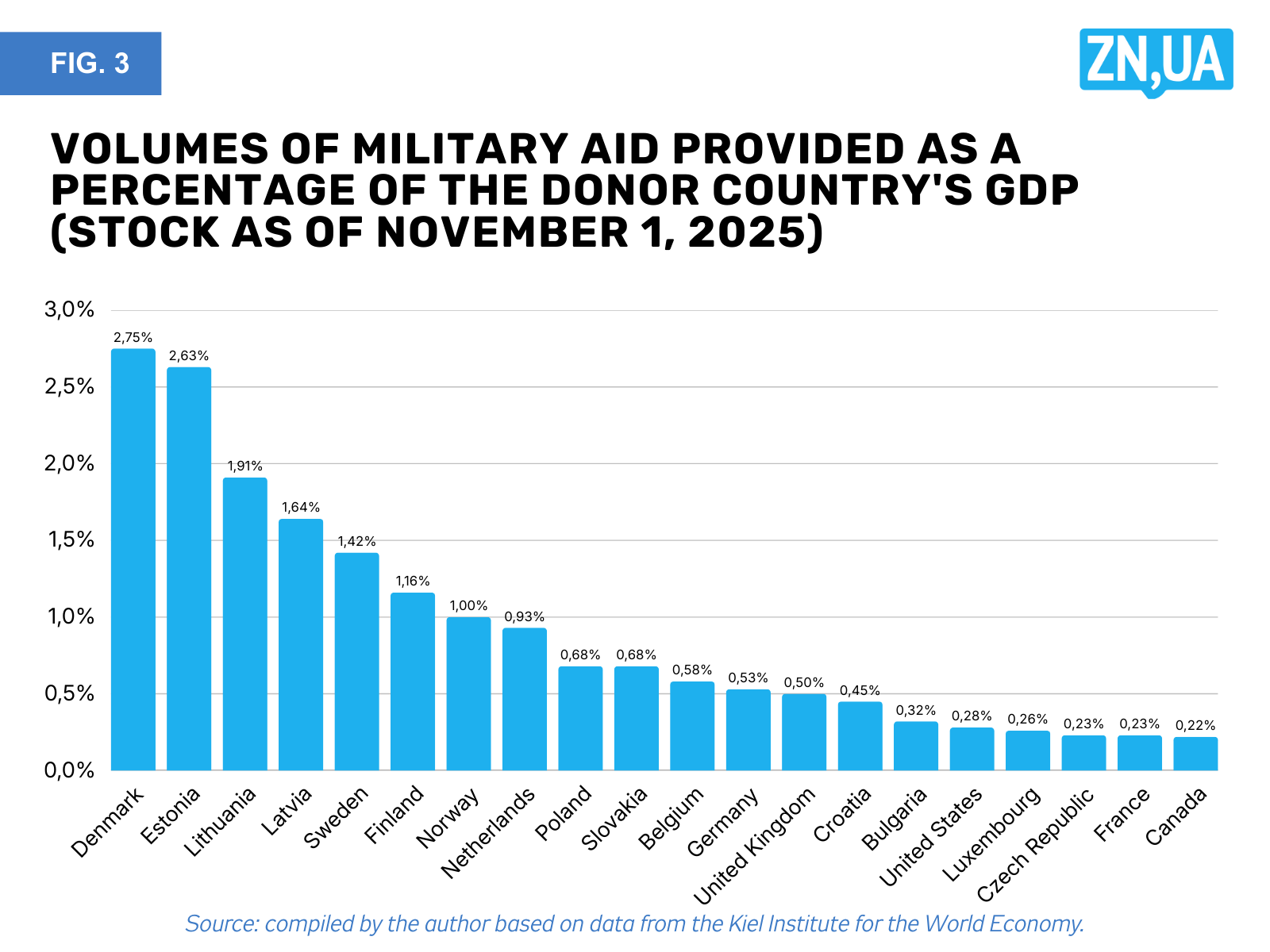
At the lower end of the donor ranking are Hungary, Austria, Switzerland, Malta and Cyprus, which provided no military aid to Ukraine. Minimal assistance to the army came from several “frugal” European governments: Ireland (0.02% of GDP), Spain (0.06%), Greece (0.08%), Italy (0.09%), Slovenia (0.13%), Romania (0.15%), Iceland (0.17%) and Portugal (0.17%).
Bruegel experts interpret these disparities among EU countries as manifestations of a “collective action” problem—a situation in which actors, acting rationally in their own interest, fail to take steps that would benefit the collective as a whole.
They also note that European rearmament plans and military support for Ukraine are heavily influenced by specific domestic factors in member states that neglect the creation of European public goods. Factors such as geographic proximity to Russia and levels of public debt significantly affect the degree of resistance to Russia among EU members.
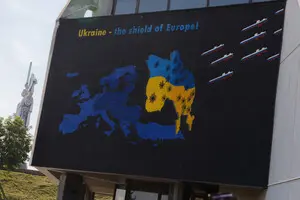
In Bruegel’s metaphor, EU countries closer to Russia choose “guns and butter,” while those farther away primarily choose “butter.” In my view, however, governments that provide no military assistance to Ukraine are effectively making a cynical choice in favor of “butter,” prioritizing domestic consumption over paying for Europe’s security and saving Ukrainian lives.
In assessing current financing of European security and assistance to Ukraine, it is more appropriate to refer not to a “collective action” problem but to a free-rider problem. A free rider benefits from a public good (such as clean air, defense or public transport) while avoiding paying the associated costs, relying on others to do so.
In the context of the problem under study, Ukraine and the leading military donors effectively (mentioned in figures 2 and 3) compensate, through their resources and losses, for the irresponsible behavior of free-riding states.
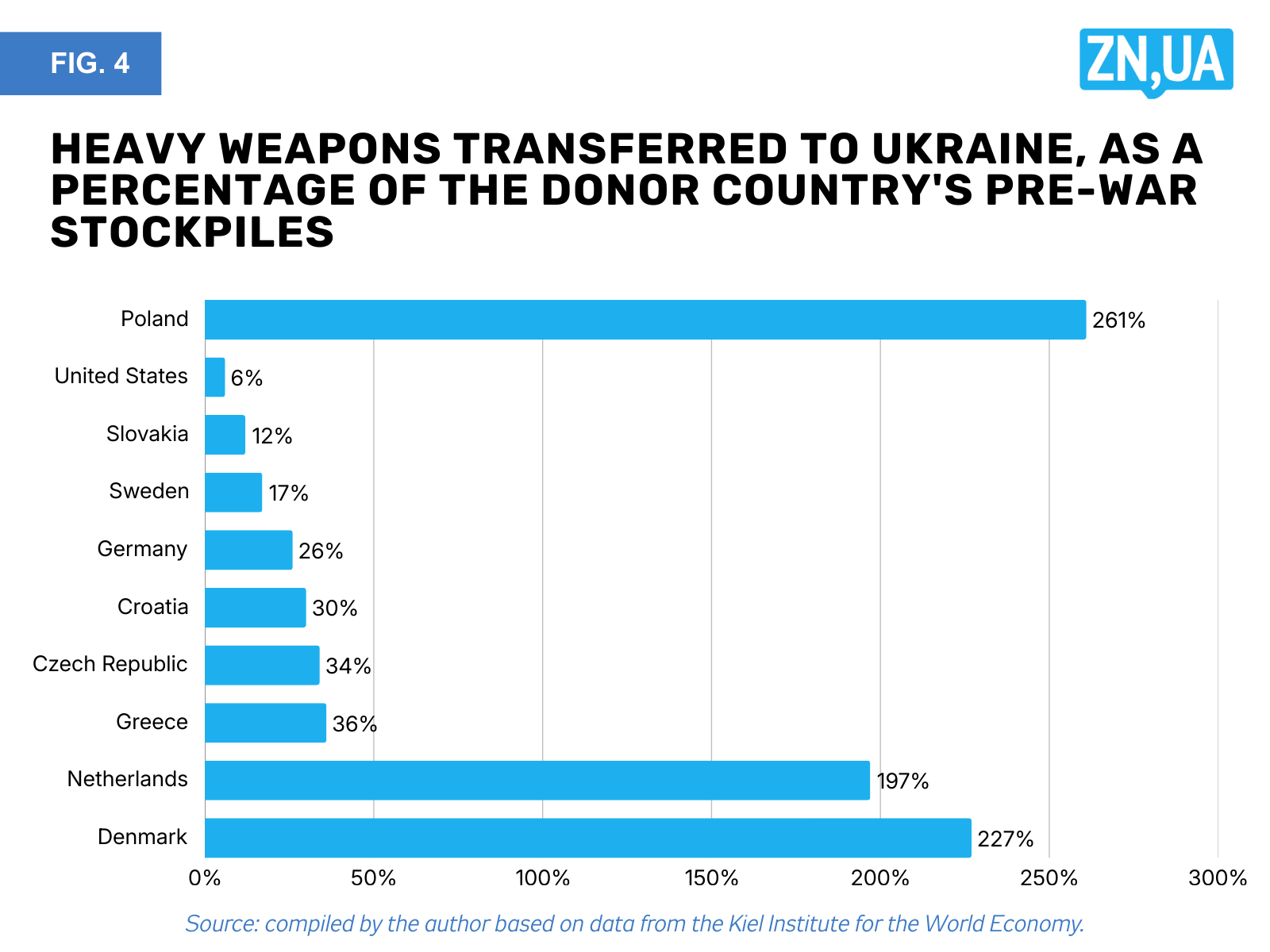
Contributions to European security can also be assessed by the share of heavy weapons stockpiles transferred to Ukraine during the war. Kiel Institute experts found Denmark to be the undisputed leader, having transferred twice as much heavy weaponry as it held in stockpiles in 2021. The Netherlands followed with 197 percent. Greece, Czechia and Croatia transferred roughly one-third of their heavy weapons stockpiles. By contrast, the United States transferred only 6 percent of its pre-war stockpiles (see Figure 4).
Today, the integration of Ukraine’s defense-industrial complex with that of the coalition of the willing is accelerating. Through existing financial mechanisms and technological solutions, this integration enables Ukrainian industry to expand production and improve logistical support for the Defense Forces.
For Europe, the value of military support for Ukraine lies in the creation of a European collective good—security and defense. With the help of Ukraine, Europe effectively gains military sovereignty and long-term deterrence against Russia. From a European perspective, Ukraine’s determined resistance against Russia also buys time for Europe to rearm amid the anticipated withdrawal of US forces and the erosion of traditional US security guarantees within NATO.
Unfortunately, despite these considerations, allied military support for Ukraine remains insufficient in both scale and composition and does not compensate for the loss of US military assistance.
One can only hope that all European countries will properly assess Ukraine’s contribution to Europe’s collective security system and, in the near future, significantly step up military aid to Ukraine while ensuring the continuity of economic support.
Please select it with the mouse and press Ctrl+Enter or Submit a bug
 Follow on Telegram
 Login with Facebook
 Login with Twitter
 Login with Google