
 Support ZN.ua









Financial Monitoring Service: Record Reports, Zero Cases — And Hundreds of Millions Flowing Out of Ukraine
Stability or Stagnation? How Rising Imbalances Threaten the Economy

19 march, 2026, 18:21
Share

The start of 2026 presents an outwardly stable picture: inflation appears under control, international reserves are at a historic high, the foreign exchange market is relatively stable, and the banking system is accumulating deposits. Yet behind this stability another reality is taking shape, one in which the structural imbalances now building up could significantly constrain the country’s economic recovery.
The economy is paying for stability
As of February 2026, the key policy rate of the National Bank of Ukraine stood at 15 percent, only slightly below the 2025 level of 15.5 percent. The gap between inflation and the policy rate amounts to 7.4 percentage points. In effect, this means that monetary policy remains among the tightest in Europe. The result is plain to see: the rate on new loans to the economy is 19.2 percent, while deposit rates are only 9.2 percent. This creates a wide interest spread, generating windfall profits for the banking system but doing nothing to stimulate investment. In practice, the economy is getting expensive credit and cheap deposits, making the financial system geared not towards development but towards preserving liquidity.
The total volume of credit in the economy at the start of 2026 stood at UAH 1.21 trillion, 9.8 percent higher than a year earlier. But the structure of that growth raises serious questions. Corporate lending grew by 5.1 percent, while consumer lending rose by 25.4 percent. In other words, the banking system is increasingly financing consumption rather than production. Compared with the situation before 2014, the picture becomes even more telling: the corporate sector’s share of lending has fallen by 8.2 percentage points, while the share of households has increased by 8.2 percent. In other words, the financial system is gradually losing its investment function.
The clearest indicator of the state of lending is the 5–7–9% program. As of the start of this year, loan agreements totalling UAH 466 billion had been signed, with outstanding debt at UAH 152 billion. This programme accounts for more than 40 percentr of hryvnia-denominated business lending. In effect, almost half of all business lending is taking place thanks to state subsidies, without which this type of lending would be even smaller.
Despite the tight interest-rate policy, the money supply is continuing to grow rapidly. At the start of the current year, the money supply (M3) stood at UAH 3.96 trillion, up 16.1 percent year on year. Cash outside banks rose by 17.1 percent. This creates potential inflationary risks, especially in the conditions of a wartime economy.
Currency stability thanks to reserves
A defining feature of current monetary policy is the National Bank of Ukraine’s near-total control over the foreign exchange market. In effect, the NBU is covering the structural currency deficit by selling foreign exchange from its reserves. Since the start of 2026, the negative balance of interventions has amounted to $7.3 billion. Average foreign currency sales exceed $700 million to $1 billion a week. Without these interventions, the hryvnia exchange rate would be significantly weaker.
Yes, Ukraine’s international reserves stand at $54.7 billion, holding at a historic record high. But the key question is where those reserves come from. Their growth has been driven mainly by international financial assistance, not by a balance-of-payments surplus. In other words, currency stability depends to a considerable extent on external financing.
Controlled devaluation
Since the start of 2026, the hryvnia has depreciated by 3.8 percent against the dollar and by 2.2 percent against the euro. As of March, the dollar exchange rate stood at UAH 43.98, and at UAH 44.17 on the cash market. In practice, the NBU is pursuing a policy of controlled devaluation, gradually adjusting the exchange rate within the regime of managed flexibility.
In February 2026, the foreign exchange market showed declining activity. The volume of non-cash transactions between banks and the NBU amounted to $6.15 billion, 13.9 percent less than in January. In the cash segment, transaction volumes came to $2.75 billion, a decline of 10.2 percent. This points to reduced public demand for foreign currency, which is also helping support market stability.
So what is wrong?
Yet despite this overall stability, the central problem today is the absence of economic growth. Ukraine’s current monetary model makes it possible to preserve macro-financial stability, but it does not create the conditions for rapid economic development.
ВАС ЗАИНТЕРЕСУЕТ

First, the policy rate and lending rates remain too high for an economy that needs investment-led recovery.
Second, the wide interest spread between loans and deposits creates an incentive to seek financial returns instead of lending to the real economy. As a result, business lending is becoming increasingly dependent on state programmes.
Third, the structure of lending is shifting towards consumer credit, while the share of loans to business is gradually shrinking.
Fourth, macro-financial stability is becoming more dependent on international aid. International reserves are being sustained primarily by external financing, not by the structural competitiveness of the economy.
Fifth, current monetary policy is geared towards stability, but it has no clear role in stimulating economic growth.
Ukraine needs to move to a new monetary model that combines hryvnia stability, affordable lending, support for investment and the development of the domestic financial market.
Without that, monetary policy will remain a policy of stability without development.
Strategic steps are needed
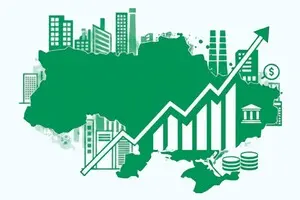
A shift is needed from a policy of rigid stabilization to a policy of economic development. Monetary policy must cease to function solely as an anti-inflationary instrument. Its chief task should be to create financial conditions for economic recovery, investment and the modernization of the economy. That means gradually reducing the real cost of money for production.
Reducing the cost of credit for the real sector. Once inflation and the foreign exchange market have stabilised, the next step should be a gradual reduction in interest rates. This would help activate investment lending, lower the cost of finance for business and accelerate economic recovery. Credit for the economy in wartime and the postwar period cannot remain at 19–20 percent.
Creating a system of long-term investment lending. Ukraine needs mechanisms for long-term money. This requires developing state and mixed development institutions, creating refinancing instruments for investment loans and launching lending programs for infrastructure, energy and industry. Without long-term credit, industrial modernization is impossible.
Developing the domestic financial market. The current model is too dependent on external financing. Ukraine needs to develop its domestic capital market, institutional investors and long-term financing instruments. That would reduce the economy’s dependence on external sources of funding.
A new balance between exchange-rate stability and economic growth. Exchange-rate stability policy must not restrain economic development. Ukraine needs to move to a more flexible exchange-rate policy that supports export competitiveness, reduces the import imbalance and stimulates the development of production.
For development, the country needs a model that combines hryvnia stability with active lending to the economy and investment-led growth. Ukraine today has one of the most paradoxical macro-financial situations in the world: high reserves, a stable exchange rate, but weak economic growth and expensive money for the economy. Current policy is effectively focused on preserving short-term stability, but it is not fulfilling its key function—stimulating development and investment. For a country fighting a war and preparing for large-scale postwar reconstruction, that is not enough. Ukraine needs a new development strategy in which financial stability becomes not an end in itself, but an instrument of economic growth.
Read this article by Bohdan Danylyshyn in russian and Ukrainian.
Noticed an error?
Please select it with the mouse and press Ctrl+Enter or Submit a bug
Stay up to date with the latest developments!
Subscribe to our channel in Telegram
 Follow on Telegram
Пожалуйста выберите один или несколько пунктов (до 3 шт.) которые по Вашему мнению определяет этот комментарий.
Пожалуйста выберите один или больше пунктов
Нецензурная лексика, ругань
Флуд
Нарушение действующего законодательства Украины
Оскорбление участников дискуссии
Реклама
Разжигание розни
Признаки троллинга и провокации
Другая причина
Отмена
Отправить жалобу
ОК
 Login with Facebook
 Login with Twitter
 Login with Google