
 Support ZN.ua








The Price of Return: How Much a Ukrainian Must Earn Not to Leave the Country
 Infographics


Once the hot phase of the war ends and the security situation improves, one of the top priorities for the authorities and society will be to create appropriate conditions for the return of Ukrainian refugees. For a massive and irreversible return of Ukrainians to their homeland, a number of fundamental conditions have to be created, namely the availability of decent wages and a sufficient number of jobs, access to healthcare and administrative services, and new housing for those who have lost their homes. Choosing the right levers of the state’s financial-economic and migration policies will be equally important.
Neoclassical economic theory asserts that wage differentials between countries are the main driver that pushes people to migrate to countries with higher levels of pay. A World Bank study identified the following key pull factors for migrants: prospects of higher wages and improved living standards in the host country, safety and protection, political freedoms, professional development, and freedom from discrimination.

Unfortunately, even before the full-scale war, wage levels in Ukraine were very low (see Figure 1). For instance, the average monthly salary of full-time employees in Ukraine, converted into euros, amounted to €434 in 2021 and €549 in September 2025.
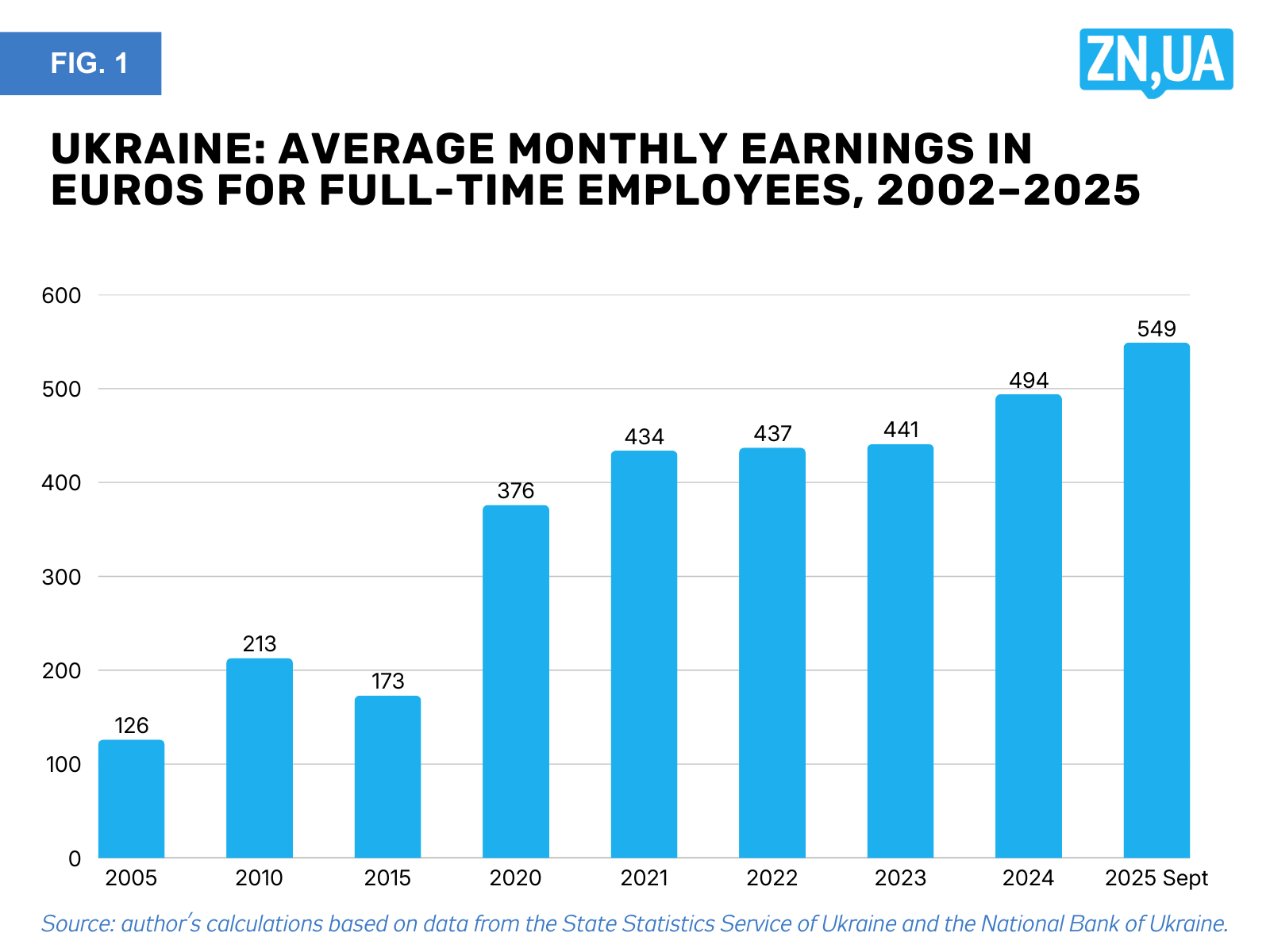
In terms of wages, Ukraine’s labour market cannot compete with those of EU member states. Figure 2 presents the average and minimum monthly wages in euros in EU countries and in Ukraine as of the most recent date. To ensure relevant conclusions, the sample was narrowed to those EU member states that received the largest number of Ukrainian refugees during the war, as well as neighbouring countries that do not exhibit hostile behavior towards Ukraine.
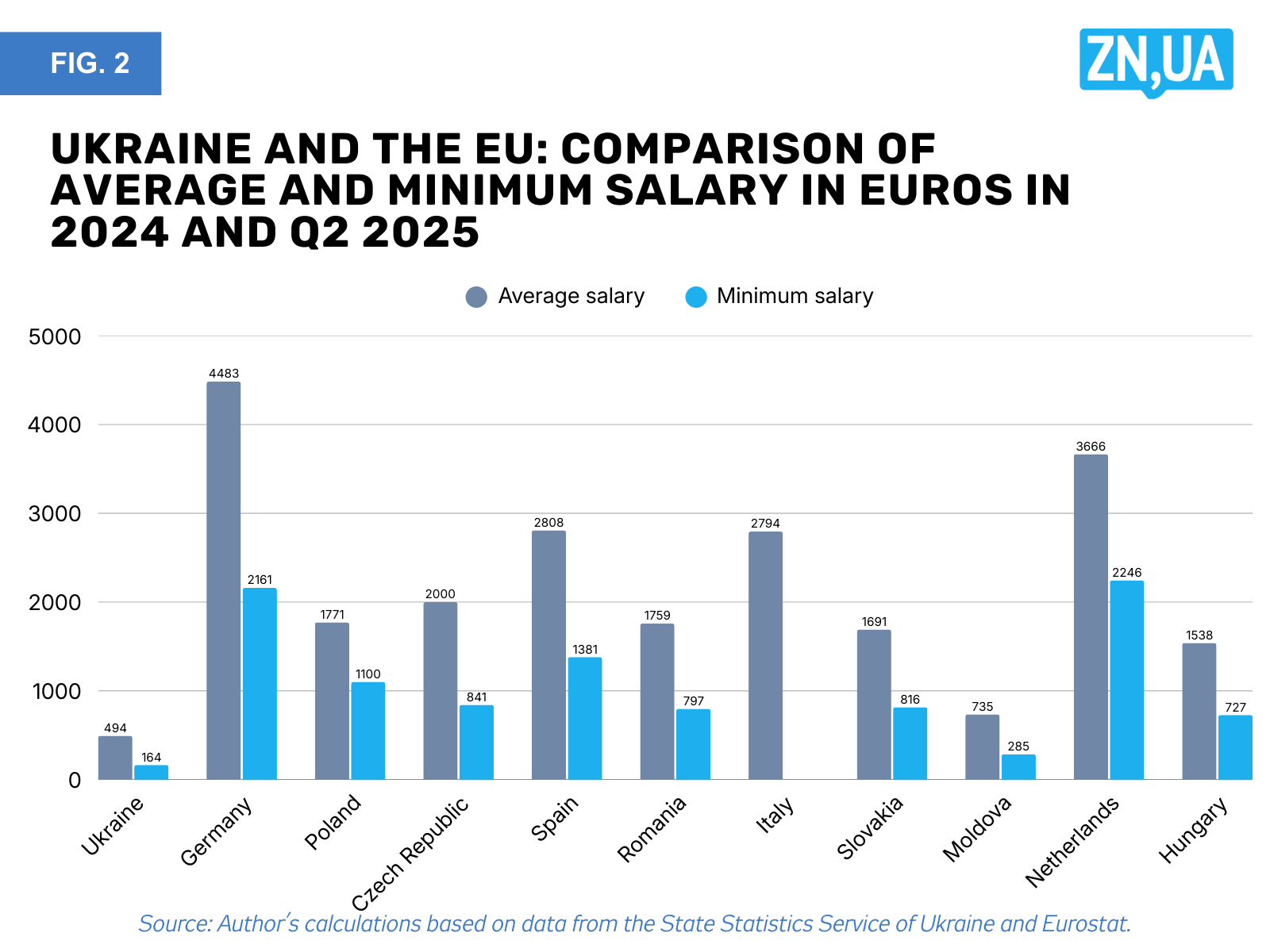
In Ukraine, the average salary (€549) lags severalfold behind both the average and minimum wages in the countries included in the sample. For example, in Poland the average gross salary amounted to €1,771 per month, with the minimum standing at €1,100; in the Czech Republic—€2,000 and €841, respectively. In Germany, the average salary was the highest among the countries studied—€4,483—while the minimum wage amounted to €2,161.

Ukraine’s closest neighbours—Romania, Slovakia, and Hungary—have average wages of €1,540–1,760 and minimum wages in the range of €727–816. Only Moldova, which is not an EU member (but has sheltered a large number of Ukrainian refugees), maintains a minimum wage comparable to Ukraine’s—€285 per month. At the same time, Moldova’s average wage is half as much again as in Ukraine.
Thus, the indicators of average and minimum wages in the new EU member states suggest that the average wage level in Ukraine must reach at least €1,000 per month so that the labour markets of neighbouring countries do not absorb the remaining Ukrainian workforce, and so that Ukrainian refugees have incentives to return home.
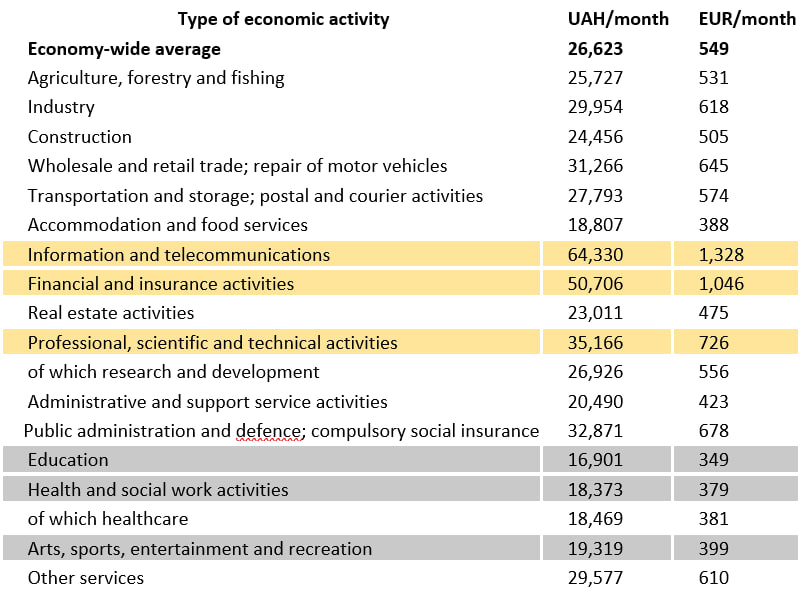
The problem of the dramatic lag of wages in Ukraine compared with neighbouring countries is even more acute for workers in certain sectors of the economy due to the considerable sectoral differentiation of wages in Ukraine. For example, the average salary in Ukraine is desirable but unattainable for many employees in the social and humanitarian sphere. In particular, the average monthly salary of full-time education workers amounts to only €349; the average remuneration is €381in healthcare and €399 in arts, sports, and entertainment (see table).

Ukraine: average salary of full-time employees by type of economic activity in September 2025, in hryvnias and euros
The acuteness of the problems associated with low wages is somewhat mitigated by the fact that most employed persons in Ukraine own their homes, whereas abroad the majority of our citizens live in rented accommodation. To calculate the adjusted average salary in different countries (taking into account housing rental costs), we used data from www.numbeo.com. Data on the rent of a one-room apartment outside the city centre—in the capital of the respective country—were subtracted from the average salary in the corresponding country.

The results indicate that in the Eastern European EU member states the rent of such an apartment ranged from €376 in Bucharest and €546 in Budapest to €792 in Warsaw and €856 in Prague. Madrid (€955) and Amsterdam (€1,730) had the highest rental levels. The resulting data on average salaries adjusted for housing rent in the studied EU countries and Moldova are shown in Figure 3.
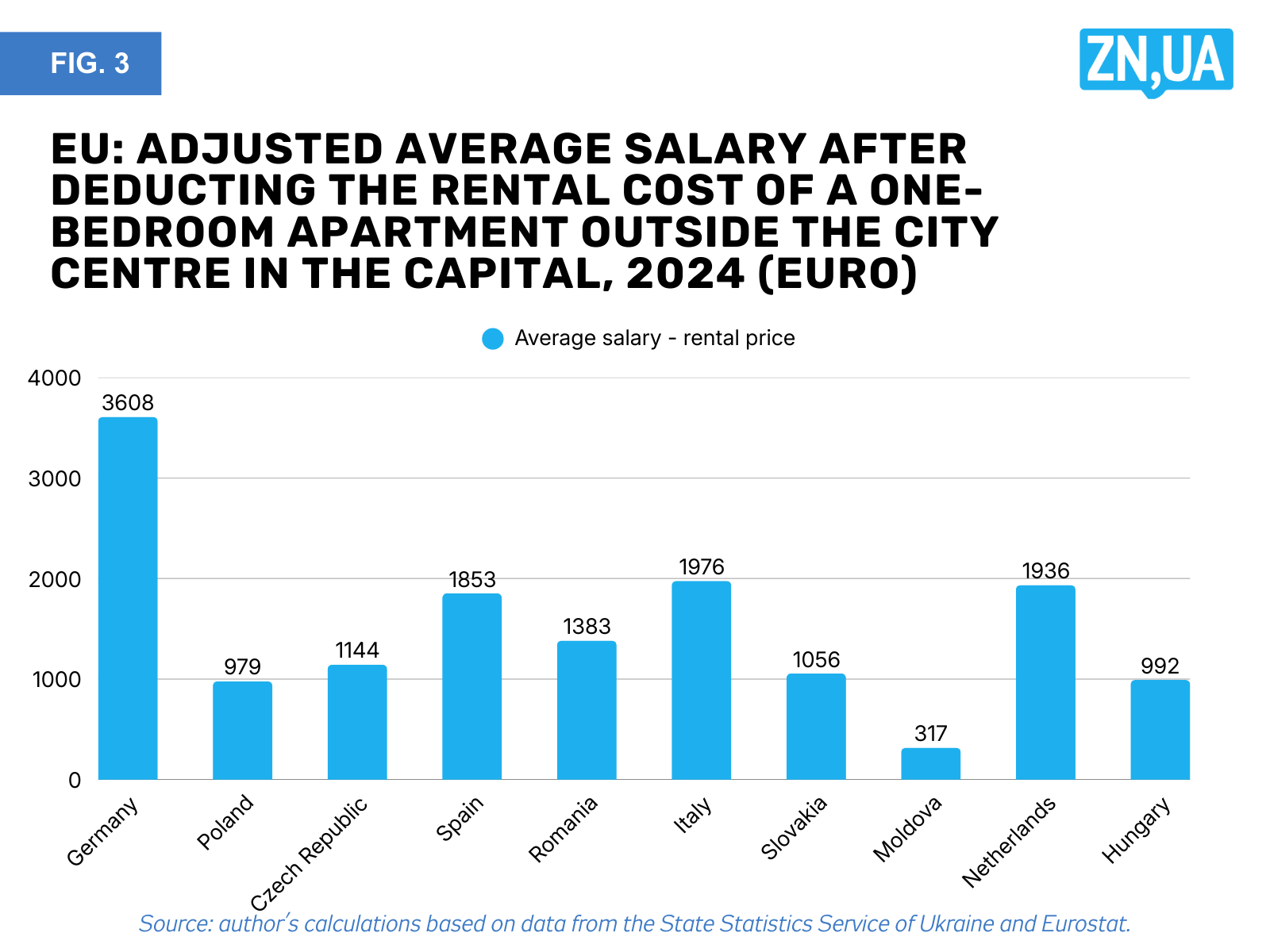
As we can see, in Poland, Hungary, Slovakia and the Czech Republic, the adjusted average salary on the local labour market, after deducting the cost of renting modest housing, decreases to about €1,000. In Romania, the adjusted salary is somewhat higher—€1,400—due to more affordable rent. In Germany, the adjusted average salary is the highest—€3,600. In Spain, Italy and the Netherlands, the adjusted average salary is quite high but notably lower than in Germany—approximately €1,900.
It is obvious that raising the average salary in Ukraine to the identified target level of €1,000 is an extremely difficult task. Its implementation will require systemic measures aimed at increasing the productivity of the national economy and applying redistributive mechanisms such as administratively mandated increases in the minimum wage and the establishment of adequate pay rates in the social and humanitarian sectors.

Economic theory postulates that, in order to ensure sustainable and inclusive economic development, real wage growth must align with increases in labour productivity in the economy.
Unfortunately, at present, the structural problems of the national economy result in low labour productivity in many sectors. Experts of the Vienna Institute for International Economic Studies have shown that in Ukraine’s agriculture sector labour productivity is close to 50 percent of the level in Poland and Romania and to 10 percent of the level in Germany. In the information technology and communications sector, labour productivity in Ukraine reaches 50 percent of the Polish level, 40 percent of the Romanian level and 20 percent of the German level.
However, labour productivity in the sphere of professional and technical services and scientific research in Ukraine fluctuates between 12 and 25 percent of productivity levels in the aforementioned EU countries. And in Ukraine’s manufacturing industry, productivity barely reaches 20 percent of the level in Romania and Poland and only 10% of the level in Germany.

To increase labour productivity, our state must, first and foremost, create favourable conditions for attracting foreign direct investment (FDI) into the real sector of the economy and invest significant resources in modern education. Labour productivity should also grow through the expansion of digitalisation and automation across different sectors of the economy, as well as the modernisation of transport, energy and communications infrastructure.
Improving conditions for FDI implies the establishment of a well-functioning legal system, industrial parks, export processing zones, appropriate infrastructure and training, and a stimulatory labour market policy. All this will support the qualitative renewal of the country’s productive forces, the integration of enterprises into European value chains, and the improvement of employment prospects for skilled labour.
An increase in labour productivity in the economy and the resulting rise in wage levels in Ukraine would become a fundamental pull factor for working-age Ukrainian refugees who currently have low-paid jobs in their host countries or are not employed at all.

In practical terms, creating appropriate conditions for the mass return of Ukrainian refugees also entails:
- providing them with consultations on the possibilities of purchasing or receiving subsidised housing and on the availability of temporary accommodation;
• facilitating employment in the local economy and the implementation of an active government-led labour market policy;
• increasing the accessibility of employment services in Ukraine from abroad, improving digital job-search platforms and developing online services for repatriates;
• providing educational services and vocational training for returning individuals, and organising training programmes on managing one’s own business;
• ensuring access to microcredits for starting a business and providing legal support;
• conducting public works aimed at restoring infrastructure, with the possibility of temporary employment for repatriates and decent remuneration for their labour.
The success of programmes aimed at returning Ukrainian refugees to their homeland and their successful reintegration into the local economy will not only address the critical problem of Ukraine’s labour shortages for post-war recovery and reconstruction but will also very likely generate positive qualitative changes.

International experience shows that refugees who return after a war usually make a significant contribution to the development of the national economy. The main mechanisms of influence are innovations and technological knowledge acquired abroad, production skills and new competencies, networks of social ties and contacts with the diaspora, accumulated savings and investment in the local economy.
OECD experts have noted that, upon returning to their homeland, professionals with new technological, scientific, managerial and marketing knowledge and skills create new companies, transfer the acquired skills, and generally improve the nation’s human capital.
Implementation of the outlined initiatives in the sphere of wage policy and migration policy must, of course, be preceded by the end of the acute phase of the war, the restoration of Ukrainians’ trust in the actions of central and local authorities, and the return of confidence in the effectiveness of government actions and its ability to overcome challenges of an existential nature.
Please select it with the mouse and press Ctrl+Enter or Submit a bug
 Follow on Telegram
 Login with Facebook
 Login with Twitter
 Login with Google