
 Support ZN.ua








Budget 2026: Pros and Pitfalls
 Infographics

The Verkhovna Rada is preparing to consider the 2026 draft state budget in its second reading. The document prioritizes funding for the country’s armed resistance against the aggressor, while also introducing new social, healthcare and education programs. At the same time, it reduces the real value of social security spending, increases allocations for public administration and debt servicing without clear justification, scales back the investment component, and introduces more advanced approaches to managing public investments.
In the draft budget, consolidated budget revenues are projected at UAH 3.5 trillion, or 34% of GDP. At first glance, this seems to indicate a decrease in revenues compared with 2024 and 2025. However, the main components of this decline are foreign grants (a fall from UAH 88.7 billion in 2025 to UAH 43.2 billion in 2026) and the own revenues of budgetary institutions (from UAH 669.2 billion to UAH 88.4 billion). Excluding these two components, the adjusted volume of forecasted revenues for 2026 amounts to 32.7% of GDP, which even exceeds their levels in 2024 and 2025 (see Figure 1).

The 2026 state budget deficit is projected at 18.4% of GDP, which is lower than the 2025 planned deficit (21.1%) and slightly higher than the actual 2024 deficit (17.6%). The high cost of domestic borrowing forces the government to meet its financing needs mainly through external creditors. Gross external borrowings are expected to reach 20.6% of GDP, compared to 4.1% for domestic borrowings. At the same time, net financing from the domestic market will be negative: UAH 105 billion more will be spent on redeeming domestic government bonds than will be raised from their placement.

Consolidated budget expenditures in 2026 are forecast at 58.3% of GDP, below the 2025 plan (63%) and the 2024 actual execution (64.6%). Of the 2026 planned expenditures, 57% are allocated to defense, security and law enforcement. Expenditures excluding these functions— 25.1% of GDP—will almost match the 2024–2025 levels (Figure 1). This means that spending on socio-economic programs, relative to GDP, will remain stable throughout 2024–2026.
Figure 2 shows the trajectory of consolidated budget outlays by government function. The largest component—defense spending—was financed at about 30% of GDP in 2024–2025, with a planned decrease to 26.2% of GDP in 2026. However, if warfighting continues until the end of 2026, amendments to increase defense expenditures should be expected, as has already occurred in 2023–2025. Spending on public order and security is planned to decline from 8.7% of GDP in 2024 to 7% in 2026, although this figure may also be revised.
.png)
Expenditures on economic activity in 2025–2026 are expected to remain around 3.3% of GDP, although they were higher in 2023 and 2024. Within these totals, 0.6–0.8% of GDP will go to road infrastructure. According to the Ministry of Finance, the 2026 budget provides UAH 50.5 billion to support and develop the economy, including UAH 18 billion to compensate interest-rate differentials under the “Affordable Loans 5–7–9” program, UAH 15.8 billion for the “eOselya” mortgage initiative, UAH 4.9 billion for grants to small businesses, investment nannies and industrial parks, and UAH 1.9 billion as a contribution to the US–Ukraine Reconstruction and Investment Fund.
Budgetary expenditures on human capital development will decrease, compounding the introduction of new programs in education, healthcare and social protection. Social security and welfare expenditures are projected to fall, in relative terms, from 6.8% of GDP in 2024 and 5.7% in 2025 to 5.3% in 2026. Healthcare expenditures will remain stable at 3–3.1% of GDP, while education spending is forecast to rise slightly from 4.5% of GDP in 2024–2025 to 4.8% in 2026.
A key innovation of the draft budget is the planned 50% indexation (from September 2026) of school teachers’ salaries, which will require UAH 41.8 billion in additional allocations. The budget also provides UAH 5.1 billion to raise the pay of primary- and emergency-care physicians. Furthermore, UAH 14.4 billion is allocated for free school meals, and UAH 10 billion for a nationwide health-screening program.

To increase the birth rate, the government intends to allocate UAH 24.5 billion for “demography development measures.” Specifically, these include:
- an increase in maternity benefits for uninsured women (+ UAH 1.1 billion in expenditures);
- a rise in the one-time childbirth payment to UAH 50,000 (+ UAH 6.8 billion);
- a higher child-care benefit of UAH 7,000 per month (+ UAH 6.5 billion);
- the launch of the “eYasla” program for child care from age one to three (+ UAH 8.9 billion);
- and the introduction of a one-time payment to first-graders under the “School Starter Pack” program (+ UAH 1.2 billion).
Budgetary and donor expenditures to support internally displaced persons (IDPs) and citizens whose homes were damaged are estimated at UAH 71.8 billion. This includes UAH 39.6 billion for IDP living allowance, UAH 14 billion for housing for IDPs from occupied territories, UAH 4.4 billion to cover the down payment for IDPs under the “eOselya” program, UAH 4 billion for compensation of damaged or destroyed housing under the “eVidnovlennia” initiative, UAH 2.5 billion for the HOME housing compensation program and UAH 2 billion for social services to IDPs facing hardship.
Support for war veterans is positioned as an important priority of social policy, although the budgeted amounts for relevant programs are relatively modest. Specifically, it is planned to allocate:
- UAH 5.7 billion for housing for war veterans with group I–II disabilities;
- UAH 3.6 billion for assistance programs for veterans, their families and the families of the fallen;
- UAH 2.9 billion for financing the work of specialists assisting veterans and demobilized persons;
- UAH 1.1 billion for establishing veteran support spaces;
- UAH 1 billion for dental services for veterans.
Budget expenditures on debt servicing in 2025–2026 are planned at around 5% of GDP, whereas in 2021 they amounted to 2.9%. In the first year of the war, external creditors agreed to postpone interest payments on external debt, which reduced total interest outlays in 2022–2026.
The budget bill provides UAH 323 billion for servicing domestic debt. The sharp increase in public debt during the war and the high interest rates in the domestic market are the main reasons for such large payments. Elevated domestic rates are an inevitable result of the National Bank’s chronically tight monetary policy and its placement of high-yield deposit certificates among banks. According to Ministry of Finance estimates, the average weighted interest rate for domestic debt instruments in 2026 will be 17.1% per annum, while for external debt instruments it will be 5%.
Unproductive expenditures of state funds on excessive interest payments for domestic government bonds and NBU deposit certificates narrow the fiscal space available for financing defense and socio-humanitarian spending. The insufficient scale of such expenditures, in turn, weakens the results of military and defense operations, increases human losses and undermines the foundations of the country’s economic resilience.
A problematic aspect of the draft budget is the increase in spending on public administration, reaching 2% of GDP in 2026—the highest level in recent years. Traditionally, this category was financed at 1.7–1.8% of GDP. During the protracted war, the financial appetites of civilian administrative structures have become excessive. This is reflected both in the size of their budget requests and in salary indicators: in August 2025, the average salary of civil servants was UAH 61,600, compared with UAH 25,900 for the economy as a whole.
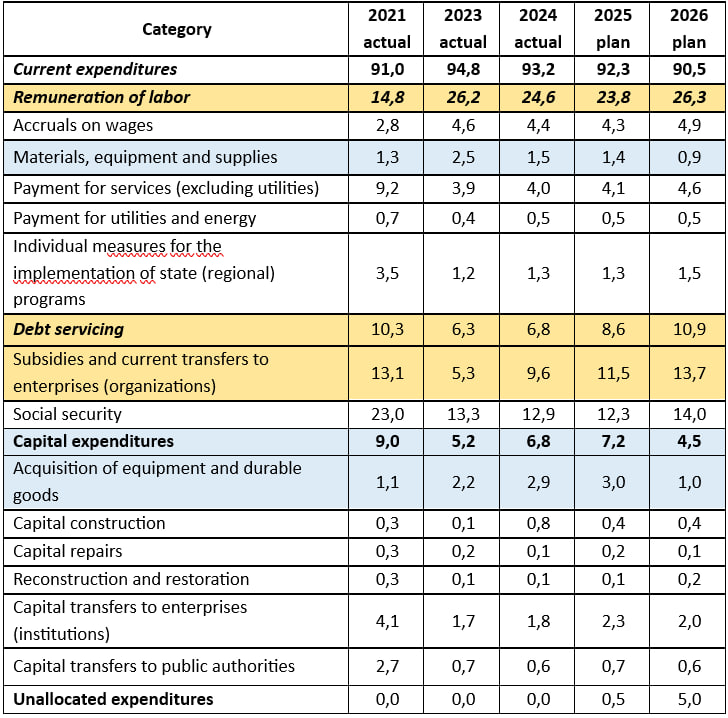
An analysis of the structure of budget expenditures by economic category reveals another alarming trend: the shrinking of the investment component. Capital expenditures of the state budget will almost halve, from 4% of GDP in 2024–2025 to 2.1% in 2026. The share of capital expenditures in total expenditures will fall from 7% in 2024–2025 to 4.5% in 2026 (see Table). The decline in this share will be accompanied by increases in spending on wages (from 23.8% in 2025 to 26.3% in 2026), on debt servicing (from 8.6 to 10.9%) and on subsidies to enterprises (from 11.5 to 13.7%).
Structure of State Budget Expenditures by Economic Classification, % of total expenditures
The draft budget includes UAH 109.3 billion in funding for 66 public investment projects across 11 sectors. Of this total, UAH 45.9 billion will come from the general fund. The main investment areas will be:
- energy – UAH 34.8 billion;
- transport – UAH 23.3 billion;
- healthcare – UAH 18.6 billion;
- education and science – UAH 15 billion;
- municipal infrastructure and services – UAH 8.8 billion;
- social sector – UAH 5.7 billion.
The share of capital expenditures in the state budget is expected to fall to 4.5% in 2026. It is therefore worth recalling the IMF’s conclusions presented in the October Fiscal Monitor: during 2010–2022, the average share of public investment in total expenditures was 11% in advanced economies, 20% in emerging markets and 32% in low-income countries.
Of course, the realities of a wartime economy shape a peculiar structure of budget expenditures in Ukraine. Yet, if we sum the shares of capital and unallocated expenditures—most of which will go toward weapons procurement—their combined share reaches 9.5%, still below the average investment share across all country groups.

Globally, public investment is regarded as a powerful driver of economic growth and productivity. IMF experts identify the following main channels through which public investment exerts its influence:
- accumulating physical (capital and infrastructure) and human capital;
- generating new knowledge and innovation through research by public institutions;
- creating conditions and incentives for entrepreneurs to engage in innovation, expand production capacity, and raise productivity.
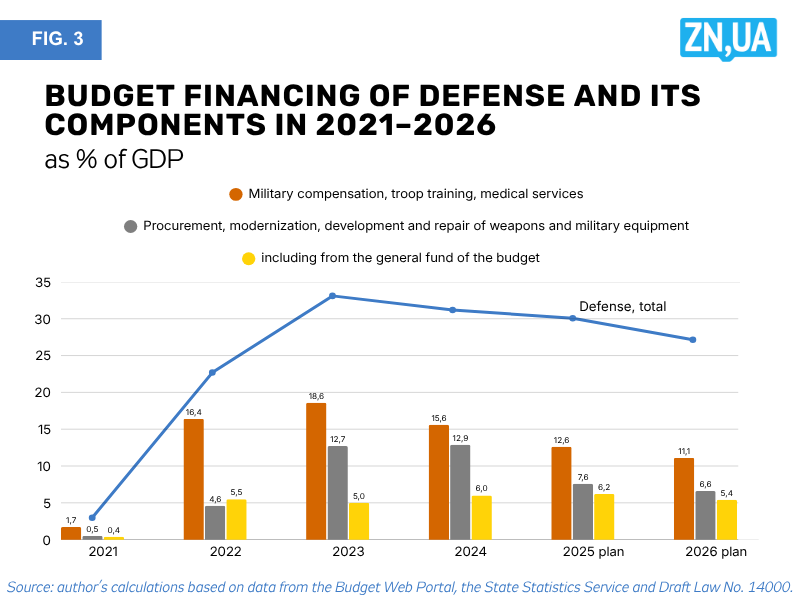
In Ukraine, within the defense spending envelope (UAH 2.7 trillion, or 26.2% of GDP in 2026), financing for the development, procurement and repair of weapons and military equipment will account for UAH 678 billion, or 6.6% of GDP. For comparison: in 2024 this program was financed at 12.9% of GDP, and in 2025 at 7.6% (see Figure 3). It is not excluded that this amount will be increased during budget execution. Nevertheless, the planned spending for weapons procurement, repair and modernization currently appears insufficient.
Logistics support for the Armed Forces of Ukraine has been inadequate throughout the entire period of the large-scale war and does not match the scale of the armed struggle against the aggressor. It is well known that the front still lacks many means of striking the enemy and protecting personnel, while Ukrainian defense industry enterprises operate at only one-third of their capacity. This remains a key reason for casualties among the Defense Forces and for the creeping occupation of Ukrainian territory by the aggressor.

On the other hand, it is worth noting the increase to UAH 5 billion in appropriations for the Innovation Development Fund and the allocation of UAH 2.4 billion for the development of special defense technologies. These resources will support the Brave1 grant program for introducing new defense technologies, testing robotic and unmanned systems and purchasing equipment for experimentation and research.
During further refinement of the budget bill and its preparation for the second reading, non-priority and low-efficiency expenditures should be cut as much as possible, spending on public administration and domestic debt servicing should be reduced, and the long list of new social programs should be reviewed in light of the realities of a war of attrition. At the same time, components of material and technical support for the Armed Forces and public investment in reconstruction should be increased.
Read this article in Ukrainian and Russian.
Please select it with the mouse and press Ctrl+Enter or Submit a bug
 Follow on Telegram
 Login with Facebook
 Login with Twitter
 Login with Google