
 Support ZN.ua








After Russian Shelling: Morning Reflections

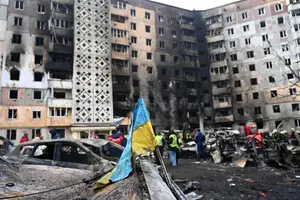
Last night, peaceful Ukrainian cities once again shuddered from explosions as nearly 50 missiles and 480 drones invaded airspace across the country. Twenty-five people were killed in Ternopil, including children. It was not the first such night for our country, but no less horrifying for that. And yet every morning after a night of terror, of strikes and direct hits, of tears and alarms, each Ukrainian city is reborn anew. Not as the grand Phoenix—an overly lofty metaphor that immediately comes to mind—but as an ant colony, where each and every one has a task: to defend, to clear rubble, to feed, to search, to teach, to comfort with a kind word, to help… And so you walk through your hometown on your way to work. There is a faint smell in the air—perhaps the gunpowder from air-defence interceptions, perhaps the smouldering of extinguished fires in high-rises—and you think. You think about where the limits of human endurance lie. And what, in fact, the ultimate purpose of Russia’s night-time terror is. Of these base, merciless strikes. After all, everyone understands that shelling the rear does not change the situation at the front, nor the line that official reports call “the line of contact.”
The answer seems obvious, and Russians hardly hide it: to destroy Ukraine’s energy system, to weaken the state economically by forcing resources toward repairs and compensation and to exhaust Ukrainian society psychologically. The latter is, in fact, something analysts often overlook when explaining Russia’s crimes against civilians. And this is not only about the impossibility of sleeping or resting at night—a biological necessity for clear thinking and daily functioning. What Russia wants is for us to break down internally: to cry, to hide in basements like burrows, to sit in cold and darkness and beg for “any end to the war.” From time to time, in transport or in shops, you overhear those insidious phrases: “Maybe we should negotiate,” “How long can this go on,” “Let’s just agree to what they want.” One should not assume these words come only from defeatists or enemy agents. Ordinary people, who know little of history, may also believe that if you give the aggressor a finger, he will spare the hand—or the whole body. Here one can simply recall the legendary words of Golda Meir, a native of Kyiv and later a founder of the State of Israel: “You cannot negotiate peace with those who come to kill you.”

To truly understand Russia’s tactics, we need only remember how it treated civilians in peacetime in the period we now call the Great Terror. In 1937–1938, psychological pressure, physical torture and brutal punishment were routine tools of interrogators working with the arrested or suspected. Ivan Bahrianyi’s well-known novel The Garden of Gethsemane describes in vivid detail the daily methods of breaking people and the Jesuit mockery of those who tried to preserve their dignity. And although Bahrianyi’s novel is autobiographical, it is still literature. So it is worth recalling the testimonies of those who survived the darkness of the Soviet-Russian repressive machine. Journalist and public figure Mykola Prykhodko (1907–?), who managed to emigrate to Canada after the Second World War, left striking testimony about his time in Lukianivka prison in Kyiv and the interrogations he endured in the building of the People's Commissariat for Internal Affairs (NKVD, Soviet internal ministry and secret police) on Rosa Luxemburg Street (today 16 Lypska Street). Recalling his cellmates—peasants, students, respected professors, railway workers and city drunks—he wrote in At the Crossroads of Death that the entire system was designed to break a person morally and physically and make the interrogator’s “work” easier. Beatings with chair legs or boards studded with nails, hours of forced standing, fingers slammed in doors, staged executions—this was far from the full arsenal of NKVD “persuasion.” Sounds familiar, doesn’t it? Recall the stories of our prisoners of war—nothing has changed. The misanthropic essence of the Russian empire is the same no matter what colours its flag happens to have. As Prykhodko wrote, “It often happened that after interrogation, the prison orderlies dragged a person by the arms or legs down the corridor and threw them into the cell like a sack. Sometimes people were taken to interrogation without a break for many days. From beatings and sleeplessness they reached a state of dull madness. In the end, broken, signed whatever the interrogator invented.” Those signatures filled the mass graves from Bykivnia in Kyiv to Rutchenkove Field in Donetsk and Demianiv Laz in Ivano-Frankivsk, where tens of thousands of Ukrainians are buried.
The name Zinaida Tulub (1890–1964) is familiar to anyone who follows Ukrainian historical fiction. Her best-known work, the dilogy People-Catchers, vividly depicts the struggle of Ukrainians under Hetman Petro Sahaidachnyi in the 17th century. Yet only those who study our literary history know of her exile to Kolyma in Russian Far East. Without recounting every detail of her case, it is enough to say that NKVD officer Lt. Khvat extracted a confession from her, claiming she belonged to a “counter-revolutionary organisation”—the absurdly named “Electoral Centre”—which supposedly carried out subversive activities ahead of the upcoming elections to the Soviets. The absurdity was that under the 1936 USSR Constitution, all citizens were guaranteed universal, equal and direct voting rights; no one could forbid her to run for office, even with opposition views. Reality, of course, proved otherwise. Zinaida Tulub received ten years in the Gulag. In a 1954 letter to Kliment Voroshilov, Chairman of the Presidium of the Supreme Soviet of the USSR, she asked for rehabilitation and explained what drove her to falsely incriminate herself: the shock of her first interrogation, during which the investigator cursed, threatened to rot her in a cellar and kept her awake and without food for two or three days. Exhaustion, despair and thoughts of suicide followed. “Death began to seem to me the only salvation from this horror,” she later recalled. After a week without sleep or rest, she signed the accusation—and lost, for many years, everything she cherished: her beloved work, her friends and the possibility of writing the novel about Giordano Bruno she had long dreamed of.
I recount these stories not to frighten the reader but to remind us what kind of darkness Ukraine managed to escape by gaining independence. That darkness did not disappear. It became the foundation of today’s Russian political system and the ideology of the aggressor state. In their world, there is no law, no respect for others’ views, no value in human life. They want to break our inner resistance and psychological resilience the same way they broke people when they ruled our land. That is why they try to deprive us of heat and light, sleep and a sense of safety in our relatively peaceful cities. We can, and must, oppose them with our Ukrainian stubbornness, determination and unrelenting desire to preserve our freedom above all else. Because we remember all too well the terrible price we paid when trapped inside the Soviet version of the Russian empire. So let us hold the line.
Please select it with the mouse and press Ctrl+Enter or Submit a bug
 Follow on Telegram
 Login with Facebook
 Login with Twitter
 Login with Google