
 Support ZN.ua








Mindichgate: How Society Will React — Protests, Power Struggles and Plunging Ratings

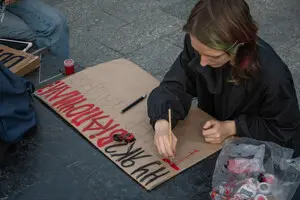

The publication of NABU’s Operation Midas investigation on corruption in the energy sector, coupled with grim news from the front and cold, powerless homes, first shocked Ukrainians and then left them in despair and hopelessness. And this is but a small part (20%) of the operational evidence base exposing corruption schemes and their participants, including in the defence sector, healthcare and so forth.
ZN.UA already knew and reported that the war had not stopped theft and corruption schemes, whether small or large, at all levels; on the contrary, we have published 17 articles on corruption in the energy sector alone. Society seemingly suspected this as well. But knowing “in general” is one thing, and seeing the cynical details in published materials is quite another.
“This is the end. All is lost. A political crisis will weaken Ukraine even more. The West will not provide money, the front will collapse. What is the point then?” Such reactions could be heard in the first days. Later, they began to shift toward anger and the eternal question, “What is to be done?”
MP Zalizniak spoke of three sociological surveys already recording a collapse in President Zelenskyy’s approval rating. According to ZN.UA, even before Mindichgate, 23–24 percent of those intending to vote in future elections planned to vote for Zelenskyy. Therefore, a decline of the president’s rating below 20 percent is not a collapse, but it is a clear trend.
How, and on what terms, is it possible to continue moving forward with a government whose credibility has been utterly undermined? An expectation hangs in the air: something must happen.
“What, in your opinion, will be the impact of Operation Midas and the information campaign around it on Ukrainian society?”—this is the question ZN.UA posed to Ukrainian sociologists and psychologists. Below are their responses.
Svitlana Chunikhina, Deputy Director of the Institute of Social and Political Psychology of the National Academy of Educational Sciences of Ukraine: “I do not expect any significant destabilisation of society caused specifically by corruption scandals. Here are several arguments.

First, according to research data, a sharp shift in attitudes toward the authorities occurred in 2024. It was then that Ukrainians finally became convinced of corruption in Zelenskyy’s team. The current scandal merely added details to a picture that had already been evident to the majority—that the country’s leaders act without integrity in matters related to finances.
Second, the state and the nation, in their current form, are far broader than the political regime. The fact that Ukraine is governed by unprofessional and dishonest politicians or officials does not signal a collapse of statehood and does not lead to societal breakdown—because Ukraine is not reducible to five or six of Zelenskyy’s managers. Even though Russian propaganda portrays the situation precisely in this way.
Third, research shows that Ukrainians are still ready to resist Russian aggression and, at the same time, do not impose on themselves a complete self-ban on criticising the authorities or taking to the streets. Society seems to have a shared sense of the boundary beyond which the legitimate right to protest may become dangerous to state resilience. Skills of societal self-regulation manifest themselves here as well.
Fourth, truly important and critical events today are taking place at the front. As long as the front holds, citizens will largely avoid excessive radicalisation. But if the situation at the front gets out of control, grievances against the authorities will grow like an avalanche. The problem with corruption is precisely that it undermines the state’s defence capability and significantly increases the likelihood that the war may turn into a catastrophe for Ukraine.”
Andrii Bychenko, Director of the Sociological Service of the Razumkov Centre:
“One can say with considerable confidence that the overwhelming majority of Ukrainians reacted negatively to the figures implicated in the scandal. However, predicting its consequences for Ukrainian society is difficult.
.png "Andrii Bychenko")
For now, its impact is likely minimal. Despite the resonance of the case, it fully aligns with the prevailing public perception of the authorities. Today, on the one hand, citizens typically show a very positive attitude and high trust toward Ukraine’s defence institutions and a negative attitude and low trust toward other state institutions and civil servants in general, on the other. A significant portion of society considers this part of the state apparatus prone to corruption. Therefore, the new corruption scandal merely added some details but did not change the public’s overall view of the authorities.
As for the further developments and their impact on Ukrainian society, predicting it is extremely difficult, as it depends on many currently unpredictable factors. The main ones are:
- The information gathered by NABU and the materials that will be published. Here, what matters is not only the information itself but also how well the accusations are substantiated — both in fact and in the eyes of the public.. Another important factor is the low level of trust in anticorruption bodies. At least, until Operation Midas, the overwhelming majority of Ukrainians did not trust NABU or SAPO.
- The authorities’ response, both in action and in public statements.
- The reaction of Western partners, both in action and in public statements.
- The impact on Ukrainian society of other factors, primarily those related to the war, the economy and energy supply.
- The effectiveness of attempts by Russian intelligence services, which will use the situation to divide Ukrainian society.
But it is impossible to predict how all these factors will unfold; therefore, it is impossible to forecast the course of events. One can only guess—or fail to guess.”
Serhii Dembitskyi, Deputy Director of the Institute of Sociology of the National Academy of Sciences of Ukraine: “According to research by the Institute of Sociology of the National Academy of Sciences of Ukraine, Ukrainian society returned to a prevailing state of socio-political negativism already last year (it had previously been recorded in 2021). Our society remains in this state today.

In this context, the NABU ‘tapes’ should not significantly change overall public sentiment; it is already quite difficult to worsen it further. But in the field of public opinion, some aspects have proven resistant to socio-political negativism under wartime conditions.
One of these aspects is the assessment of Volodymyr Zelenskyy’s performance as President of Ukraine. Of course, it is no longer as high as in 2022 or 2023, yet it still shows that a significant share of Ukraine’s population supports the incumbent president. The ‘NABU leak’ can be compared to a foothold for an attack on the political authority of the government. The key question is how this foothold will be used—for a full-scale offensive aimed at destroying legitimacy or merely as a lever of pressure in negotiations intended to outline the future political landscape.
In forecasting further developments, the factor of political alternatives must be taken into account. Ukrainian political culture is traditionally person-centred. And as long as normal political life remains ‘on pause’ and no one openly declares an intention to run for the presidency, Volodymyr Zelenskyy will remain a mental anchor not only for his electoral base but also for several other social groups.”
Oleh Pokalchuk, social psychologist: “Society’s mood will deteriorate once again. That will be the extent of the impact. Society has no instruments of influence. Some number of young people will gain motivation, and this will affect their worldview. Unfortunately, there are few young people. And there will be even fewer.

Maidans and protests are not the instruments. They are expressions of sentiment. All previous Maidans had specific beneficiaries. And these beneficiaries were certainly not society. Society gained a feeling of justice. Someone else gained new positions and new corruption opportunities.
Public gatherings will not eliminate the phenomenon. It cannot disappear in principle. Corruption is the result of the long-term erosion of our socialist system. We have the Ukrainian Soviet Socialist Republic. It’s Soviet because our Verkhovna Rada (Supreme Soviet) is supreme. Ukrainian is self-explanatory. And it’s socialist because all the institutions and the system of relations between them have survived without significant changes.
Kyiv-centric thinking suggests: all the horror is on the Pechersk Hills. But somewhere in a district town the same thing is happening, even if on a smaller scale.
Impeachment. Such an instrument does not exist. The question was thoroughly examined back during the ‘Ukraine without Kuchma’ campaign by very interested and competent people.
For decades, I have heard the wishful fantasies of radical regime change, coups and all the rest.
Here we must look at the wartime economy, which rests on Western money provided by countries that recognise our authorities as legitimate because they were elected. And this is the legal basis for dealing with us because the president, the parliament and other officials were elected lawfully.
The only effective example in modern history is the Chilean junta, owing to an exceptional coincidence of circumstances and against the backdrop of dozens of unsuccessful attempts. Military coups are always temporary. And after a coup occurs, no one will deal with the country. The very next day, Europe and America will stop giving us money with relief. That is the main problem. Technically, a coup is not a problem. The problem is what happens afterward. In the event of such a change of power, Ukraine would have to spend roughly three years in economic and political isolation. Only after that, if we survive, will others begin to talk to us again, little by little.
Some kind of ‘palace coups’ are more likely. They preserve the appearance of legitimacy.
But the system of checks and balances in a corrupt society is actually much stronger than we imagine. Organised crime takes great care of its security. Forceful actions occur when people cannot reach an agreement. What we are seeing now is not even force; it is demonstration. It is sending messages to those who understand what these messages mean. And for society, this is simply a new season of a thirty-year-long series.
The only possibility for change is elections. In this respect, shifts in public sentiment indeed influence political processes and institutions. But there are no elections—and none are expected.
For us, first comes autumn, then Christmas and New Year — and after that everything will be pushed off until the holidays are over. Whatever festive performances they put on, the entropy stays the same. There have been brighter shows before. And they all ended the same way.”
Read this article in Ukrainian and russian.
Please select it with the mouse and press Ctrl+Enter or Submit a bug
 Follow on Telegram
 Login with Facebook
 Login with Twitter
 Login with Google