
 Support ZN.ua








Mindich-style Makhnonomics—An Inevitable Consequence of Irrational Economic Model

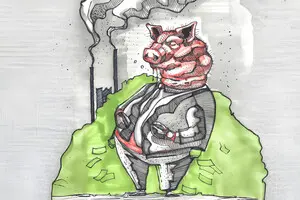

For a long time, political confrontation in Ukraine unfolded on the basis of a gelatinous electoral mass which, within very short political cycles, could vote for politicians with diametrically opposed political programmes. Moreover, some of these “candidates” were not politicians at all, but rather seekers of power as a drug and a source of corrupt rent income.
One of the biggest paradoxes of Ukrainian politics on the eve of the full-scale war is why former President Petro Poroshenko did not become Ukraine’s Park Chung-hee—in economic policy, of course.
Like Poroshenko, Park Chung-hee came to power after a period of mass protest activity, although Park, like Poroshenko, had nothing in common with grassroots street activism. In foreign policy, he too relied on a strong strategic ally, the United States. But the similarity ends there.
In a harmoniously developing polity, state ideology (or, in more liberal terms, a development project or value system) must align with economic policy. Otherwise, it is a bluff, camouflage, a Venetian carnival mask politicians use to deceive voters.
For Park Chung-hee, this coherent development model was the doctrine of relying on one’s own forces—chuch’esŏn (not to be confused with North Korea’s juche). In foreign policy, Park did not limit himself to close cooperation with the U.S.; he found a technological donor among Westernised countries, with Japan becoming such a donor for South Korea.
Thus, in Ukraine, under a conservative ideological environment, a symmetrical economic model should have emerged, aimed at smart protectionism, re-industrialisation, development of technical education, science, industrial innovation, internal market protection and support for complex, high–value-added exports.
Instead, under Poroshenko there was no policy of “reliance on one’s own forces” at all. On the contrary, numerous IMF cooperation programmes were expanded (South Korea, incidentally, hardly used them), while the economy followed the path of maximal openness—full import access across virtually all product lines, deindustrialisation instead of a new industrial policy, destruction of technical education and loss of technological competencies. Overall, Ukraine experienced a systemic decline in economic complexity and value added in its export structure.
The cognitive dissonance of Ukraine’s ideological space lay in the amusing combination of grant-funded liberals “with a portrait of Stepan Bandera over their heart” and industrialists like Poroshenko who relied on IMF-style economic models leading to the erosion of the country’s industrial potential.
If you think things changed after 2019, you are only right insofar as the changes intensified these contradictions. Supporters of quasi-liberal models became even more devoted admirers of Stepan Bandera (who, by the way, was an apologist for economic nationalism, not Hayekian libertarianism), while conservative politicians became even more dependent on external narratives for shaping economic models (more liberal “hardcore,” more IMF).
A hundred years ago, Ukraine experienced similar processes. There was no IMF then, but there were similar Ukrainian politicians suffering from dissociative political-identity disorders.
If one analyses the stages of the Ukrainian national-liberation project of 1917–1921, several phases can be distinguished.
The first stage was the beginning of the reconstruction of post-imperial structures permeating the emerging cluster of the Ukrainian economy and shaping the profile of new productive forces.
Then came the launch of the project of national Reconquista and ressentiment. Failing to achieve success in small things and not solving the basic questions of further development (including society’s attitude toward key assets and the system of national income distribution), political leaders rushed to immediately realise grandiose megaprojects such as borders “from the Sian to the Don.”
At the second stage, processes of deconstructing the post-imperial crystalline lattice of former productive forces were launched. Since these force fields permeated the very body of the productive forces, such transformations quickly turned into an autoimmune self-destructive process.
Instead of consolidating internal social forces to build a national development cluster, deconstruction and destruction took place.
As a result of the failures of the second stage, the system quickly shifted to an authoritarian development model, where military and quasi-military actors (former civilians who became military and embraced military political aesthetics) attempted to seize power.
The final stage was otamanshchyna, or “authoritarian anarchism”—a bizarre antipode of democratic centrism.
Today, it is common to think that the national project then failed because of some small detail: the Central Rada, Ukraine’s revolutionary parliament, did not use the potential of Ukrainianised units on the Southwestern Front, or general mobilisation was not announced, which led to the failure to stop the Bolshevik advance near Kruty.
In reality, the problem was systemic, and the trend toward defeat emerged at the boundary between the first and second phases.
Post-imperial reconstruction should have turned into an all-national republican development project that would unite society. The national project had to answer not only questions of ethnic development but also solve a two-variable equation: the system of national income distribution and society’s model of attitude toward basic assets.
The inability to launch an all-national republican development project—and the slide into the irrationality of reconquista and ressentiment—caused defeat. And that defeat became inevitable already at the beginning of the second stage of the national project.
Our contemporary problems also stem from the inability to move from the amortisation of the USSR’s former potential to building a new republican project with a new model of allocating and employing productive forces.
One reason is that the remnants of Soviet economic potential remain too tempting a prize, not yet fully carved up by the elites during capital accumulation.
Meanwhile, at the micro level, destructive anarchic forces of a new Haidamaky-style movement are maturing, just as they did a century ago. And this model of anarcho-economics is actively supported and provoked by the grant-funded wing of the political class.
“Nestor Makhno allows everyone to take one set of whatever they need to wear. Whoever takes more, he has them all shot…”
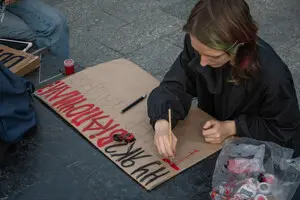
This is a kind of “IMF-based Makhnonomics”—a strange hybrid of 21st-century Ukrainian realities, where proponents of liberal Makhnonomics simultaneously support IMF cooperation programmes.
For years, we desperately argued over what economic model was emerging in Ukraine, usually debating two types of politico-economic systems: a strong state (quasi-state capitalism) or the “night-watchman state.” Constant swings between a form of statism and minarchism.
In essence, no one in Ukraine has yet attempted to implement the third fundamental development concept: the state as a developer of the economy and social system.
This is unsurprising, given that such a model requires deep historical perspective and continuity of governance across multiple political cycles.
As often happens, when ruling elites periodically lose their way in development concepts, the economic model forms on its own, influenced by objective economic processes.
Ernst Mach, the positivist philosopher, once proposed an interesting theory: the human mind, or inner self, is not a divine spark but merely a hypothesis that simplifies mental processing.
The Makhnonomics model is also a kind of hypothesis that allows our economy to survive amid cyclical crises, political instability, geopolitical tectonic shifts, monopolism and oligarchic dominance—as well as within the gripping regulatory tentacles of the state.
The hypothesis of anarcho-capitalism helps explain the cognitive dissonance of full Kyiv restaurants or the flow of premium-class cars on city roads. It resembles the dissonance felt by the inhabitants of Sicheslav in 1917–1920 when they saw Makhno’s wagon train, with characters dressed in operetta caftans embroidered with gold braids and raccoon furs. The Makhnovites dressed colourfully and with zest for life, much like today’s top Mindich-like layer of our society chooses elite cars and personal tuning.
How and why did Makhnonomics emerge in Ukraine as a spontaneous form of organising the deep economy and what global consequences does this hold?
Makhnonomics is a system in which part of society becomes richer while the state becomes poorer, and official laws do not work.
Makhnonomics, or the economy of “small shopkeepers,” flourishes in services and trade against the background of a relatively strong hryvnia. But the parameters of Makhnocapitalism are unsuitable for a country with 10 million pensioners like Ukraine. Under such a model, you cannot expand basic infrastructure, nor even maintain it at the level of linear depreciation of fixed assets.
Here the analogy becomes clear: expensive cars on broken roads, new residential districts built on rotting infrastructure, and perpetual traffic jams on collapsing Kyiv bridges, while “Makhnocapitalists” travel the country in rusty train carriages.
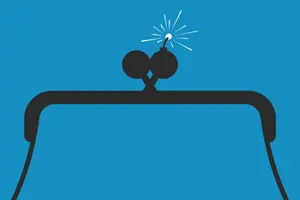
Market-game theory suggests that our anarcho-capitalism can survive only by consuming the residual resource of the economy, which can still be amortised.
Here it is worth recalling the words of Nouriel Roubini: “Any economic model that does not properly address inequality will eventually face a legitimacy crisis.”
During wartime, Makhnocapitalism—amid legal-system collapse and degrading state institutions—can quickly transform into a “Haidamaky economy.” It therefore requires urgent adaptation to the needs of a post-capitalist reality, which is emerging across the world.
Carl Schmitt’s “theory of the partisan” states that societies require an image of the enemy. If an external enemy cannot be defeated, society shifts its gaze inward. The archetypal “partisan,” or in today’s Ukraine a person who has gone through war, becomes, in Schmitt’s words, “a symmetrical enemy” of the old governance system, whose new social status amplifies the power of his individual decisions, including destructive and resistance-driven ones.
Such “partisans” may become easy prey for external manipulators who will channel their energy into dead-end paths of social evolution.
Globalism will only aggravate the partisan’s wounds, not heal them. Globalism is interested not in healing the partisan but in disposing of him—for example, somewhere in Africa in private military companies.
Therefore, only the launch of a strong republican conservative project can heal society and channel the entropy of its fire toward… heating water—that is, toward economic growth. And thus transform entropy and chaos into a creative reconstruction process.
Please select it with the mouse and press Ctrl+Enter or Submit a bug
 Follow on Telegram
 Login with Facebook
 Login with Twitter
 Login with Google