
 Support ZN.ua








The Crisis of Meaning, the Corrosion of Resilience



We Ukrainians are a spiritual people. Much in our lives is built on faith: faith that there is justice in the world; faith that we will be rewarded for our labor (including military service), suffering and intentions. But most of all—for faith itself. Yet faith is not constant. It fluctuates—sometimes strengthening, other times weakening. Right now, for instance, it is declining. At least religious faith is: according to opinion polls, our religiousness has "cooled" over the past six months to roughly pre-war levels.
But religion is only the visible tip of the iceberg. The “melting of the tip” signals a broader erosion of faith—faith in the future, in survival, in one’s own strength. There is nothing strange or shameful about this: for faith to remain strong, it must be nourished, not merely exploited.
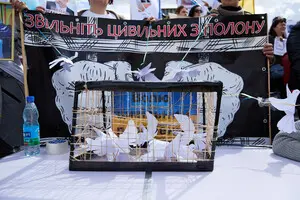
Faith is not nourished by slogans, propaganda or routine “addresses to the nation” with a predictable set of catchphrases. Faith is nourished by meaning. We experienced this in the early phases of the full-scale invasion. The meaning behind our actions brought unity and resilience. Three years on, we still value our resilience. But increasingly, it rests on nothing more than pure faith in a miracle.
This may be faith’s final refuge—and it is especially fragile because it is personal. In our belief in miracles, each of us stands alone before God (or fate or simply our own thoughts). And every blow to that belief can be fatal. The blow does not come from Russian missiles or drones—what else can we expect from the devil? Faith in miracles dies of internal hemorrhaging. One day, after hearing the latest news. Watching your boss lose his business. Running into bureaucracy—at a welfare office or a school. One day, some seemingly small thing—not a missile or a drone!—breaks the camel’s back, and suddenly, you see it clearly: the miracle is not coming. Soldiers grow weary. Resources are depleted. Insomnia grinds people down. The government remains unchanged and grows increasingly arrogant. Every day, the miracle we need becomes larger. And belief in it becomes more elusive.
The loss of faith coincides with a rise in emigration. It seems odd—those who didn’t leave in the first year of the full-scale war are now deciding to go, even after pouring so much energy and money into resisting. Why did the numbers of people leaving and returning balance out in 2023, only for another half a million to leave the next year?
Sadly, we have no sociological data to explain this. And it would likely be hard to collect. People give many different reasons for their “delayed” departure. But in the end, it often boils down to the same conclusion: “There was no longer any point in staying.” That is, the second, third and subsequent waves of war-time emigration are often about meaning, not danger or fear. Our “fatigue” is, above all, a deficit of meaning and only secondarily a lack of rest. Just as our cultivated resilience stands on one pillar: we see meaning in our actions. Once that meaning begins to fade, our resilience starts to crack. Meaning permeates society, binds it together and gives each person something—or someone—to lean on during moments of weakness.

From the outset of the full-scale invasion, the authorities took control of the information space—from Telegram channels and Facebook opinion leaders to “unified” television—and created a monopoly on the production and dissemination of meaning. This was no good news. But many were willing to tolerate it in the context of the all-out war.
The next piece of news, however, was worse: the “one-man show,” which has become almost the only publicly accessible narrative, has nothing to do with creating meaning. On the contrary, the propaganda saturating the information space is designed to generate simple social reflexes—not to strengthen us, help us endure or preserve meaning but to “cover up” the authorities’ arbitrariness.
We see how this works every day. For example, the initial headlines about the closure of NABU all emphasized that the suspect “has ties to the Russian Federation.” This is a trigger. It needs no clarification or proof—just saying it is enough. Or leaving it unsaid—as with the Security Service of Ukraine (SSU), which also harbors many “ties to the Russian Federation” but has not been dissolved. Uncomfortable questions and rational arguments vanish between the lines and drown in waves of emotion.
Or another example: SSU head Maliuk’s comments about NABU detectives daring to search the home of National Guard Commander Pivnenko. Words like “hero,” “combat commander,” “defense of Bakhmut,” used liberally by Maliuk, sounded like incantations—sacred symbols of holiness and immunity from scrutiny. And permissiveness: the SSU chief flatly stated that the general should have simply shot the detectives, regardless of warrants or legal grounds.
In this way, the authorities and their information agents of all ranks shape not meanings to help people endure inevitable losses, fear and fatigue but a binary set of symbols, sacred or devilish, that appeal not to understanding but to reflex. This reduces the “public” (not the people) to a fragmented, manageable mass. Fragmented because fewer words are left that cannot be turned against their speaker. And more words appear that can trigger waves of hate. There are fewer and fewer sources of meaning—inside and around us—that give us confidence in ourselves and in one another. As a result, our sense of community becomes increasingly tenuous. And mentions of the future tense in everyday speech—an indicator of our willingness to endure with strength—are increasingly rare.

Perhaps, for our leadership, this is simply professional deformation. True performers know how to read a crowd and control its emotions (their box office and bookings depend on it). After years in power, the performers and their producers never learned (or even considered) how to treat the people not as an audience to entertain and charge but as the people. And their work—not as a tour but as governance. They remain a troupe of light entertainers, who—cruel irony!—must now perform skits and “earn” in times of grave hardship. In part, this makes their job easier—the audience craves distraction and entertainment, not meaning. But when the audience is left only with informational fast food that generates shallow emotion, a crisis of meaning begins. That, in turn, leads to a loss of faith and to the corrosion of resilience—something we pride ourselves on and present to the world as our mark of strength.
But we are used to this. Ukrainians have long lived in a country where the authorities and the people inhabit parallel realities. And the less these realities overlap, the more comfortable both sides feel. Occasionally, the authorities overstep and violate this silent social contract—then Ukrainians take to the Maidan. In our daily lives, we rarely rely on state institutions. We rely more on horizontal networks—and, in strategic matters, on ourselves. And also—on God.
Still, the world has invisible mechanisms of self-regulation. The Ukrainian government, which commands massive media power but is organically incapable of producing meaning, inadvertently created for its people the chance to return to a tested remedy for restoring meaning and healing social isolation: Maidan.
The authorities have found a way to bypass the safety locks they themselves installed—fear of “rocking the boat,” fatigue, self-censorship—and spurred people into action, to feel solidarity again. To do something together again, even if with their last ounce of strength.

Maidan has always been a radical measure. A last resort. And now, for an exhausted body fighting to survive, it is more dangerous than ever. But what choice do we have if there is still no alternative? Both society and the authorities keep going in circles, returning to Maidan roughly every ten years. We come with the same hope—that at the end of this spiral (in this case, Bruno’s barbed spiral), a worthy future will emerge, one that justifies our present resilience.
We desperately need a renewal of faith, a rediscovery of meaning. Our resilience depends on it—on the feeling that your sacrifice, whatever it may be, is not in vain. On the future tense—the postwar renaissance, whatever form the war’s end takes. On the sense of belonging along both axes of Cartesian plane—solidarity with those beside us and with those yet to come. You can remain resilient only as long as you lean on that plane. As long as you feel you are part of something larger. As long as there is meaning.
Please select it with the mouse and press Ctrl+Enter or Submit a bug
 Follow on Telegram
 Login with Facebook
 Login with Twitter
 Login with Google