
 Support ZN.ua








When Will You Free the Civilians?

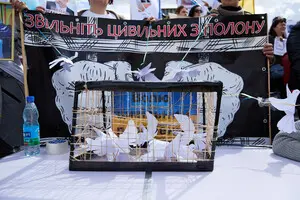

More than 16,000 Ukrainian civilians have been subjected to enforced disappearances and arbitrary detention by the Russian Federation. However, only 1,861 of them have been officially verified as imprisoned, and just 886 are recognized by the International Committee of the Red Cross as being in custody. These numbers are not just statistics. Behind each is a human life.
Participants of the panel discussion “Challenges of Identifying and Releasing Civilians from Russian Captivity: Strategies of the State and Civil Society”, held within the framework of Carpathian Sea Democracy Week, discussed systemic obstacles faced by the state, human rights organizations, and the international community in bringing civilians home.
Categories of Civilian Detainees and the Scale of the Issue
Stanislav Kulish, a representative of the Ukrainian Parliament Commissioner for Human Rights, emphasized that the actual number of civilians held is much higher than reported:
“On the one hand, the numbers are large, but on the other — we know they're even higher. We don't have full access to data on all citizens detained by the aggressor state.”

According to Kulish, civilian hostages in Russian captivity fall into three broad categories:
- Former military personnel or individuals associated with Ukraine’s defense (e.g., volunteers, veterans, law enforcement), whom Russia classifies as prisoners of war to manipulate prisoner exchanges.
- Civilians convicted under Russian occupation, who are formally held in prisons by the so-called “courts” of the occupying power.
- Civilians held illegally, with no known charges or confirmed whereabouts — the most difficult category to address due to Russia’s systematic concealment and refusal to allow international oversight.
International Pressure and the People First Campaign
Oleksandra Romantsova, Executive Director of the Center for Civil Liberties and Nobel Peace Prize laureate, stressed the need for continuous diplomatic pressure:
“We launched the international campaign People First so that the return of civilians becomes the top priority in every negotiation. Not metals, not oil, not political ambitions. The first thing any ambassador or businessman must ask is: ‘When will you release the civilians?’” These should be the first questions posed by the Chinese ambassador, the Indian businessman buying oil from the Russian Federation, and the Trump administration.
The cases of releases of Oleg Sentsov, Oleksandr Kolchenko, and Oleksii Chirnii demonstrate that large-scale international campaigns can be effective. The current task is to scale up the People First campaign and make the fates of thousands of unknown individuals visible.
Systemic Reforms Ukraine Must Implement
Yuliia Poliekhina, a legal expert and documenter from the SICH Human Rights Group, stated:
“Crimes committed against civilians in captivity during the Russian aggression are not only war crimes but crimes against humanity. Their scale, brazenness, and systematic nature demand strong international response and accountability.”

She highlighted several urgent reforms needed in Ukraine:
- Recognize the legal status of released civilians and provide them with guaranteed access to medical, psychological, and legal aid.
- Simplify bureaucratic processes through a “one-stop shop” system for documents, a registry of released detainees, and a streamlined verification process.
- Improve coordination between ministries and the Human Rights Commissioner.
- Ensure free legal aid and state-funded psychological support centers.
“International humanitarian law needs updating. Modern wars are hybrid conflicts where civilians are taken hostage and used as leverage. Ukraine must initiate amendments to the Geneva Conventions,” Poliekhina concluded.
Enforced Disappearances: Legal, Not Just Humanitarian, Issues
Maria Mykhalko from the International Commission on Missing Persons (ICMP) in Ukraine emphasized that missing persons represent not just a humanitarian crisis but a legal challenge:
“We must not only locate and return these people — we must secure justice for them and their families.”
The ICMP focuses on documenting disappearances, searching for missing persons, and identifying the bodies of the deceased. It is crucial that every fallen or tortured individual is given a name, returned to their family for a dignified burial, and — most importantly — not reduced to just a number in reports.
This is not the first time the ICMP has dealt with such challenges. One of the most notable examples is its work in the former Yugoslavia following the wars of the 1990s, particularly in the case of the Srebrenica genocide. Back then, expert evidence gathered by the ICMP was used in the UN court as proof of war crimes.
“We want the evidence collected in Ukraine to be accepted in court as well — both national and international. This is the foundation for justice,” said Mykhalko.
A Unified Database: How to Help Civilians in Russian Captivity
Russia is holding thousands of Ukrainian civilians — without communication, without official charges, and without any chance of legal defense. Many are held incommunicado for years. For example, Oleksandr Babich, the mayor of Hola Prystan, has been in captivity for over three years. Journalist Dmytro Khiliuk and civilian Iryna Horobtsova have been sentenced on fabricated charges such as espionage or terrorism.
“The problem is that there is still no unified registry of such people. Families turn to different organizations, but this data is not consolidated,” says Anastasiia Panteleeva, head of the documentation department at the Media Initiative for Human Rights.
To change the situation, human rights defenders are calling for the creation of a unified system for verifying detained civilians. This would help structure the information and strengthen advocacy efforts.
The second step is dividing detainees into target groups: elderly people, those with serious illnesses, persons with disabilities, or journalists. This approach can help engage international professional communities in campaigns for the release of specific individuals.
“A unified database and targeted lists are the path to effective international pressure. This approach allows us to speak about a specific person who must be rescued from Russian torture chambers — not just dry statistics. And that can truly influence negotiations,” Panteleeva emphasizes.
"Passports Through Torture": How Russia Fakes “Voluntary” Occupation
Kseniia Onyshchenko, a lawyer with the SICH Human Rights Group, provides a concrete example of one of Russia’s numerous crimes — the forced passportization in the occupied territories of Ukraine, which Moscow presents as a "voluntary decision by citizens." “Russian Telegram channels show applause and celebrations of fake referendums. But behind that is a system of coercion, deprivation of basic rights, torture, and intimidation,” she explains.
While documenting testimonies of people who managed to escape occupation, human rights defenders record widespread human rights violations. Those who refuse to accept Russian passports are denied access to healthcare, pensions, education, and employment. Worse yet, people are abducted, unlawfully detained, and tortured to fabricate statistics of “voluntary” citizenship acceptance. These manipulated figures are later used as “evidence” in Russian propaganda on international platforms.
Onyshchenko emphasizes that one of the few effective strategies today is continuous public exposure and truth-telling to the global community. Advocacy efforts must be coordinated — between civil society, diplomatic missions, and the state. “We must force international institutions to act. The UN, the Red Cross, and other organizations must not stay silent — they should develop new mechanisms of pressure on Russia. Sanctions that don’t work are just a formality.”
People First
This discussion once again underscored that the return of civilians from Russian captivity is not solely the responsibility of human rights defenders or state institutions. It is an issue that must be raised at every international forum and during every diplomatic meeting — because people must come first.
Every unlawfully detained Ukrainian is not just a statistic, but a life, a family, a story. Silence about these crimes plays into the hands of the aggressor. In contrast, sustained advocacy, a unified stance from the state and civil society, international pressure, and global attention can shift the situation. Only by joining forces can we bring our people home — and hold the perpetrators accountable.
Reference by ZN.UA:
Carpathian Sea Democracy Week is an international event — the 2nd Festival of the Carpathian Sea Democracy Week, which took place from April 28 to May 3, 2025, in Truskavets–Skhidnytsia. This event is analogous to well-known democratic festivals in Europe, where leading politicians, civil society activists, and business representatives gather annually to discuss current issues. In Ukraine, with the support of Scandinavian countries, such an event provides an opportunity to establish working contacts with the Northern European countries.
Please select it with the mouse and press Ctrl+Enter or Submit a bug
 Follow on Telegram
 Login with Facebook
 Login with Twitter
 Login with Google