
 Support ZN.ua








The Bill Nature Will Have To Pay



Three years of Russian war in Ukraine have led not only to human casualties and infrastructure destruction; they have also caused massive damage to the climate. According to preliminary research by the Initiative on Greenhouse Gas Accounting of War (IGGAW), between February 24, 2022, and February 23, 2025, greenhouse gas emissions caused by the Russian invasion reached 230 million tons of CO2 equivalent.
During the third year of the war, emissions increased by 30 percent (55 million tons of CO2 equivalent), as compared to previous periods. Emissions over three years of the full-scale war can be compared to the total annual emissions of four European countries — Austria, Hungary, the Czech Republic and Slovakia — combined or the emissions of 120 million fossil fuel-powered cars.
Emissions structure: combat operations and fires lead the way
The authors of the study identified six main categories of emissions caused by the war.
The largest amount of emissions is directly related to combat operations — 82.1 million tons of CO2 equivalent, accounting for 36 percent of the total. This category includes emissions from fuel consumption by military equipment, the production and use of ammunition, the manufacturing of military equipment and the construction of fortifications.
Ranked second are emissions related to the reconstruction of destroyed buildings and infrastructure, estimated at 62.2 million tons of CO2 equivalent (27 percent).
The third largest source was landscape fires at 48.7 million tons of CO2-eq. (21 percent). This category showed the largest increase in 2024, when the area burned more than doubled compared to previous years.
Dry summer and war — a devastating combination for forests
The sharp increase in the number of forest fires in 2024 is a cause for great concern. The total area burned was 92,100 hectares, twice the average for the previous two years. Most of these fires were caused by military operations (see figure).
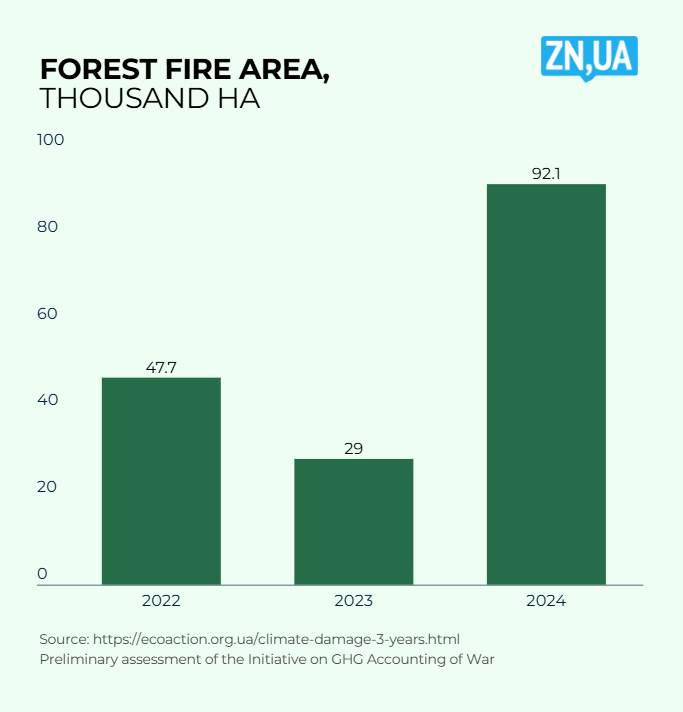
Experts attribute this increase to unusually dry weather conditions, which are likely the result of climate change. This created ideal prerequisites for fires caused by combat operations to start as small blazes and then grow into large ones. The situation is particularly difficult in the combat zone, where it is dangerous for firefighters to work, so the fires often rage uncontrollably.
Other sources of emissions
The study also takes into account the following major sources:
- destruction of energy infrastructure — 19 million tons of CO2-eq.
- changes in civil aviation routes due to airspace closure — 14.4 million tons of CO2-eq.
- displacement of refugees — 3.3 million tons of CO2-eq.

Constant shelling of energy facilities leads to emissions not only of CO2, but also of sulfur hexafluoride (SF6), a greenhouse gas that is 24,000 times more potent than CO2 in terms of its environmental impact.
How is the climate impact of the war assessed and who should be held responsible?
To assess the climate damage, the authors of the study use a social cost of carbon of $185 per ton of CO2 equivalent.
The social cost of carbon measures the current cost of an additional unit of greenhouse gases emitted today, summing up the total global cost of the damage it causes throughout its life cycle in the atmosphere. This indicator covers economic losses from climate change that may be felt in the agriculture, energy services and labor productivity sectors, as well as various types of risks related to human health (in particular, mortality rates) and ecosystems. As a result of applying the social cost of carbon, the total climate damage caused by the full-scale war is estimated at over $42 billion.
Assessing the climate damage caused by war is a relatively new step: there has been no widespread practice, especially in the context of hostilities, of conducting such a detailed and comprehensive assessment of the impact of war on the climate. This creates an opportunity for Ukraine not only to assess the scale of the damage, but also to advocate at the international level for the aggressor's environmental and climate responsibility.

The report on greenhouse gas emissions during the war is an important step in efforts to hold Russia financially accountable for the damage caused.
For reference, ZN.UA
The study was carried out by the Initiative on GHG Accounting of War and the Ecoaction Center for Environmental Initiatives NGO with the support of the Ministry of Environmental Protection and Natural Resources of Ukraine.
This document calculates carbon emissions caused by Russia's ongoing full-scale invasion of Ukraine, which began on February 24, 2022. It is based on detailed analysis and modeling that captures only the war-related emissions and their consequences in Ukraine and Russia. The underlying methodologies remain largely unchanged from the previous iteration of the report, which provides the reader with a more detailed explanation of the calculations.
The work on assessing emissions caused by the war brings together international and Ukrainian experts. Lennard de Klerk and Mykola Shlapak are the authors of all iterations of the report. Lennard de Klerk is a Dutch engineer and climate expert, one of the first in the world to systematically study the impact of armed conflicts on climate. He coordinates the work of the IGGAW. Mykola Shlapak is a Ukrainian expert on environmental protection, greenhouse gas emissions accounting and climate policy.
Other experts are also involved in the preparation of reports at various stages, including leading Ukrainian climatologist Svitlana Krakovska and experts in fire monitoring and spatial analysis.
The report titled “Climate Damage Caused by Russia's War in Ukraine: February 24, 2022 – February 23, 2025” was published with the support of the European Climate Foundation (ECF) and the International Climate Initiative (IKI).
Please select it with the mouse and press Ctrl+Enter or Submit a bug
 Follow on Telegram

 Login with Facebook
 Login with Twitter
 Login with Google