
 Support ZN.ua








Gas Camouflage: How Russia is Trying to Return to the EU Market. Attempt 2



A number of European energy companies that have won, or are about to win, arbitration cases against Gazprom for failing to fulfill contracted gas deliveries in 2021–2022 are now facing the issue of recovering their funds. These are significant sums—too large for Europeans to ignore, even if Russian gas remains attractive. According to available data, European companies have filed lawsuits against Gazprom totaling approximately €18 billion. Of that amount, Germany’s Uniper alone is to recover €13 billion, according to a Stockholm arbitration ruling from June 2024.
Naturally, Gazprom has no intention of paying anything to anyone. It is trying to avoid direct monetary payments, actively delaying and obstructing arbitration rulings as much as possible. Nevertheless, it will have to pay eventually. Russia’s so-called “national treasure” is in dire financial straits. Putin’s much-hyped “pivot to the East”—an attempt to replace the EU market with China—has failed. Central Asian countries cannot absorb the volumes that were previously exported to Europe. Russia’s gas projects for Iran via the Caspian Sea and for India via Central Asia, Afghanistan and Pakistan are merely publicity stunts by Gazprom. Hence, desperate attempts are underway to regain access to the “lost paradise”—the European gas market.
Gazprom has been attempting this since last year. Back then, the working scheme involved “Azerbaijani” gas—that is, continuing the transit of Russian gas through Ukraine disguised as Azerbaijani gas. On paper, of course. For various reasons, that scheme failed. This year, they are trying again. Both Gazprom and the Kremlin understand that sooner or later, the “national treasure” will have to pay the Europeans. Without this, any plans to return to the EU market will remain mere dreams. The payment of arbitration awards will be the prerequisite for Gazprom’s re-entry into the European market.
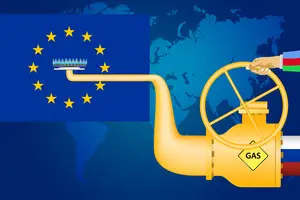
The new plan devised in Moscow takes the form of “payment in kind,” meaning compensation through gas deliveries equivalent to the owed amounts. Through its lobbyists in Europe—particularly in Germany—Gazprom wants to present the idea of such “payment in kind” as a proposal initiated by its European partners. Camouflage is crucial here, as Moscow is counting on the European Commission finding it difficult to reject proposals from its own companies. If the initiative were to come directly from Moscow, Brussels would immediately attach political conditions—namely, an end to Russian aggression against Ukraine before any gas relations could resume. That’s why the camouflage is of utmost importance.
The proposed mechanism involves mixed supplies: 50 percent of the volume would be delivered as compensation at zero cost, and the other 50 percent as commercial deliveries at market prices. This arrangement is considered highly attractive for European companies seeking to recover their losses. At the same time, such supplies would slightly reduce financial pressure on the loss-making company and restore the possibility of using Russian gas as a tool of influence over European partners.
The volume of compensation supplies amounting to €18 billion can be estimated at approximately 70 billion cubic meters, based on the average indicative export price of the Russian Ministry of Economic Development for 2025 ($308, or €271 per 1,000 cubic meters). However, companies might insist on setting a lower price, which would proportionally increase the volume. It was no coincidence that Putin mentioned a gas price of $220 per 1,000 cubic meters for Germany at the St. Petersburg Forum—a price roughly corresponding to the 2021 export rate before Gazprom, under Kremlin instructions, launched a “special operation” to dry up the EU gas market and drive prices upward. At that price, the volume of compensatory supplies could reach around 95 billion cubic meters.
Simultaneous commercial deliveries of this volume of natural gas would bring Gazprom at least €18 billion in revenue, with corresponding contributions to the war budget. For Gazprom, such mixed supplies would achieve several strategic goals at once: restoring partnerships with European companies by resolving a contentious issue; re-entering the EU market with a carte blanche for continued presence; and intensifying lobbying in the EU on “cheap Russian gas as the savior of the European chemical industry and energy sector.” This would be even more important for the Kremlin, as it would delink gas trade from the requirement to end the war in Ukraine, thus dealing a serious blow to the EU’s plans to phase out Russian gas.
It was no coincidence that Putin spoke about gas and European industry at the St. Petersburg International Economic Forum on June 18. He promoted the idea that Russian gas remains a profitable and stable resource for European industry, in contrast to the “volatile” exchange prices in the EU and the “complicated” infrastructural competition with the US. He pointed out that European market prices are significantly higher due to exchange fluctuations—up to $650 per 1,000 cubic meters—while Gazprom was selling gas to Germany at $220.
However, the obstacle for this plan is the lack of pipeline capacity for exporting gas to the EU. In reality, only one line of the Turkish Stream pipeline, with a capacity of 16 billion cubic meters per year, is currently operational for the EU market—and it is nearly at full capacity. The Nord Stream pipelines through the Baltic Sea are out of service. Both the new German government under Merz and the European Commission have rejected renewed efforts to revive Putin’s pipelines. The Yamal–Europe pipeline through Belarus and Poland cannot be used due to Warsaw’s principled political stance. Poland has fully renounced Russian gas and is urging other EU countries to do the same. Moreover, Poland’s EuroPolGaz is suing Gazprom for €1.55 billion for failing to meet its contractual obligations under the Yamal–Europe agreement.
The only route that remains viable is the traditional one through Ukraine, then Slovakia to Austria, and through the Czech Republic to Germany. However, Moscow believes that the EU’s position will remain tied to the cessation of Russian aggression against Ukraine. Additionally, opaque business schemes between European companies and Gazprom have previously led to corruption, and there is no indication that Gazprom will change its methods.
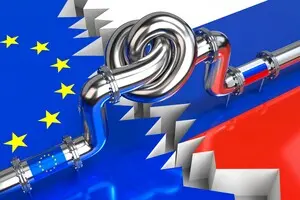
While offering European companies the promise of a carrot through its lobbyists, Gazprom is also hinting at the availability of a stick—primarily aimed at the European Commission. Gazprom may threaten Slovakia’s SPP with a multi-billion-euro lawsuit for failing to fulfill its contractual obligations to purchase gas under a contract valid until 2034, if imports cease due to an EU ban starting in 2027. However, it appears that Gazprom and SPP may be engaged in a coordinated effort to pressure the European Commission by claiming that the Slovak national gas company will suffer massive losses, and will therefore have to seek compensation from Brussels via the Court of Justice of the European Union.
As for unblocking transit through Ukraine, Moscow believes this can be resolved through “certain people in Kyiv,” on the one hand, and by organizing pressure from Brussels via Bratislava, on the other. Slovakia is especially interested in this arrangement, as the Eustream gas transmission operator would earn large sums, and SPP would receive a discount under the aforementioned long-term contract. Additionally, the scheme would appear clean from Kyiv’s perspective, since the gas transiting Ukraine’s system would belong to a group of European companies, not Gazprom. Ukraine’s GTS Operator would receive transit fees and contribute to the national budget. It remains unclear who the “certain people in Kyiv” are, but the assumption is that the Kremlin is betting on someone close to the Presidential Office. Especially since in June 2025, a Swiss arbitration tribunal issued a final ruling in favor of Naftogaz, ordering Gazprom to pay $1.37 billion. It is likely that European envoys from the “group of interested companies” will try to persuade Kyiv to accept the proposed scheme, arguing that it, too, will benefit—albeit at the end of the line.
In conclusion, Russia is not giving up its attempts to return to the EU gas market under a European façade. This testifies both to Gazprom’s poor financial condition—which cannot be rectified without a “return to Europe”—and to the urgent need to replenish the state budget by any means necessary. It is likely that several European companies could form a consortium to jointly receive compensation gas, making Russian gas appear European at the Russia–Ukraine border (similar to the “Hungarian” oil scheme at the Belarus–Ukraine border). Gazprom’s European lobbyists, along with the governments of Hungary and Slovakia, will likely pressure the European Commission to persuade Ukraine to accept the “pragmatic plan” of mixed supplies, regardless of whether Russia ends its war against Ukraine.
It is clear that the proposed scheme—no matter who proposes it or how Gazprom and the Kremlin attempt to disguise themselves—cannot be acceptable to Kyiv while Russian aggression continues. Moscow must not be given new opportunities to replenish its war budget against Ukraine and Europe. This is in our common interest — both Ukraine’s and the EU’s.
Please select it with the mouse and press Ctrl+Enter or Submit a bug
 Follow on Telegram
 Login with Facebook
 Login with Twitter
 Login with Google