
 Support ZN.ua








The Church in the Waves of the Flood
 Reader Survey
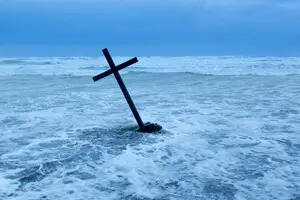

War often makes visible what has remained hidden for centuries. And the Orthodox world has been immersed in war for a long time now. The war in Syria. The war in Libya. The war in Ukraine—the one that began in 2014. The Israeli-Palestinian war. The Gulf War. All these conflicts unfold on—or sharply affect—“canonical territories.” Above all, those of the old Greek churches: Antioch, Jerusalem and Alexandria.
Russia’s war against Ukraine holds pride of place on that list—if only because there are no obvious religious boundaries between the warring sides. You cannot cast a Christian or Orthodox minority as a clear-cut victim—of religious hatred, political circumstances or an “alien-faith majority.” This war is being waged on “canonical territory,” between peoples who identify as “Orthodox.” It is being waged with the full support of one of the canonical Orthodox churches. The Patriarch of Moscow—not some marginal non-canonical figure, but “first among equals,” his name still commemorated in the diptychs—blesses aggression against Orthodox neighbors. Nor does he shy away from helping himself to the spoils, absorbing into his own church what has been taken by force from other Orthodox Christians.
Finally, church interests and related myths became one of the causes of the aggression—if one is to believe the man who unleashed this war. Not only did that provoke no objection from the Patriarch of Moscow; on the contrary, he seems to have been rather delighted and flattered that the Russian president thinks so highly of the church’s importance and cares so much for its interests. The Russian Orthodox Church supports the war ardently and without reservation. The rare “anti-war” priests, theologians and writers have, at best, left the bounds of its “canonical territory.”
After all this, one is tempted to write something grand. Something like: “After this, nothing can remain as it was before—neither in the Orthodox world nor in global Orthodoxy.” It is, after all, so obviously wrong. The blessing of weapons. The preaching of hell. Fratricide, finally. The myth of “brotherly nations”—a mockery of historical reality. But from the standpoint of faith, a war between Orthodox peoples is a war between brothers in Christ, regardless of political or national affiliation.
Yet lofty phrases and the romantic hopes behind them are wholly out of place here.
From the first days of the full-scale war, many of us—believers and sympathizers alike—expected some kind of response from the Orthodox Church. Not sporadic cries of shock from individual clergy, but a response from the church in its fullness. It never came. Not in the first days of the war. Not a year later, or two, or three.
Apart from Patriarch Bartholomew, who issued sharp statements that were easily dismissed as part of his conflict with his Moscow counterpart, perhaps only Patriarch Daniel of the Romanian Orthodox Church spoke out with any force. Metropolitan Onufriy of the Ukrainian Orthodox Church of the Moscow Patriarchate also unexpectedly issued a “seditious” address on the first day of the full-scale invasion, calling Russian aggression the sin of Cain.
But once the initial shock wore off, everything was smoothed over and almost fell silent in the Orthodox airwaves. From time to time, if some persistent journalist asks an awkward question, church leaders may mutter through clenched teeth something along the lines of “war is bad and peace is good.” But no more than that. And Patriarch Daniel of Bulgaria, in a recent interview, seems to have voiced the prevailing view: conflicts, wars and instability in the modern world cannot shake the unshakable foundations on which the church stands.
Well, that is honest, at least. The church does have its “unshakable foundations,” and that is, of course, good news. The bad news is that, shielding itself behind those “unshakable foundations,” the church remains not simply unshaken—it becomes utterly indifferent to everything that does not directly concern those same “unshakable foundations.” Including the sin of Cain.
Whatever may be happening within the Russian Orthodox Church, whatever heresies the Patriarch of Moscow may be spinning, the ROC remains perfectly acceptable company. Not only on global Orthodox platforms, but even at inter-church gatherings. When Orthodox leaders sent letters of support and sympathy—back when Russia’s constant strikes on civilian targets had not yet become the daily routine—they usually addressed them to Metropolitan Onufriy, head of the Ukrainian Orthodox Church of the Moscow Patriarchate, and through him to his flock. The result was the absurd impression that only the faithful of the UOC-MP deserved sympathy in the hell that Russia, with the blessing of the Patriarch of Moscow, had unleashed on Ukraine. No one in the “canonical club” would think of sympathizing with anyone but the “canonical.” That, too, is part of their “unshakable foundations.”
The latter cannot be shaken, not by missile strikes and not even by theologians. The Conference of European Churches, for example, issued a statement titled Resisting Empire, Promoting Peace: Churches Confront the “Russian World” Ideology. In that document, the doctrine of the “Russian World,” promoted by the Russian Orthodox Church, is explicitly called heretical. The authors state plainly that the ROC—and Patriarch Kirill personally—are consciously distorting Christian faith in order to support Russian imperialism in general, and the war against Ukraine in particular.
But no matter how many theologians may gather, no matter what arguments and evidence they produce, they too are unable to shake these “unshakable foundations.” All that external “noise” does not seep behind the closed doors of synods and patriarchal offices, and changes nothing in global Orthodoxy. Even the word heresy has proved powerless. There is no longer any good or evil, truth or falsehood—there are only the “unshakable foundations.” And the task of church institutions comes down to preserving that unshaken state. At any cost.
That is why politics matters more than mission. The interests of the church as an institution matter more than human lives and, it seems, even more than souls. And the institution’s first and overriding interest is to preserve the sovereignty of its own structure spread across a defined canonical territory. The inviolability of that territory’s borders, and the principle of non-interference in the internal affairs of a local church—this is now what the “unshakable foundations” of global Orthodoxy have been reduced to. From the standpoint of this “canonical convention,” Russians killing Ukrainians with the blessing of the Patriarch of Moscow is simply an “internal matter of the Russian Orthodox Church.”
For the same reason, the local Orthodox churches are unwilling to recognize the Orthodox Church of Ukraine. The allegedly “dubious ordinations” of OCU bishops are a pretext, not the cause. The real cause is that the very precedent of Ukrainian autocephaly is profoundly unsettling. To recognize Ukrainian autocephaly would mean admitting that no canonical territory can sleep soundly any longer—its borders, too, may be breached.
To uphold the inviolability of the ROC’s status and acknowledge the legitimacy of its claim to Ukraine as a “canonical territory” fits neatly into the program of preserving the “unshakable foundations” on which most of today’s Orthodox churches stand. Their “unshakable foundations” coincide with the borders of their canonical territories. They also coincide with the outlines of the political alliances that have taken shape and endured for centuries in an Orthodox world divided into “Greek” and “Slavic” camps. And that is yet another “unshakable foundation” that nothing—not even a nuclear strike delivered by consecrated missiles—will be able to shake.
When we speak of countries and nations, it is entirely natural to speak of borders. But when it comes to the church, that becomes somewhat uncomfortable. Because in theory—or rather, in the Creed—the church is unity. One common body. When we speak of political nations, we inevitably speak of division—self-determination, political choice, languages, traditions and distinctiveness. In the case of churches, some of that is true as well: there is distinctiveness here too. But it is secondary and instrumental, meant to translate and adapt Christianity to local languages and traditions.
In reality, however, individual Orthodox churches care more about their borders, territories and institutional interests than about mission. They are just as focused on what separates them as on what they share. So while the phrase “sister churches” is often used in church language, these sisters have long since ceased to live in their father’s house. They have married their respective states and changed—sometimes, it seems, even forgotten—their maiden name.
In reality, there is no such thing as “global Orthodoxy”—no single church, no common organism that responds as a whole to the pain or joy of one of its members. The high hierarchs can still, with some difficulty, gather together over the coffin of one patriarch. But what good is that if they are incapable of making decisions together? Incapable of responding jointly to the challenges faced by one of their own? Incapable even of feeling compassion for the pain of another’s flock?
One could say there is nothing new in this. The very structure of global Orthodoxy—a conglomerate of “national” churches—has spent its entire history teetering on the edge of disintegration (and even somewhat beyond it). And if, despite all that, the “unshakable foundations” have still not been shaken, then perhaps the current upheavals will not move them either? Perhaps “canonical geography” will hold and go on dictating the rules in the Orthodox world. In other words, perhaps the patriarchs do know what they are talking about?
Or perhaps they are making the classic mistake: relying on their “unshakable foundations” while the ground is slipping away beneath their feet. Literally.
The principle of “canonical territories” leaves Orthodox churches vulnerable from both sides. From within, there is the danger of the church merging with the state, religion with ideology—to the point of creating a civil religion “based on” Christianity, as is happening, for example, with the Russian Orthodox Church.
But the biggest problem with this “canonical geography” lies in its static nature. Geography today increasingly describes not places, but routes. And attachment to a clearly demarcated territory makes it impossible to answer one of the defining challenges of our age—population mobility.
We are living in an age of a great flood. The world has shifted from its place. The currents may still be quite thin, but in some places they are already merging into noticeable rivers. It does not matter what exactly forces people to leave the places where they had settled, to betray the basic principle of civilization—sedentariness. It may be climate change, war, economic necessity or simply an inner restlessness—the migratory syndrome.
Territories are slipping out from under our feet, including canonical territories. And everything built on the territorial principle will lose its footing. It will be revised. Or simply dissolve, along with whatever once tied people to territory. Clay professes no religion. Stones belong to no church. Water speaks no “native language.” People do all that. And they do not stop doing it when they leave their native walls behind, when they go far from their native land. They preserve their identity—for a time. One generation, at most two. If that identity has no support—in a community that shares the same faith, practices the same rites and traditions, speaks the same language—that bond erodes. People assimilate. And the problem is not that they have “lost touch with the land.” People do not live “on the land”—they live within communities, within social ties, within language.
The church, seen from this perspective, has enormous potential. But only if its “unshakable foundations” are not territories and not political alliances, but people. For the first Christians, the church was imagined as a ship—an ark on which believers move toward salvation. That is to say, the church as a community is by nature mobile and flexible, capable of uniting across borders and barriers—state, political, cultural.
Many Orthodox churches have learned to live in a world where people, the farther things go, the less often they attend church. That is not so important—if they live on “canonical territory,” they still “belong” to the national church, actively or passively, whether they want to or not. But what happens when people leave that “canonical territory”? Which church do they belong to then? And can the church do anything to avoid losing them?
We are passing through a period of crises, and some of them—demographic, climatic, military—strike the Orthodox world especially hard. In such times, the winner is not the one who preserves territory. It is the one who manages to gather and preserve people.
Please select it with the mouse and press Ctrl+Enter or Submit a bug
 Follow on Telegram
 Login with Facebook
 Login with Twitter
 Login with Google