
 Support ZN.ua








High School Reform: For Grants or for Children?


The New Ukrainian School reform has found itself at the center of a scandal. For the first time in nearly ten years of its existence, dissatisfaction has moved beyond hushed conversations in teachers’ lounges and arguments on social media and taken the form of a very real petition, submitted on the government website on behalf of parents, demanding that the process be suspended.
According to a survey by the Association of Ukrainian Cities, conducted in April 2025 and covering 995 communities, 70 percent believe the reform should be paused until martial law is lifted. And that is a serious sign, because it is local self-government bodies that are supposed to ensure its actual implementation.
Society is genuinely alarmed. This can no longer be dismissed as “isolated voices” from people instinctively opposed to change. If the situation is not defused in time, the debacle could seriously damage the authorities’ ratings, already shaken by corruption scandals and criticism of personnel policy, in which loyalty is increasingly displacing professionalism.
International donors, who have invested substantial funds in the New Ukrainian School reform over the years, may also quite reasonably ask: where are the results? And, more importantly, who is accountable for them?
Summoned to report
The minister of education and science has already been summoned to the parliament on April 8 to report on preparations for the high school reform. A meeting of the relevant parliamentary committee is also scheduled for that day, and lawmakers are already collecting proposals from communities.
Meanwhile, the Ministry of Education and Science and the presidential office are also trying to get through to the communities.
According to our information, at an internal meeting with regional education officials, Oksen Lisovyi delivered three key messages:
- The New Ukrainian School is a political issue.
- No New Ukrainian School means no funding from international partners.
- Communities must be “pressed harder” so they do not refuse the reform.
In addition, the minister and his deputy, Nadiia Kuzmychova, held a closed meeting with journalists. If the ministry team’s goal was to explain to society what is happening with the reform and lower the temperature, it would have made more sense to speak publicly. But they chose a different format—one open only to those the ministry wanted to see. A format that makes it possible to shore up the rear and keep the situation under control.
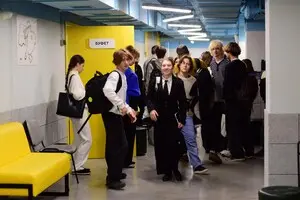
At the same time, representatives of communities and local administrations were gathered for the Congress of Local and Regional Authorities under the President of Ukraine. There, in addition to Oksen Lisovyi, they were also addressed by Deputy Head of the Presidential Office Viktor Mykyta. Invitations were sent out in turbo mode, just a few days before the event.
According to our sources, the gathering resembled a Soviet-style party congress, with Lisovyi and Mykyta reading their speeches from paper. It was nothing like the way Liliia Hrynevych once inspired people with the idea of the New Ukrainian School when it was first launched.
The congress was held on Zoom, but no recordings or transcripts of the meeting are publicly available. Only terse statements from communities—“discussed,” “heard”...—along with a social media post from the education minister saying that the meeting concerned “how consistently and with what quality of governance we are implementing changes in education together.” It is a pity the minister did not explain whether that consistency was being praised or criticized.
Yet the very fact of such a meeting will allow the authorities to create the impression that communities supported the reform. At the very least, there will be something to show international donors.
By the way, the minister did not forget about the donors while speaking with communities—and said so quite frankly on Facebook: “I emphasized the direct link between the implementation of the reform and the subventions and resources that the state and international partners are directing toward updating the educational environment, equipping schools and supporting the New Ukrainian School.”
It seems that before long, anyone dissenting from the ministry’s policy will be frightened with donors. So that those criticizing the reform feel guilty for depriving our education system of funding.
Why communities are resisting
Of course, not all community leaders see education as an investment in the future rather than an expense. In some places, a more modern school network could have been created even without waiting for the reform—yet for years they simply preserved what already existed.
At the same time, even those ready for change are constrained by the framework imposed from above: the authorities’ strategic decisions, the design of the reform and the rules governing its implementation. That framework can either provide support or suffocate.

And it is precisely from this angle that the current position of communities should be viewed. In their opinion, as expressed in the Association of Ukrainian Cities study, the following problems “hinder” or “rather hinder” the effective launch of the reform:
- lack of information about the substance and final outcome of the reform (68%);
- poor communication between the Ministry of Education and Science and communities (62%);
- absence of a ministry-approved regulation on specialized lyceums, including their structure and the organization of study within them (86%);
- lack of clarity about the sources of financing for implementation of the reform (81%);
- failure to take wartime challenges into account (82%).
The ministry has announced a “national rollout of specialized high school” as early as September 1, 2027, and by then communities are expected to create a network of lyceums. But the ministry still has not prepared the key regulatory framework that would allow communities to understand how exactly the institutions they are now creating are supposed to function.
There are still no officially approved requirements governing the structure of an academic lyceum and the conditions for organizing the educational process there (the Model Regulation on the Lyceum). It remains unclear by what mechanism a lyceum attended by children from different communities will be funded—who will pay for meals, utilities and boarding accommodation. It is not known how competitions are to be held for the positions of lyceum director and teachers (there is no Regulation on the Competition). So who, exactly, is sabotaging the reform here?
But the communities’ main fear is that some of them will lose high school altogether. As education expert Mykhailo Honchar of the Association of Ukrainian Cities explains, “More than 200 communities will not be able to open lyceums because of low population density. For example, in Ivano-Frankivsk region they are planned in only 60 percent of communities. For students, this means studying far from home and depending on family finances for transport and accommodation.”
Add to this the old, familiar problems that have not gone away over all these years of reform: bad roads, with children in some communities spending an hour getting to school, a shortage of school buses and the lack of a network of boarding facilities where students from villages without a high school could live.
The problem is not where they are looking for it
To let off some of the public steam, the current leadership of the Ministry of Education and Science, headed by Lisovyi, may be offered up as a ritual sacrifice and blamed for derailing the reform. The ministry can certainly be faulted for many things. But it would be unfair to shift all responsibility onto it alone.
This is also the responsibility of those who launched the reform in the first place. From the outset, the New Ukrainian School contained more image-making, politics and grant logic than genuinely new ideas (you can read about that here).
Lisovyi’s predecessors managed to reap political dividends from the New Ukrainian School reform because at that stage they were only promising the future. The current ministry team has inherited a different role: to gather the stones. Because the reform is only now entering what may be its most difficult phase—one that will bring tectonic changes to the school network and the structure of schooling itself.
But that is not the only problem. Reforms are built not on impressions, but on data. Yet the New Ukrainian School never had a serious analytical foundation. Before its launch, there was no systematic study of the state of our education system—its strengths, its weaknesses and what it might build on. Nor was there full-fledged monitoring and corrective work at every stage of the reform—after primary school and in grades 5–9.
The problems are compounded by the opacity of the processes surrounding the reform. We have already written about the “talking points” handed to experts—when they are told exactly how new measures are supposed to be commented on. And this is not only a matter of backroom maneuvering, but of the attitude toward discussion itself. Of understanding that an open conversation with society is more effective than a warm bath in the company of courtier experts. And however harsh such a discussion may be, it is necessary. Incidentally, one of the demands in the parents’ petition calling for the suspension of the New Ukrainian School was to ensure a public discussion of the changes.
And what do we have in reality? Here is one example from the ministry’s latest August conference. It was described on social media by Serhii Diatlenko—a former ministry official and now an expert at the Central Reform Office and in the Polaris program funded by the Swedish government: “This time [at the conference] those ‘who disagree’ with education policy were not ignored; they were openly bullied both from the stage and behind the scenes. They exist and always will because there is a demand for ‘disagreement.’”
And that is only one side of the communication surrounding the changes. The other is the public image, in which there is no room for doubt or criticism, because society is being offered a glossy version of what is happening. Here, for example, is a recent statement from the government portal: “The team of the Ministry of Education and Science of Ukraine has implemented comprehensive reforms at all levels—from preschool to science/innovation—and laid the foundation for long-term change.” It sounds like a report from a parallel reality. I hear the same tone in the ministry’s news mailings that I receive as a journalist.
And in that reality, complex processes are astonishingly quickly reduced to simple, almost rhetorical formulas—with the “correct” answers already embedded in them. The situation around high school reform is suddenly boiled down to the question: is someone really prepared to abandon the future because of organizational difficulties? Or, even more bluntly: should the reform really be halted because of those who “do not understand change” or “do not want to change”?
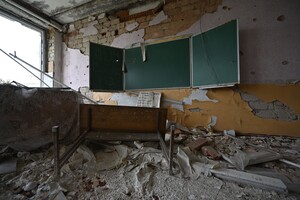
But that is a false frame. Because what is at stake now is not resistance to reform itself—the reform is not merely overdue, it is long overdue—but resistance to the way it is being carried out. As Mykhailo Honchar aptly put it, “The New Ukrainian School reform has no opponents, but there is a clear-eyed understanding that we are the ones who have to live here.”
The main capital of this country is its people. And that is why education cannot remain a field for image-making. We truly do need the help of international donors right now. But that does not mean that, for the sake of that help, we must agree to an imitation of reform and twist communities’ arms. Nor is that what donors are demanding. They provide resources for change; the rest is our responsibility. And our choice: to carry out a reform—or merely pretend to.
Please select it with the mouse and press Ctrl+Enter or Submit a bug
 Follow on Telegram

 Login with Facebook
 Login with Twitter
 Login with Google