
 Support ZN.ua








Rain Ruins Autumn Marathon of Crop Champions



The spectacular finish of the trio chosen by farmers as the leaders of the harvest race—corn, soybeans and sunflower—was spoiled by rain. Ukraine is busy gathering its main crops, and the main intrigue of the season is now in the fields: will corn be left to “winter over” as if it were a winter crop?
Once a year, every publication—regardless of its concept, editorial policy, audience or country—writes about the harvest. Usually, this topic is brought up in summer, in the midst of the wheat harvest. And it is no wonder: wheat is the strategic raw material for bread. Yet the real struggle for yield and profit unfolds in autumn. It is precisely in this period that everything is decided—from the well-being of a single village to the indicators of the state budget.
The lifeblood of economy
According to operational reports from the regions, Ukraine has gathered more than 35 million tons of grain and 13.6 million tons of oilseed crops. More than 22 million tons of wheat have been threshed. Households have finished digging potatoes, the country’s second bread.
Altogether, three crops (sunflower, soybeans and corn) provided $11.5 billion of agricultural exports in the 2024 calendar year. Wheat accounted for only $3.7 billion. The total export of agricultural and food products (according to the State Customs Service and the State Statistics Service) in 2024 amounted to $24.5 billion. These three crops have in fact become the foreign-exchange pulse of the agricultural sector.
It was precisely this highly liquid trio that ensured profitability for the sector, which had heroically carried 2022 and 2023 on its shoulders. Despite some difficulties, farmers’ mood in summer could be described as moderately optimistic.
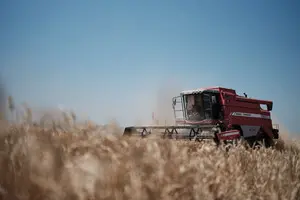
In a farmer’s calendar, there has never been a year when the weather sided with those in the field. The year 2025 has once again confirmed that there is no such thing as a stable climate anymore—there is only adaptation. Spring was late and cold. Summer, on the other hand, brought waves of abnormal heat alternating with downpours and hail, which locally damaged crops in central and southern regions.
Sunflower and corn proved especially sensitive: during the grain-filling period they suffered from lack of moisture across a large part of their acreage. In central regions, farmers report yield reductions of up to 20 percent compared with planned levels (according to the Hydrometeorological Center and the National Academy of Agrarian Sciences, NAAS).
Autumn brought further serious tests: in the last third of September, frosts were recorded both in the air and on the soil surface. In the first ten days of October, temperatures continued to fall, and almost daily rains created an unfavorable weather background that slowed ripening and prolonged the harvesting campaign. Risks of losses, both in quantity and quality, have increased significantly.
Sunflower: quantity and quality
The sunflower production forecast has sharply worsened due to low yields: on average across the country it is 1.8 tons per hectare. Pessimists say that only 10.5 million tons of sunflower can be expected. Some analysts mention 11.8 million tons (according to APK-Inform and Agroperspektyva analytical centers).
An interesting detail: regardless of season, weather or price, farmers are always in a hurry to harvest sunflower. Unlike corn, a little more than one million hectares remain unharvested. To date, over 7 million tons have been gathered from 3.9 million ha. Last year, by mid-October, 9 million tons had been collected from more than 90 percent of the area—4.52 million ha (according to the Ministry of Economy, formerly the Ministry of Agrarian Policy).
For many in the agricultural community, sunflower is more than a strategic commodity. Yet even it cannot withstand the ordeal of bad weather. The biggest problems are seed shattering from the heads, reduced oil content and an increased acid value (up to 4–8 percent), making it unfit for consumption and suitable only for technical purposes (according to NAAS).
Corn
The first 5 million tons of corn have been harvested—only from 15 percent of the total area. Last year, by the end of the second ten-day period of October, the country already had more than 13 million tons of corn harvested from 60 percent of the fields.
Therefore, corn exports in 2025/2026 are lagging far behind last year: 1.2 million tons versus 4 million (according to the Ministry of Economy). The weather broke traders’ plans: they now have to search for batches and form export lots under conditions of harvest delay.
News feeds have already flashed alarming claims that Ukraine has lost the EU and Chinese markets to corn from North and South America. One can relax — nothing has been lost. Although Ukrainian corn sales on global markets are smaller than Brazil’s, there is enough place under the sun for everyone.

Farmers remain cautious: first, they say, everything must be harvested, because the rains have delayed the campaign and moisture levels are off the charts. Few are willing to incur extra costs for drying, so one can assume that some corn will indeed be left to winter in the field. Each farm will decide individually: either harvest and spend on drying or leave it.
It is not the first time farms have left corn in the field over winter. Low prices and high moisture due to prolonged rains once led to such a paradox: in Poltava region alone, 170,000 hectares of corn lay under snow waiting for spring (according to Agroperspektyva).
The practice of delaying harvest to let grain dry naturally is known but temptingly risky, agronomists say. At an average daily temperature of about 5–6 °C and relative humidity of 80–90 percent, intensive moisture loss almost stops. Moreover, losses can grow: by the 35th day of harvesting, up to a quarter of the yield may be lost (according to NAAS).
The possible harvest is estimated at 28 to 32 million tons. The south of the country has contributed practically nothing.
Soybeans
By mid-October, 3 million tons of soybeans had been harvested from 1.3 million ha, compared to 5 million tons from 2.3 million ha last year. Harvesting continues, as do the spread of disease and mold. Delays in harvesting soybeans lead to risks of seed shattering, fungal growth and self-heating of the mass at moisture above 16 percent.
Soybeans are unlikely to set records, but they should still surpass the 5-million-ton mark.
No need to explain who leads among the trio chosen by farmers—all the more so because the sunflower and sunflower-oil segment has for years provided producers and processors with a decent profit.
New challenges
When technology entered agriculture, the number of working hands on Ukrainian farms dropped sharply. And the harvest, as a festival thanking the land, began to fade into the past.
When pronouncing the word harvest, officials see taxes, foreign-exchange revenue and an opportunity to form next year’s budgets. In years when the agricultural sector declines, the entire economy feels the effects.
Ahead lie new challenges: drying, transportation, storage and successful sales. Autumn will bring not only fatigue but also price fluctuations, energy risks and logistical constraints.

The paradox of the situation is that the weather, which should help the crop grow, sometimes becomes its main enemy. In an era of technology, global markets and investment, agricultural production once again reminds us: success still depends on the elements.
And here is another paradox: the more a producer invests in the crop, the more dependent they become not on their efforts but on chance. When sunflower, corn and wheat grow in the field, they do not obey contract terms or heed analysts’ forecasts.
Thus, every day of rain now has its own price—not in millimeters of precipitation but in lost dollars. We are used to saying that grain is currency. Well, weather is its chief regulator.
Please select it with the mouse and press Ctrl+Enter or Submit a bug
 Follow on Telegram
 Login with Facebook
 Login with Twitter
 Login with Google