
 Support ZN.ua








China’s Shadow in Alaska: Will Xi Become the Third Player in Putin-Trump Nuclear Game?

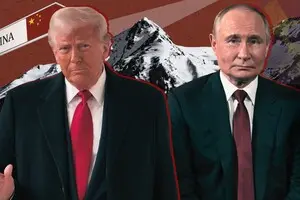

When proposing a meeting with Donald Trump, Russian leader Vladimir Putin included nuclear arms control on the agenda. The last valid treaty in this sphere between the US and Russia—New START—expires at the beginning of next year and, by law, cannot be extended. Still, talks on possible restrictions, reductions and controls could be useful—not least because non-nuclear states, the vast majority of countries, consistently demand them, and because Nobel Peace Prizes are occasionally awarded for achievements in nuclear disarmament. By suggesting Alaska—a frontline US military stronghold—as the venue, Trump signaled that he was prepared to discuss nuclear missile issues but rather with China than with Russia. Within a few weeks, Putin may convey this personally to Xi Jinping in Beijing.
A dying treaty
The New Strategic Arms Reduction Treaty (New START) was concluded with a validity period of ten years and could be extended only once—for another five years. When the treaty was about to expire in 2020, during Donald Trump’s previous presidency, he did not want to extend it, instead proposing a new format involving China. Joe Biden extended New START for five years, announcing his intention to do so on the very first day after his inauguration, and within two weeks the decision was carried out by both sides—the US and Russia. Now, with New START finally receding into history, Trump is unlikely to exert major effort to impose limits on the US without clear geopolitical returns.
Signed in 2010, New START spared Russia the loss of parity with the United States. It set an achievable limit for Russia of 700 deployed delivery systems (intercontinental and submarine-launched ballistic missiles, as well as heavy bombers), which could carry no more than 1,550 deployed nuclear warheads. Even before signing the treaty, the US had already reduced the number of its delivery vehicles— for instance, by removing B-1 bombers from nuclear forces—and lowered the number of warheads deployed on them, placing four warheads on Trident-2 submarine-launched missiles instead of eight. The warheads taken off delivery vehicles created a potential for rapid re-deployment in crisis (a “hedge” in US terminology).

By contrast, under New START, Russia barely managed to maintain the permitted number of delivery systems, each armed with the maximum technically feasible number of deployed warheads. Russia is believed to possess more nuclear warheads and munitions overall than the US but without the potential for rapid return: whatever is in Russian storage and not on missiles or near bombers is essentially destined for dismantling, repair or disposal.
The added value the US derived from New START was the system of inspections and notifications on changes in the status of strategic nuclear forces—at its peak, dozens of inspections and hundreds of notifications annually. This system made the strategic nuclear sphere predictable for both parties. Russia constantly exploited this component as leverage over the US. Eventually, Moscow announced the suspension of inspections in 2023 and the cessation of data exchanges in 2024. Still, Russia repeatedly stated it would abide by the treaty limits—a claim that can be believed, since the Russian Federation simply lacks the capacity, due to chronic shortages of reliable nuclear delivery vehicles, to exceed them.
The reckless war of aggression against Ukraine has only made Russia’s problem with nuclear carriers more acute. Before Ukraine’s Operation Spiderweb, Russia had, by various estimates, 55–60 Tu-95 strategic bombers, all covered by New START. Ukrainian drones destroyed at least seven and damaged several more. In percentage terms, that is up to 15 percent of the entire Tu-95 fleet. Considering that only about 40 were truly combat-ready, the effective loss could be as high as 25 percent.
Russia’s situation with intercontinental ballistic missiles is equally strained. The Votkinsk machine building plant—which produces Yars ground-based mobile and silo-based ICBMs, services the earlier Topol-M, and manufactures Bulava submarine-launched ICBMs (notorious for more failed than successful tests)—has had to divert a significant share of capacity to producing Iskander-M short-range ballistic missiles for the war.
It is also tasked with the semi-mythical non-nuclear Oreshnik missiles. A handful of Iskanders or one Oreshnik come at the expense of one Yars, Topol-M or Bulava. In total, Russia likely has little more than 200 Yars and Topols on permanent duty. The strain of the war could well have reduced their production and maintenance by a dozen or two. That may not immediately lower the number on alert, but it certainly cuts into their stock of spare missiles, undermining the reliability of an entire component of Russia’s nuclear forces.
For Washington, New START is no longer worth clinging to. It neither sustains parity with Russia—which cannot breach its limits anyway—nor ensures meaningful transparency, as Moscow does all it can to conceal its decline as a nuclear power, above all from the US.

Still, arms control regimes retain value for Washington. Limits agreed with a worthy adversary reduce the costs of sustaining and modernizing nuclear forces. The US is set to spend more than $1.2 trillion on the current modernization cycle of its strategic arsenal, which may run through 2040. In parallel, Washington is budgeting roughly $250–300 billion for a new space-based early warning and interception architecture, the so-called Golden Dome. Treaty restrictions on adversaries help keep these vast expenditures within planned bounds. But there is no point in imposing reciprocal limits on Russia: it cannot exceed New START thresholds anyway and is already struggling to sustain its strategic deployments.
Nor does Washington urgently need separate arms limitations with China. The latter is rapidly expanding its arsenal from a few hundred deployed warheads toward the 1,500 warhead level now observed in the US and Russia. But Beijing will reach that level in 2035 at best. Should an unexpected acceleration occur, the US has significant hedge capacity, allowing it to nearly double its deployed warheads—though with technical risks and financial costs. China has no such option.
What could matter is the prospect of a Chinese “nuclear coalition”—one that might include Russia and North Korea in a coordinated nuclear posture. Such a coalition would make maintaining global nuclear balance more difficult and costly for the US. America’s nuclear modernization programs are already running late and over budget. Factoring in the need to deter China and Russia simultaneously would impose additional burdens with potentially disruptive domestic political consequences.
The China factor
China has consistently refused to join formal talks on strategic nuclear arms control. This was Beijing’s position during Trump’s first term, when Washington proposed a new trilateral format with the US, Russia and China after New START. Beijing rejected the idea, saying its arsenal was too small for symmetrical restrictions.
But the situation is changing rapidly. In 2020, China’s arsenal was estimated at about 200–220 warheads. By 2023, it had grown to over 500, and by 2030 it could reach 1,000. Beijing is actively deploying new DF-41 mobile ICBMs and constructing silo fields in the desert region of Xinjiang. At the same time, it is investing heavily in intermediate-range missile systems capable of regional strikes—from Taiwan to US bases in Japan and Guam.
Any premature entry into arms control agreements would hinder China’s ability to catch up with the US by 2035. Yet Beijing has a clear interest in keeping Washington bound to New START limits even after its expiration.

It is therefore quite possible that Beijing is behind some of Moscow’s nuclear control initiatives. Back in December 2021, within the ultimatums presented to the US and NATO over Ukraine and European security, Russia tried to include restrictions on US strike and missile defense systems in the Far East. Whether this originated in China or was a Russian attempt to please Beijing is unclear—but the demands aligned with Chinese interests. Similar motives are visible in Moscow’s repeated accusations against Washington over plans to deploy intermediate-range missiles in the Pacific, particularly in the Philippines.
Putin’s latest proposals for renewed nuclear dialogue with Washington may again reflect Chinese interests. The strain of modernizing America’s nuclear arsenal is already evident, particularly in anticipation of a Chinese “nuclear coalition.” For this reason, the Trump administration could plausibly be interested in arms control negotiations as a way of reducing costs of maintaining global parity.
But the question is: negotiations with whom? Putin offered himself as an interlocutor. This looks like an act of strategic deception: the US is asked to limit its arsenal once more, in exchange for limits on Russia’s—which is already in decline. Meanwhile, China would continue rapidly building up toward American levels.
Invitation to Putin to hold talks at a military base in Alaska may have been, among other things, a US signal that Washington sees China’s hand in Russia’s initiatives—and is responding accordingly.
Alaska is the frontline bastion protecting North America against nuclear missile threats from China, North Korea and Russia’s eastern forces. As he walked the red carpet there, Putin could hardly miss the point: Alaska has more weapons than people, making it unique in global nuclear architecture. Here are deployed GBI interceptor silos of the US missile defense system, as well as NORAD’s missile warning command centers. Components of the new layered US missile defense, the Golden Dome, will also be stationed in Alaska. The GMD modernization program alone is valued at more than $40 billion over the coming decade.

Putin on the red carpet in Alaska on August 15—before walking another red carpet in Beijing two weeks later at the World War II anniversary commemoration—played, among other roles, that of China’s messenger. He was given at least a symbolic response to his proposal for a new US-Russian nuclear treaty.
The security signal from Alaska may be this: Donald Trump is ready to discuss nuclear arms with Xi Jinping, possibly with Putin at the table—but not with Putin as Xi’s messenger. US-China nuclear talks could be useful in many respects, not least for curbing excessive spending on nuclear arms. But if China opts instead to build a “nuclear coalition” to compete with America, such a coalition risks facing an Alaskan fiasco.
***
US efforts to “detach” Russia from China may apply specifically to the nuclear and missiles domain. Beijing and Moscow either coordinate their doctrines and policies or they do not. Other dimensions of “separation” are too amorphous, given global trade and investment interdependence, to serve as practical goals. Of course, Putin can tell Donald Trump whatever he pleases—even that he has already detached Russia from China. But if such claims do not concern nuclear arms, they may mean nothing and cannot be verified.
Therefore, one should not perceive US moves to “detach” Russia from China as any deliberate hostility toward Ukraine. The astonishingly wide-ranging talks around Ukraine’s temporarily occupied territories may simply be part of even larger global bargains—about the balance of power, where Russia still retains a residual nuclear weight. Yet in Alaska, Trump demonstrated to Putin that this role is rapidly shrinking.
Please select it with the mouse and press Ctrl+Enter or Submit a bug
 Follow on Telegram
 Login with Facebook
 Login with Twitter
 Login with Google