
 Support ZN.ua








Big Brother China: Inside Beijing’s Expanding Global Grip

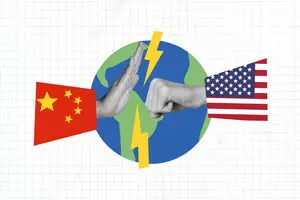

After the SCO summit in Tianjin, China, the world continues to discuss geopolitical changes and the emergence of a “club of authoritarians” against a “club of democrats,” which is losing initiative and influence. ZN.UA has covered these issues, but I want to draw readers’ attention to other very important aspects that shape the global balance of power—demographic, industrial, scientific and military.

Quantity is also quality
Thanks to the success of the “one family, one child” demographic policy (1980–2015), there are now slightly fewer Chinese than Indians or all Africans combined. Yet China surpasses India and Africa in population quality, with universal literacy and a Confucian drive to provide children with the best possible education. As a result, China commands a powerful labor force. Each year, 10 million people sit for university entrance exams. Between 2000 and 2019, six million young Chinese studied abroad; most returned home with their acquired knowledge. That figure exceeds the entire population of many countries and is larger than Ukraine’s forced emigration since February 24, 2022. In 2020 alone, Chinese universities graduated 1.4 million engineers in 2020—seven times the US figure of 200,000 and more than the total size of the Ukrainian Armed Forces.
The outcome is China’s status as a “scientific superpower”: six of the world’s top ten research universities are located in the PRC, according to the 2024 Leiden Ranking of Scientific Research Volume, giving China an edge in applied sciences. This position is now complemented by the prospect of leadership in fundamental research, as China continues to increase investment in science and invention while Trump, by contrast, has cut US science funding to its lowest level in 35 years, according to The New York Times.
China’s effort to convert human capital into educational and research capital affects all countries. And not only through the sale of Chinese applied inventions on AliExpress and Temu. These investments also fuel patent spam and scientific nationalism. Scientific nationalism manifests itself in the drive to keep Chinese achievements locked within a domestic ecosystem, as once happened with silk and gunpowder. Thus, inventions are released abroad only sparingly and with party approval—and only if foreigners learn Chinese, collaborate with local scientists and share patents and citations in Chinese journals. Patent spam, meanwhile, takes the form of thousands of Chinese experts systematically scouring the world for unpatented products (scientific, technical or software) and registering them for Chinese companies. This practice accelerates China’s own technological development while slowing that of others.
Even demographic decline—which is eroding China’s global advantage (its working-age population is set to fall from 56 percent today to 36 percent by 2100)—is being turned into an asset by the Communist Party through robotization and the spread of artificial intelligence. It is the deus ex machina or rather, the intelligent industrial robot powered by AI, that is set to replace not only the small generation born under the one-child policy—the “little emperors” generation—but also 300 million elderly citizens.
The rise of the robots—in China?
China enjoys enormous economic advantages over other countries. These include state subsidies for industrial development and a labor force that remains cheaper than in the West. At the same time, a key problem for today’s democratic world is that China has already proven that even without democracy or personal freedoms, it is possible to significantly improve living standards. China has set a precedent: democracy is not essential for a good life.
China also benefits from an extraordinary concentration of specialized enterprises in certain cities, enabling, for instance, the assembly of a drone in a matter of hours rather than weeks, as in the US. But Beijing wants more. Its ambition is not only to reclaim its domestic market but also to capture foreign markets, despite a shrinking and aging workforce.
This ambition is achievable for China, though impossible for most countries. The path is the robotization of all industries under AI control. One example is Xiaomi’s “dark factory,” so called because it requires no workers and thus no lighting, heating, wages or social benefits. Producing one smartphone per second, the facility can manufacture at least 10 million smartphones annually and potentially as many as there are seconds in a year—31,556,952. Similarly, Chinese robotic factories now produce more cars than the US and Japan combined, at costs one-third lower than those of German and Japanese plants. And these factories arose in just a few years (2010–2016), rapidly conquering markets across Europe, Asia and Latin America.
After the automation of the auto industry (2016), robotization spread to electronics and electrical engineering, now nearing completion. Altogether, China hosts the world’s largest number of robotic factories (half of the planet’s 2.5 million industrial robots), adding 275,000 annually—the fastest pace globally. By 2030, this automation advantage will translate into global dominance in both profits and jobs. The leader of industrial robotization, China stands to capture the lion’s share of the $15 trillion in profits global robotization will yield, as well as most of the 97 million high-paying jobs tied to robot servicing. Conversely, most of the projected 85 million unemployed worldwide—displaced by ultra-cheap Chinese robot-made goods—will be in other countries, including Ukraine. This will echo the British Industrial Revolution of the late 18th–early 19th centuries, when cheap British textiles flooded global markets, overwhelming tariff protections by Napoleon in France and Alexander Hamilton in the US.

For Ukraine, this means that Chinese robots could destroy most domestic industrial firms, except those that manage to adopt equally efficient machinery. Otherwise, Ukraine risks being reduced to a purely agrarian economy. The only potential safeguard may be total militarization, with exclusive focus on developing a military-industrial complex independent of a China-dominated global market. Meanwhile, in democratic states, 85 million unemployed workers displaced by Chinese robots could become the battering ram of would-be dictators. A telling example is America’s “rust belt” of deindustrialized states, where the unemployed fervently support Trump.
Big (Chinese) Brother is watching us—through smartphones and beyond
The problem with industrial robots and automated enterprises is that they are lifeless machines. They run on algorithms created by humans or by artificial intelligence. And here lies China’s greatest advantage over the West and Silicon Valley in particular. True, the West (California, Taiwan, the Netherlands) has a two-year lead in the production of top-tier AI chips (2 nm vs. China’s 7 nm). But the West builds expensive, power-intensive AI models that run only on the latest high-speed chips and are deployed haphazardly across sectors. Totalitarian China, by contrast, develops inferior but energy-efficient AI models on slower chips and systematically integrates them into every sphere of life. Not only industry but also daily use. A striking example is DeepSeek, a chat client layered over a domestic AI language model for smartphones.
Free Chinese AI models could do to paid Western ones what the free Linux operating system once did to Microsoft Windows. At first, Linux confined Windows to outdated PCs and laptops. Later, in the form of Android (a Linux variant), it eliminated Windows entirely from the smartphone and tablet market.
The rise of these free and powerful Chinese AI systems (for robots and beyond) has been fueled by China’s massive data advantage: terabytes generated by billions of Internet users inside and outside China, wherever Chinese telecommunications equipment is installed. These data are the foundation of Chinese AI, which the Communist Party is systematically embedding across all sectors of society and the economy.
Abroad, Chinese AI also has bright prospects. The reason is its energy efficiency and high performance on outdated chips, which translates into even higher performance on the latest Western ones. Thus, free Chinese AI is likely to gain the upper hand in the data centers of Saudi Arabia and the UAE, both built with cutting-edge Nvidia chips. Having purchased the world’s most advanced data centers from the US, these Gulf states must still pay for American algorithms used in their computers. By contrast, Chinese AI requires no such payments. Beijing wants not money but data.
Thus, the West risks losing the AI race not because it has weaker “hardware” but because it cannot offer the world better—and free—software for that hardware.
Trump’s America may well exit the race altogether—in AI, as in education and science—because his team is dismantling the very foundations of America’s information and technology breakthrough since the 1970s.
By restricting foreign talent, Trump is depriving Silicon Valley of its workforce. By destabilizing the dollar and tech stocks, he undermines companies’ incentive to pursue AI breakthroughs. By rewriting economic statistics “Stalin-style,” he robs US AI of reliable data. Washington’s purchase of Intel shares makes the US resemble Communist China in the worst ways—but without China’s centralized program for collecting and using data. Unlike Xi and his scientific advisors, Trump has no clear vision of what to do with such resources. Under these circumstances, Chinese victory over the US—not only in robotics but also in AI—appears increasingly likely.
The last argument of kings
As China strengthens its case for leadership while the US deteriorates politically and psychologically, both powers may be tempted into military brinkmanship. But such games could spiral into uncontrolled escalation. Combat experience would not help much: China has not fought a full-scale war since 1979, the US since 1991. Allied support may be limited: Xi’s allies fear his outright victory, while Trump alienates his partners with tariffs and sanctions.
In such a scenario, the outcome of war may depend on sheer quantity and quality of arms. At present, that edge clearly lies with China. It mass-produces cheap drones and components for both Russia and Ukraine and will surely exploit this advantage. Combined with at least a fivefold lead in industrial robotization and the declared “fusion” of military and civilian technologies, China could achieve a fivefold edge in producing and repairing military equipment.
America’s greatest vulnerability, however, is China’s dominance in rare metals essential to advanced US weapons. Without these, American factories would be forced to rely on conventional materials, stripping the US military of its technological edge. The result could be a reversal of roles: the US forced into “Russian-style” warfare—mass troops with outdated equipment, echoing World War I or Vietnam—while China pursues high-tech warfighting.
The only solution for Washington is to mobilize all Western resources against China. But that would require America to make both symbolic and material concessions to its allies. Such concessions are hard to imagine from Trump and his electorate, unless the US faces catastrophic defeat.

Are we ready for a Chinese world?
The recognition of the possible Chinese dominance, brought about by US failures, compels each of us to ask difficult questions. How will Ukraine’s education and science systems, with their meager resources and limited funding, function under the global dominance of Chinese language, education and science? What will Chinese robot-made goods do to what remains of Ukrainian industry? Which of our knowledge assets will flow into China’s digital “ocean of data”? What can we hope to bargain for in return from Chinese AI firms and at what dangers will that pose? And how will escalation between the US and China, and the prospect of China’s victory, affect us?
Read this article in Ukrainian and russian.
Please select it with the mouse and press Ctrl+Enter or Submit a bug
 Follow on Telegram

 Login with Facebook
 Login with Twitter
 Login with Google