
 Support ZN.ua








A Letter Without Evidence: How Security Service Undermined the Spirit of Open Competition for Chairmanship of Economic Security Bureau


It all started with promise. International experts secured the majority of votes. Ukraine had a chance to demonstrate that it had finally learned how to conduct open and transparent competitions. And the Economic Security Bureau (ESB) had a real opportunity to gain an independent director. But do you think this suited our authorities—those accustomed to micromanaging everything related to law enforcement? Of course not. That’s why, just two days before the competition was set to begin and interviews with candidates were scheduled to start, the selection commission received a letter. From the Security Service of Ukraine (SSU).
As a result, the interviews scheduled for Sunday, June 8, 2025, were canceled. But this time, not for long. Because international members have the deciding vote in this competition commission. And according to the law, their vote takes effect 24 hours after the commission fails to reach a majority decision. Therefore, the interviews with candidates for the chairmanship of the ESB have been postponed by only two days.
However, the commission members representing international partners oppose even this brief postponement—let alone waiting for explanations from the Security Service, which sent the letter. This, incidentally, was insisted upon by the Ukrainian members of the commission. When those explanations might arrive remains unknown, while the deadlines set in agreements with international partners are rapidly approaching.
There is also the issue of a quorum within the commission. According to its regulations, a quorum requires four members to be present. This means that for the commission to operate and make decisions, at least one government representative must attend. If he or she chooses to ignore the meeting, the entire competition will be derailed. Until recently, there was hope that the authorities would not resort to such a cynical and blatantly obvious move—one that would be immediately recognized as such by international partners. Turns out they might.
Today, three Ukrainian members of the commission failed to attend the meeting, disrupting it due to the lack of a quorum. Formally, the decision to proceed with the interviews — supported by the international experts — has come into effect. But in practice, it changes nothing: without a new vote to reschedule the interview dates, the process cannot move forward.
Such a decision is only possible if the Ukrainian members of the commission return to work and ensure a quorum. At the moment, however, it appears that their position is entirely dependent on the political will of the Presidential Office. Without it, the competition is unlikely to continue.
The Presidential Office has used this tool before—and paid handsomely for the service. Remember Kateryna Koval? The very same figure who once discredited the competition for the head of the Specialized Anti-Corruption Prosecutor’s Office, turning it into a political farce. Today, she’s back in power. Koval has been appointed Deputy Chair of the Qualification and Disciplinary Commission of Prosecutors (QDCP), the body responsible not only for selecting candidates for the prosecutor’s office but also for deciding who gets sanctioned or dismissed. In other words, Koval and her colleagues will now have the authority to “remove” those prosecutors who prove inconvenient to the authorities—or to the system itself.

Still, the competition for the head of the ESB isn’t dead yet — it’s being kept alive, quite literally, by anti-corruption NGOs who are urgently appealing to international partners and experts. But what happens when they’re gone? That’s precisely what the authorities seem to be aiming for, insisting that Ukraine is now fully capable of appointing the heads of anti-corruption bodies on its own. When that day comes, the only “competitive processes” left will be orchestrated through schemes like this one—a tactic the Security Service of Ukraine has, unfortunately, made all too clear.
Lately, we have repeatedly expressed our admiration for the operations of the agency led by Vasyl Maliuk. Both Operation Spider’s Web and a number of professional actions taken by the service during the war are truly impressive. But at the same time, we understand perfectly well that this structure has room for those who defend the state and those who steal from it alike. And no Spider’s Web can change this fact: these are completely different people with completely different goals. The ESB in the hands of the Presidential Office is a filtration camp not only for Ukrainian businesses but also for Ukrainian corruption and shadow money flows that the authorities aspire to control. It’s no coincidence that the people of Oleh Tatarov, an infamous deputy of Andrii Yermak, first moved in on financial monitoring and the tax service. And now, they’ve blocked the competition for the head of the customs service as well.
Right now, we don't know what might happen in the next two days, and we can only guess which candidates might end up getting hit by the Security Service. That said, we do know that among the favorites (whose names shall remain unmentioned for ethical reasons) there are both puppets of the Presidential Office and those supported by anti-corruption NGOs and some international organizations.
Of course, no competition, even with the participation of international experts, can guarantee a flawless outcome (the former head of the Supreme Court, Kniaziev, was also vetted), but it certainly reduces the risk of selecting an unethical and unprofessional leader and, most importantly, a leader dependent on the authorities. Because the Presidential Office wants to slam on the brakes when it needs to keep things under its thumb. Meanwhile, Ukraine needs to integrate into the EU and fulfill the required conditions and reforms.

So,
A letter that weighs more than evidence
On May 25, the SSU sent a document to the competition commission. It did not contain any specific accusations against the participants in the competition, only a request for “additional time to vet the candidates” for possible ties to the aggressor state. No names. No facts. No deadlines. And for some reason, this letter only reached the commission on June 6, two days before the start of the competition.
During the competition commission meeting, opinions were split: three international experts — including the commission chair, Laura Stefan, an anti-corruption specialist and former director of a department at the Romanian Ministry of Justice — supported continuing the competition. Meanwhile, three Ukrainian representatives (Oleh Hiliaka, Yurii Ponomarenko, and Tetiana Matselik) backed its suspension.
.jpg)
This is a direct signal from the Presidential Office, conveyed through pro-government members of the commission: “Stop the competition.” It is clear that the authorities are seeking ways to eliminate candidates they cannot control but who, with the decisive vote of international experts, could potentially lead the ESB. The Presidential Office simply cannot afford a second NABU, even with the existing internal problems and leaks within that bureau.
When insiders are more effective than the special services
At the commission meeting, its chair, Laura Stefan, reminded everyone that on April 22, the commission sent a request to the SSU to conduct background checks on the candidates and on April 27 received a response saying there were no grounds for concern.
However, commission member Yurii Ponomarenko clarified that the team accompanying the commission had previously found information about possible ties to Russia for at least three candidates through open sources. And this was done by non-government-affiliated analysts, not an institution with a billion-dollar budget.
However, the issue here is not only how the service works but also the fact that, most likely, the tool for stopping the competition was invented after the official response from the Security Service, which had no complaints about the candidates.
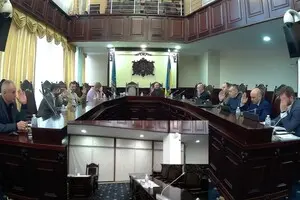
Moreover, it is telling that, according to Yurii Ponomarenko, the letter from the SSU, dated May 24, only reached the commission on June 6. Why? And when can we now expect a final response from the Security Service?
Commenting on the situation, another member of the commission, Oleh Hiliaka, said: “The SSU is busy, so it will respond when it can.” Formally, this is very polite. In essence, it is a demonstration of power. The service, which has simultaneously “checked everything” but is “still investigating,” has become a tool for delaying the process. Referring to the Spider’s Web is a good cover but not an argument in a transparent competition. It is disheartening when the wonderful and dangerous work of some is used by the dirty hands of others.
The influence equation
The formula of the scheme is simple: the SSU is subordinate to the president + a letter without evidence from the SSU ends up in the commission + international experts are forced to take it into account because it is a matter of national security + the candidate is thrown overboard, even without suspicion, just because of a hint.
Proving your innocence afterwards takes years, and the decision will already have been made. And we will find out which of the candidates the SSU will target today or tomorrow.
This is not merely a scheme; it is a new model for eliminating the unwanted. No court decision, no right to defense. One letter—and you're marked, untouchable. Welcome to the 1930s, when one report from a KGB agent could send an entire family to Siberia for ten years. Is this what we are fighting for, what people are dying for on the frontline?
This is no longer about the ESB. It’s about something completely different.
Risks for other competitions
Imagine the following competition, for example, in the NABU. You apply and are considered the favorite. But a few days before the appointment, a piece of paper appears “Has ties to the Russian Federation.” No justification, no evidence. Just a “letter.”
What would you do? Spend five years in court trying to prove you’re not a foreign agent? By then, the position will be long gone—and the label will stick. This isn’t democracy. This is a relapse into the 1930s. It’s the same “Chekist report” that once decided—without trial—who would walk free and who would be sent into exile.

Of course, some may get lucky, like the current deputy head of the SSU, Serhii Naumiuk. He participated in the competition for the post of director of NABU while being the head of one of the bureau’s departments, and even public information about his parents, who lived in the occupied territories for some time, cast a shadow on his candidacy. But Vasyl Maliuk took him as his deputy. Perhaps because Naumiuk is a former SSU officer, or perhaps because the head of the SSU took the facts into account and found no reason to fear for the fate of the state.
The same applies to the Supreme Commander-in-Chief, President Volodymyr Zelenskyy, who appointed Oleksandr Syrskyi as Commander-in-Chief of the Armed Forces of Ukraine. And where do Syrskyi’s parents live? In Russia.
So what is the SSU guided by in the case of the competition for the ESB directorship is an open question. One that already suggests some very unpleasant answers.
The power factor
The goal of the Presidential Office is to ensure that independent candidates simply do not apply for competitions (the “outsiders” will be eliminated anyway), and that international members of the commission (if they remain in place) choose from among those who are under control. Independent candidates are people too. For trying, you become a “foreign agent” and an outcast—a kind of reward for wanting change.
“But we are not in a totalitarian state!” you might say. Are you still sure of that?
The commission for appointing the ESB director is the first precedent. But if this mechanism works, it will definitely be repeated. And not just once. Because it’s convenient. Because it doesn’t require proof. Because it allows avoiding open conflicts—everything is quiet, everything is within the rules. But it is precisely this letter without proof that poses the greatest threat. Because it destroys trust. Because it makes any competition a sham.
It is quite obvious that the SSU is a tool. Why a tool? Because the ESB is, in fact, the former tax police. It is a place where all economic cases are hidden. Gas, oil, cigarettes, road construction, counterfeiting, customs, taxes, gambling—everything related to tax offences. All these cases are on the desk of the head of the ESB. It is a place where cases are not investigated but disappear. When was the last time you heard of the ESB actually bringing a high-profile case to a conclusion?
If the ESB is headed by an independent leader, the Ihor Kolomoiskyi case will simply fall apart. Because the ESB is a structure that operates in a manual mode. They decide who to pressure, which cases to bury and which to promote. It is a completely externally controlled system. It must be kept “under the umbrella.” That is why the ESB is so important—not for the SSU, but for the Presidential Office.
Moreover, according to the law, “the competition commission submits to the Prime Minister of Ukraine no more than two candidates selected from among the participants in the competition for the position of director of the Economic Security Bureau of Ukraine. Within 10 days of receiving the competition commission’s submission with information about the candidates selected as a result of the competition, the Cabinet of Ministers of Ukraine appoints the director of the Economic Security Bureau of Ukraine, who is considered the winner of the competition.”

In other words, a single candidate may be nominated by decision of international experts if they feel pressure from the authorities and a lack of transparency on the part of their Ukrainian colleagues (if at least one government representative ensures a quorum in the commission and switches to the side of light). The authorities cannot stomach this fear.
Leadership that cannot be postponed
We are currently going through a phase where men are too easy a target. War takes them away physically or squeezes them into a fist: keep quiet because of the frontline. If you speak, you are a traitor. If you don’t speak, you are an accomplice. That is why women must take center stage today. Not as a number in reports, not as a quota but as a voice and a value. In reforms. In control. In resistance. Because the flag has fallen. It must be raised by those who still can—and must. It is time to stop this game.
Because this is all about the right to live in a country where:
- accusations are backed by evidence;
- exceptions are subject to decisions;
- participation is a right for all.
If we allow a letter without evidence to become a verdict today, there will be no one left to argue tomorrow. Not to mention EU accession.
Please select it with the mouse and press Ctrl+Enter or Submit a bug
 Follow on Telegram
 Login with Facebook
 Login with Twitter
 Login with Google