
 Support ZN.ua








A Contraband Bouquet: Three Years of Schemes, Millions of Dollars in Losses and No One Held to Account


The customs service has a new head, Orest Mandzii, who previously worked as a senior detective at the National Anti-Corruption Bureau (NABU) and has nearly 30 years’ experience combating economic crime. Among his main priorities Mandzii has named the fight against smuggling and the rooting out of corruption schemes in the customs service. Well, we are glad to help with such an undertaking—and even to show how to identify, quite quickly and very precisely, the foreign trade operations that, without exaggeration, demand urgent intervention.
Our main tool is mirror statistics, a comparison of the official figures of Ukraine’s customs service with those of partner countries. Since the same goods must be declared both as an export and as an import, discrepancies in the figures point directly to smuggling, manipulation and the under-declaration of customs value. Mirror statistics can throw up both volume anomalies and price ones. The former are a sign of smuggling, the latter of manipulation of customs value. Look, analyze, stop—nothing complicated. And there are areas where volume and price discrepancies appear together—and these are the ones that should come first. Because such a bouquet of anomalies is evidence of large-scale, deeply rooted shadow activity. “Bouquet” is a very apt word here, since the example we want to use to illustrate such a compound anomaly is flowers.
When it comes to sheer numbers, only pharmacies can give the flower outlets a run for their money. Before the curfew came in, we were probably almost the only European country with 24-hour flower shops. Demand is steadily high and inelastic. The business is run through sole traders. Cash sales jotted in a notebook instead of a till receipt are the norm, even in 2026. It is less a market than a goldmine. So when we saw the anomalies in the flower mirror data, only one thing surprised us: the customs service’s stubborn refusal to do anything to curb abuses in this market—abuses that, without exaggeration, have gone on for years.
Numbers say it has all wilted
For our analysis, we took the years 2023, 2024 and 2025. Problems turned up everywhere. Our starting point is the Netherlands, perhaps Europe’s largest flower hub. Our key commodities include roses, chrysanthemums and “other”—the catch-all category into which everything that has not earned its own code in the customs statistics is lumped.
The first thing that caught the eye is that the flowers literally vanish on the way to Ukraine. In 2023, 42.6 million flowers went missing. For instance, 18 million roses left the Netherlands for Ukraine and only two million arrived, 16 million having simply disappeared (see Fig. 1). And in Ukraine no one batted an eyelid. Mislaid, rotted, nibbled by mice—these things happen, never mind a loss of more than 80 percent. The same fate befell the chrysanthemums, the lilies, the orchids and the rest of the “other” group.
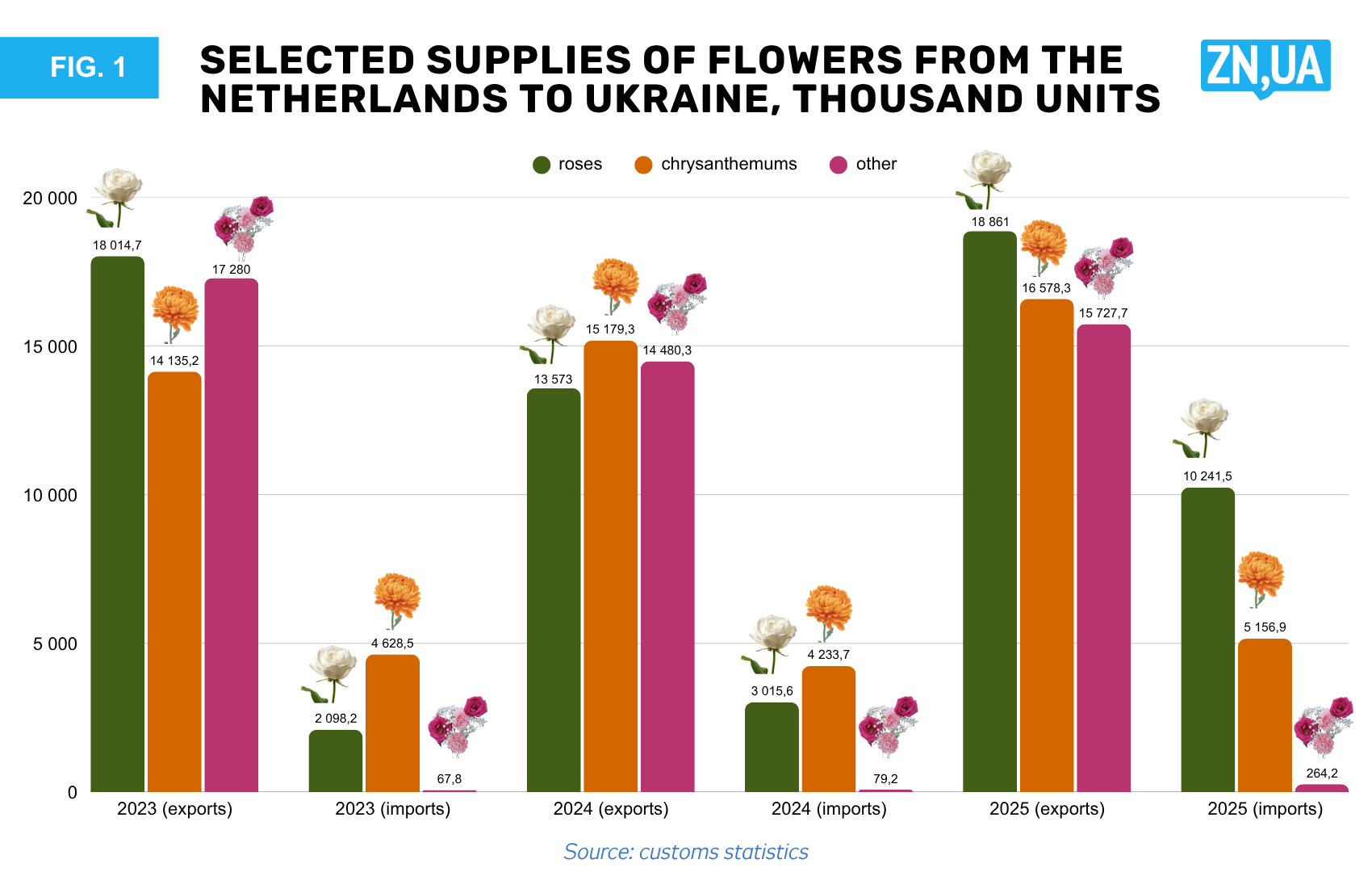
Of course, if there is no reaction—and there was none—you can carry on. So in 2024 the situation repeats itself: more than 13 million roses set off for Ukraine, and three million arrived. Across the three codes we selected, almost 40 million flowers vanish without trace along the way. Did anyone hear of concern over this, of a parliamentary temporary commission of inquiry being convened, of unrest in the customs ranks, of the relevant ministry ordering an urgent investigation? Nothing of the sort.

As a result, according to the 2025 data, another 35.5 million flowers vanish on the way to Ukraine from the Netherlands. True, that is slightly below the previous “records” in volume—but not in money (more on which is below).
Ultimately, at the end of 2025, a temporary commission of inquiry chaired by the MP Halyna Yanchenko was finally convened to address the “flower problem.” Two facts from it give us a full picture of how the customs service itself regards the matter. First, it emerged that the then acting head of customs, Serhii Zviahintsev, had been alerted to the problem long before, yet the situation stubbornly refused to change. Second, the deputy head of the State Customs Service, Vladyslav Suvorov, told the commission that, on the basis of its checks, customs had found discrepancies in only about 30 percent of shipments—and only of roses.
Suppose the checks covered 2025 alone, when fewer roses really did “go missing” than before: 18.8 million left, 10.2 million arrived. That means 46 percent disappeared, and no rounding rules will turn that into 30 percent.
Sadly, no one present pointed out the obvious falsehood to Suvorov. No one cited the rose-import figures for earlier years. No one noted that in that same 2025 almost 70 percent of chrysanthemum shipments had “disappeared.” Everyone silently accepted the 30 percent that found its way into the commission’s official report, evidently to soften the problem. In the end, the participants agreed to keep the matter under control and to carry out raids to inspect suspicious cargoes. Not a word was said on inspecting suspicious customs officers.
Yet anomalies of such magnitude in the volume can be explained by one thing only: smuggling dressed up in paperwork. No external factor could destroy 70–80 percent of the goods en route, and you could not hide that much in a van’s false bottom. These “vanished” flowers certainly did enter Ukraine and were sold here without the proper customs charges being paid and without the subsequent payment of taxes—and, crucially, with the direct assistance of customs officers. Because a gap that size cannot be missed by accident. Since we are talking about a “lucre” running to tens of millions of dollars, the shadow flower traders clearly had enough for the bribes that blinded the customs officers and stripped them of basic arithmetic.
How much are your roses?
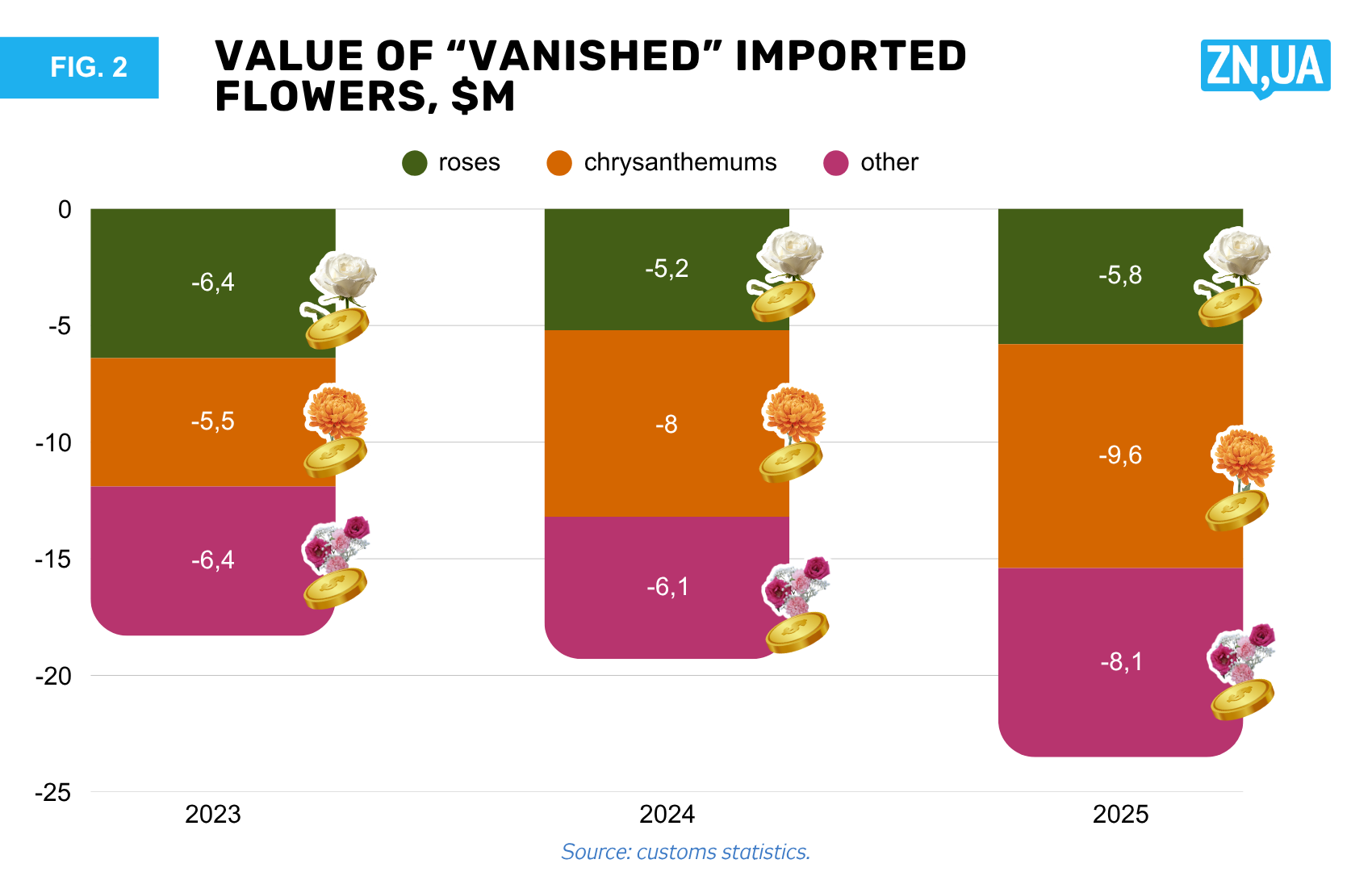
The price anomalies in flower imports are no less striking. To begin with, it is worth looking at the total value of the “vanished” flowers. In essence, these are sums on which neither the 20 percent VAT nor the 5–10 percent duty (depending on the type) was paid. So, according to the mirror statistics for our three codes, in 2023 flowers worth $18.3 million “disappeared,” in 2024 $19.4 million, and in 2025 $23.5 million (see Fig. 2). That is, in 2025 alone the state, was deprived of around $7 million through flower smuggling, and more than $18 million over the three years in all. Our partners have spoiled us so in recent years that sums in the tens of millions no longer impress. And that is a pity because it is roughly the same amount the Netherlands allocated to Ukraine this year to buy transformers to prop up the energy grid. We asked them for it because our own budget could not find the money.
The price anomalies, however, do not stop there. Comparing Dutch export prices with the average import price in Ukraine points clearly to under-declaration of customs value as well. For it turns out that the flowers are bought in the Netherlands for more than they are later sold for in Ukraine. In 2025, for example, the export price of a single rose was 16 cents higher than the import price, and that of a chrysanthemum 29 cents higher (see Fig. 3). Orchids set the 2025 record, with their export value exceeding the import value by $3.20.
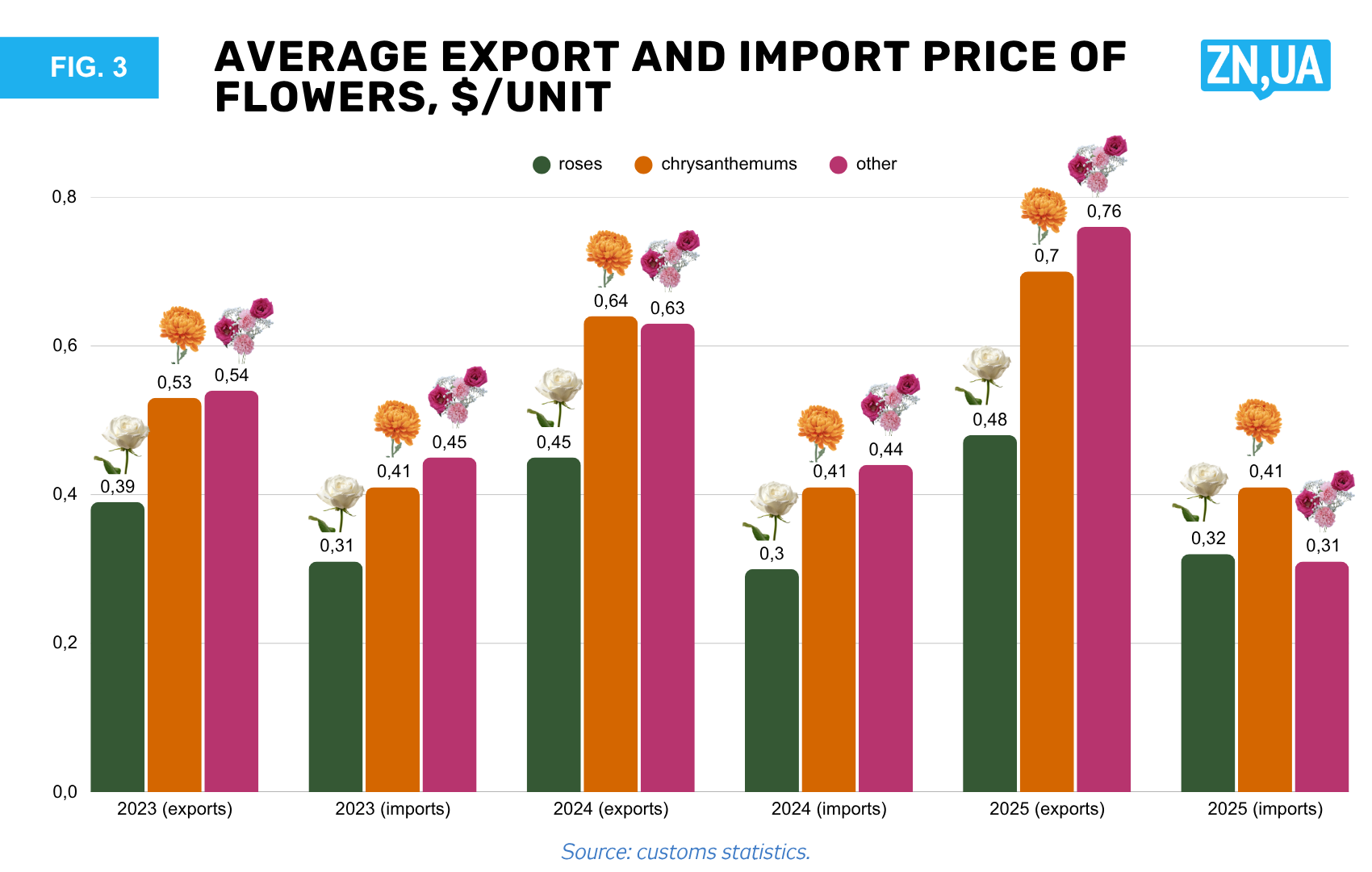
Economically this is nonsense, since the import value includes shipping, insurance and the trader’s own profit, so it is the import value that ought to be the higher of the two. If you see the opposite, it is a sure sign of under-valuation to reduce the customs duties and taxes mentioned above. Arranging it is simple: in the paperwork, instead of “roses” you can write the vague “flowering plants.” It looks much the same—except that the customs value of “flowering plants” is a fifth of that. The customs officer checking the cargo and the documents knows this perfectly well. Yet for some reason, in 2025 alone, the under-valuation of rose imports came to $1.7 million and that of chrysanthemums $1.5 million.
In other words, even the few shipments that, on paper, do reach Ukraine are still not cleared lawfully or with all the due charges paid.
Imagine buying goods to resell, only for 80 percent to vanish on the way, and then deciding to sell the remaining 20 percent for less than you paid. Would such a business be profitable? Could it survive for years?
In essence, the flower traders cheat the Ukrainian budget twice over: either paying nothing at all off the books or underpaying through grey market schemes.
Customs sees both, but, as ever, it is ready for “reasonable compromises” in return for serious money. We analyzed the geography of the trade over these years—and it shifted and expanded. Whereas in 2023 Bulgarian traders exported 70 percent of the roses to Ukraine, new countries were then actively added one after another, the Bulgarians’ dominance was diluted, and by the 2025 figures the United Kingdom had taken first place, with 34 percent of all shipments. Clearly the market was carved up and split, but none of this had any effect on the volume and price anomalies described above because the customs “single window” was always open.
To make sure we are really seeing what we think we are seeing, we analyzed carnation imports into Ukraine. A kind of control group, given the placebo. Why carnations? Because about 80 percent of them come to Ukraine from Turkey, are of Turkish origin and are brought in by a Turkish company. Almost an experiment under sterile conditions. And so, the mirror statistics for these shipments show no anomalies whatsoever. In 2023, for instance, 16.1 million left Turkey at two cents apiece, and 15.99 million arrived in Ukraine, now priced at five cents each. There are minor discrepancies in quantity that can genuinely be put down to objective circumstances. But the main thing is that there are no anomalies in value: the import price in Ukraine is two and a half times the export price. Yes, the Turkish trader does rather well out of his carnations here, but he pays into our budget everything that is owed.
It is, in fact, in the state’s interest for everyone to operate this way. In every sector. Because somehow it works out that the authorities rush to halt smuggling sector by sector and solely in response to scandals. How many waves there have already been: first smartphones, then branded clothing, then coffee, then medicines. Now flowers. And not a single attempt to solve the problem systemically.
***
This year you will hear more than once about a “reset of the customs service”: it has a new head, the Verkhovna Rada has come close to passing a new customs code, preparations have begun for a sweeping re-attestation of both management and the rest of the staff, talks have opened with the finance ministry about raising customs officers’ pay “at least to the level of 72,000 hryvnias,” and there are plans to bring them into the eOselia subsidized mortgage scheme.
What is there to say? Plenty of reasons to promise us that things will no longer be as they were. So let us not forget that this is far from the first “reset,” nor is this the first ambitious customs chief. That the schemes we have described breach both the future code and the one in force. That a large-scale re-attestation already took place in 2019–2020, and in 2023 there were local checks and the suspension of dozens of staff. And the current average customs salary in 2026 stands at 49,000 hryvnias, while stories of the lavish lifestyles of customs officers—lifestyles that match neither 49,000 nor 72,000 a month—have never been in short supply. Above all, throughout this time the customs service had every tool it needed to stop the schemes, but somehow never quite got round to it.
Please select it with the mouse and press Ctrl+Enter or Submit a bug
 Follow on Telegram
 Login with Facebook
 Login with Twitter
 Login with Google