
 Support ZN.ua








UOC-MP Awaiting the End – of War or Its Existence


In the twelfth year of the war and three years since the start of Russia's full-scale invasion of Ukraine, the leadership of the Ukrainian Orthodox Church has finally deemed it necessary to explain to its parishioners and everyone else “why we are Moscow Patriarchate no more.” Metropolitan Onufriy of Kyiv signed an Appeal on the occasion of the third anniversary of the UOC-MP Council in Theophany. Just the third one. For some reason, neither the first nor the second anniversary was honored with such a document.
It’s all in the timing, and the UOC-MP has its own time zone. In a manner that was anything but strange, the Appeal coincided with the end of the term given by law to the UOC-MP organizations to “eliminate signs of affiliation with a foreign governing center.” The other day, Viktor Yelenskyi, head of the State Service for Ethno-Politics and Freedom of Conscience, reminded that all church organizations associated with Russia would be liquidated. The Service also announced an inspection of the Kyiv Metropolis of the UOC-MP.
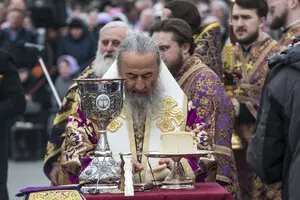
That’s a warning bell — no, more like a tolling alarm from the bell tower. For three years, the Metropolis of Kyiv has refrained from clarification. Alas, it has squandered even the last nine months — if we judge by the wording of the Appeal.
This document conveys an odd impression. At first glance, it is a relatively clear explanation of what happened at the Theophany Council. Yet, it does little to allay doubts. On the contrary, it gives rise to a myriad of new ones.
To begin with, let’s start at least with the way in which the Appeal defines the status of the Council. It emphasizes that it was a legitimate Council, since all the strata of the Church — laity, bishops, monks — took part in it. All formalities and regulations were observed. Nonetheless, there is one word missing that would put many things in their proper place. Instead of calling the Council “local” — which would be natural for an autocephalous local church — the Council, for some reason, was called “full-fledged.”
In listing the decisions of the Council attesting to the “canonical autonomy” of the UOC-MP, the document mentions that the Metropolitan of Kyiv is terminating his membership in the Holy Synod of the Russian Orthodox Church. This does him credit, no doubt. But as practice has shown, this does not apply to other bishops of the UOC-MP, who continued to take part in various (including anti-Ukrainian) Kremlin-sponsored events, visited Moscow and did not even consider it necessary to hide from the cameras. The Metropolis of Kyiv hardly responded to these blatant breaches of discipline and collaborationism. And this can be understood: the decisions of the Council referred only to the Primate. The bishops apparently retain full scope for action.
The same can be said about the decision “not to commemorate Patriarch Kirill.” It provoked an intense debate, yet in practice, nothing changed. Each parish decided (and still decides) whether to commemorate him or not. But such a decision of parishioners and priest is sometimes met with opposition from the bishop. There have been cases when priests who refrained from commemoration got into trouble because of such a decision of the parish. But nothing is heard about the bishop's wrath towards those who do commemorate. Thus, the decision of the Council remained decorative since its implementation was not ensured by the Church leadership. Once again, this calls into question the status of the Council in Theophany: was it a local Council, the main governing body of the Church, whose decisions are binding? Or was it just an “emergency meeting,” whose decisions could be slow-walked depending on the mood of a bishop, a priest or parishioners actively involved in church affairs?
Another ambiguity of the Appeal concerns the establishment of foreign parishes to take care of Ukrainian refugees. Indeed, such a decision was made. And if all other decisions are in limbo (those willing comply; those unwilling disregard), the project “UOC-MP in Europe” is being implemented very actively. All sorts of resources — people, funding and temples — are dedicated to it. And although there is no consensus among experts about how actively the Russian Orthodox Church is involved, there is no doubt about one thing: abroad, the UOC-MP is not just “shepherding the flock”; it keeps the loyalty of it to the “canonical” (aka “Russian”) Orthodoxy. It keeps the “Russian world” in the heads of Ukrainian emigrants. And it does not matter whether these people return to Ukraine after the war or settle in the West; in both places, they will retain their connection with “Holy Rus.”
The strangest passage in the document is about recognition by other local churches: “We hope that the whole family of Autocephalous Local Churches will morally support us, praise our canonical independence and duly recognize it with an appropriate distinction.” So it is only about moral support? And what does “canonical independence” stand for? It is autocephaly? But this word is not used and it seems that the authors of the Appeal carefully avoid this very word. That is, the Appeal does not mention the claims of the UOC-MP to the status of an autocephalous local church, a sister church to the “whole family” of autocephalous local churches.
It remains unclear what kind of “distinction” on the part of world Orthodoxy can be considered “appropriate” in this context. What exactly does the Metropolitan of Kyiv, who signed this Appeal, “hope” for? It also remains unknown whether any practical steps have been taken to turn these hopes into reality. Were there any statements addressed to world Orthodoxy? Yes, there were appeals — to local churches, to American television viewers, to expensive London lawyers and American lobbyists — about “persecution,” violations of rights and the need to “protect the canonical Church.” But not about recognizing the autocephalous canonical status of the UOC-not-MP-anymore.
To be fair, it should be noted that three years ago Metropolitan Onufriy was seriously planning to do this — announce the complete and unconditional separation of the Ukrainian Orthodox Church from the Moscow Patriarchate. Therefore, the documents “to be approved by the Council” were prepared in secret, under the personal guidance of the Metropolitan of Kyiv, and only the closest people had access to them. Yet all of this remained merely the aspirations of the UOC-MP leader, as the Council ultimately fell short of embracing an actual separation. The pro-Moscow lobby repelled the attempt to sever the ties.
The chance for a big game on the chessboard of world Orthodoxy, lost three years ago, will not be regained now, no matter what the Metropolis of Kyiv says. It is not just recognition of autocephaly; the UOC-MP will not even receive the “moral support” it coyly asks for. Had someone more resolute than Patriarch Kirill been in his place, the story of the UOC-MP’s 'separation' could have been fashioned into an intrigue capable of shaking the somewhat numb Orthodox world. For example, to give its Orthodox satellites a tacit instruction to recognize the claims of the UOC-MP. Divide and conquer!
Luckily, however, the current Patriarch of Moscow is an aged Kremlin lackey. He is not supposed to play his own political games and weave his own intrigues. Judging by the latest reports from “ward number 6,” Moscow is spreading the myth that “nobody cancelled the USSR”; therefore, everything Russia does to Ukraine is “our internal issue.” In the sense that Ukraine belongs to Russia. In this respect, there can be no talk of a “separate” UOC. All the more so about an authorization on this from the Moscow Patriarch, explicit or implicit alike.
Thus, the Appeal about “our autocephaly” by the Metropolitan of Kyiv is a last-ditch attempt to wriggle out of a tight spot. At least to stall for time a little longer. Maybe it will be possible to hold out until the ceasefire, and then we can expect that the question of the fate of the UOC-MP in Ukraine will be frozen, at least for the duration of the negotiations. Just the other day, Russian foreign minister Lavrov said that Russia would ensure that “canonical Orthodoxy regains its central place” in Ukraine. Except that the nine months given for re-registration under the law were not enough to survive until the talks. But perhaps the Appeal will be seen by the Ukrainian authorities as a gesture of goodwill, and the verdict — that is, the liquidation of the Metropolis of Kyiv — will be postponed for a little longer.
If it is possible to survive until the negotiations and the MP in Ukraine receives guarantees under pressure from the Kremlin, the current Appeal will turn out to be Metropolitan Onufriy’s personal alone. The Council in Theophany — whatever its status — did not adopt a “severance of ties with Moscow,” so responsibility for the “liberal interpretation” of its decisions and its status can be pinned on one person: Metropolitan Onufriy of Kyiv, who signed the Appeal. Of course, they will not do anything terrible to the elder. They will take into account his age, authority, merits and will peacefully retire him. And someone more loyal will be appointed in his place.
But even if the UOC-MP manages to weave its way through and survive, its influence in the Ukrainian territory will diminish. The shameful position of the UOC-MP on Russian aggression will not be forgotten for a long time to come. It took this church ten years of war, three years of hell (it was not enough) and a direct threat of liquidation to say something clear about its status and attitude to its (former?) Moscow leadership. But even here it was not without guile.
Please select it with the mouse and press Ctrl+Enter or Submit a bug
 Follow on Telegram
 Login with Facebook
 Login with Twitter
 Login with Google