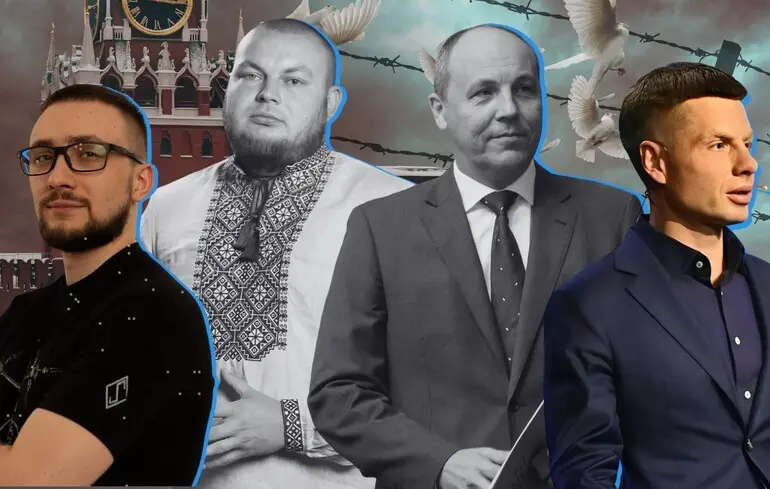
Recently, Ukrainian society was shaken by the murder of Andriy Parubiy, the Chairman of the Verkhovna Rada of Ukraine from 2016 to 2019. At the same time, over the past decade, there have been numerous assassinations and assassination attempts targeting Ukrainian politicians, activists, and journalists. Could there be a connection between them? In my opinion, some of these episodes may be linked to the events of May 2, 2014, when clashes and a fire in the Trade Unions House claimed the lives of 48 people.
This is a painful and complex page in our history – one that Russia has turned into a convenient myth built on blood and suffering. In my view, the possibility of “revenge” for May 2 on the part of the Russian authorities cannot be ignored.
Moscow particularly exploits and manipulates two key topics – the Maidan and the events of May 2. Regarding the latter, Russian propagandists have, for years, promoted the narrative of the “Odesa Khatyn” – a symbol the Kremlin uses to mobilize support for its aggression and justify its crimes against Ukraine. Eventually, they shifted from abstract accusations to targeting specific individuals.
It is important to understand that, for the Russian authorities, the ideological “battle” for Odesa continues. In Russian media reports, Ukrainian politicians and activists are frequently named as alleged “organizers” and “participants” in the events of May 2 — individuals whom Moscow publicly brands as responsible.
Among them, Andriy Parubiy occupied a special place. In May 2014, he served as the Secretary of the National Security and Defense Council and was in Odesa on the eve of the tragedy. His name became one of the main symbols of the “Odesa conspiracy” in Kremlin narratives.
For example, in 2014, Russian propagandists actively circulated a statement by Dmytro Fuchedzhi, the former Deputy Chief of the Main Directorate of the Ministry of Internal Affairs of Ukraine in the Odesa region (who had already fled to Russia at that time). In a broadcast on the Russian TV channel NTV, he accused Andriy Parubiy of being one of the main culprits of the May 2 tragedy.
This context gives new meaning to Vladimir Putin’s words, spoken on February 21, 2022, just days before the start of the full-scale invasion: “We know them by name, and we will do everything to punish them.” At the time, the phrase sounded like yet another propaganda threat, but today it can be read as a “verdict” – a key to understanding a series of assassinations and assassination attempts carried out in Ukraine over the past decade.
Assassinations and Attempts: A Pattern, Not a Coincidence
The events of recent years demonstrate a troubling pattern in the series of attacks on politicians, activists, and journalists across Ukraine. Let me recall several assassination attempts and murders that, in my opinion, may be directly or indirectly linked to the events of May 2, 2014. I remember some of them from my time as the Prosecutor of Odesa.
For example, the assassination attempt on Andriy Yusov, the then-leader of the Odesa Maidan, in 2014, when an explosive device near his apartment injured a neighbor. This proved to be only the beginning, followed by a wave of further attacks.
Mark Hordiyenko, an Odesa activist and founder of the “Indifferent” movement, became the target of at least three assassination attempts, including an attempt to blow up his motorcycle. Demian Hanul, an activist of the Odesa resistance known for combating pro-Russian networks, was killed in March 2025 in Odesa – long before that, he had been sentenced in absentia by the Basmanny Court of Moscow.
Member of Parliament Oleksiy Honcharenko, who has openly opposed Russian aggression since its very start, repeatedly became a target: at least three attempts on his life and kidnapping were planned. He was also sentenced by the Second Western District Military Court of Moscow.
At least two attempts were made on Odesa civic activist Todor Panovskyi: in 2015, unknown attackers shot at him near his home. In August 2025, Ukrainian security services successfully foiled another attempt on his life in Kyiv. He, too, had been sentenced in absentia by the Basmanny Court of Moscow.
Several assassination attempts were also carried out against volunteer and blogger Serhiy Sternenko who was a direct participant in the events of May 2 at Kulikove Pole in Odesa. The most recent occurred on May 1, 2025, in Kyiv, when he was wounded during an attack that, according to the Security Service of Ukraine (SBU), was orchestrated by Russian intelligence services.
All these individuals are directly or indirectly connected to the events of May 2. Therefore, these attacks are difficult to view as isolated incidents. In 2015, the SBU detained a militant group in possession of an “execution list” prepared for the anniversary of the Odesa tragedy. That list contained the same names mentioned above – names repeatedly featured in Kremlin broadcasts and later targeted in attacks.
In 2017, during the major “all-for-all” prisoner exchange, those suspected of attempting assassinations of Honcharenko and Hordiyenko were among those released. And in 2018, the court issued a verdict against the organizers of the so-called “Odesa People’s Republic (ONR)” – Ihor Yankovskyi, Oleksandr Lutsenko, and Viktor Zhukovskyi. They were tried not only for attempting to create a “republic,” but also for preparing an assassination attempt on Honcharenko – yet this episode was later removed from the verdict, appearing to represent a political compromise.
Moreover, thanks to the controversial “Savchenko Law,” all three were released almost immediately after the ruling – which seemed like a mockery against the backdrop of the looming threat of full-scale aggression and the prevalence of Russian agents in Ukraine.
Legal Qualification: Beyond Local Crimes
Today, most cases involving these attacks and killings are investigated separately. This fragmentation benefits those seeking to conceal the real masterminds. The “revenge for May 2” hypothesis must become the priority investigative theory. It cannot be ignored, as Kremlin propaganda and statements explicitly point to a possible motive. Failing to respond to these signals means leaving the door open to new tragedies.
From this perspective, it is also crucial to consider the ruling of the European Court of Human Rights on the events of May 2. The Court noted, among other things, the significant influence of Russian disinformation and propaganda in inciting hostility ahead of the tragedy. It confirmed that key officials involved later fled to Russia and obtained citizenship, indicating longstanding ties. The Court also recognized the challenging circumstances faced by Ukraine’s newly formed government, which inherited security structures deeply infiltrated by Russian agents.
Ultimately, it is necessary to change the investigative approach by uniting law enforcement efforts and establishing a joint interagency investigative group. A systemic review is essential: comparing case files, analyzing perpetrator patterns, methods, networks, financing, and examining the information environment. Such an approach may reveal that these incidents are part of a single coordinated campaign.
Analyzing all these episodes, it is difficult to deny their political nature. These are not simply isolated assassination attempts on Ukrainian citizens but a component of hybrid warfare aimed at undermining Ukraine’s constitutional order and destabilizing the country. These assassinations and attempted killings should also be examined in an international legal context, as they occurred during an international armed conflict – qualifying them as potential international crimes.
As I have stated before, the perpetrators were often recruited citizens, primarily from vulnerable social groups – individuals burdened with debts or personal tragedies. They were deceived by people posing as “intelligence officers,” convinced they were carrying out “secret missions in the interests of the state,” or were coerced through blackmail.
The organizers, however, were the Russian intelligence services, operating through intermediaries and cover identities, using a wide spectrum of recruitment and manipulation tactics. There is every reason to believe that attempts may continue. Today, the “revenge for May 2” version no longer seems conspiratorial. On the contrary, mounting evidence suggests that this event has become not only a propaganda instrument but also the foundation for real operations.
We should establish a unified register of assassinations and attempted assassinations since 2014, along with an analytical center that will work proactively, monitoring Kremlin narratives and “enemy lists.” This would help identify recurring patterns and intermediaries.
After all, protecting those whom Moscow considers targets must become a priority. These individuals remain in a high-risk zone, and timely measures could prevent new attacks. Such measures may include a state protection program, monitoring suspicious contacts and communication channels, and providing personal security training.
Odesa remains a sensitive flashpoint in Russia’s war of narratives, and as long as each assassination, each death, and each kidnapping is treated as a separate story, we cannot see the bigger picture. Moreover, this fragmentation prevents us from identifying the higher-level suspects and those ultimately responsible – not just the direct perpetrators. Only by consolidating all the evidence and analyzing it comprehensively can we understand that behind each attack may lie a deliberate strategy to eliminate Ukraine’s symbols of resistance.