
 Support ZN.ua










Russia Repeats the Third Reich: How “Alternative Truth” Is Created
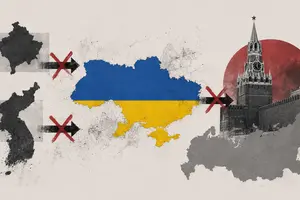
Not Kosovo and not Korea: what the west still doesn’t understand about Russia’s war against Ukraine

19 june, 2026, 13:00
Share
How do you end the war in Ukraine?
An answer to that question could save millions of lives, open the way to large-scale reconstruction and help consolidate Europe’s democratic forces. It is being sought not only in the corridors of government in Ukraine and other states. Recently, several political commentators came forward to argue that the answer for Ukraine might lie in the Kosovo model, or to reach for parallels with Korea, Vietnam and even the Cold War. The Berlin-based journalist Paul Hockenos, in an article in Foreign Affairs, drew an insistent parallel with the Balkan wars and the situation around Kosovo, while Korea and the Cold War were invoked, among others, by the British historian and writer Niall Ferguson on X. Such inept comparisons are further confirmation that many in the West are still laboring under illusions about Russia, failing to grasp the causes of this war and its consequences for the world order. While acknowledging the profound changes to the global security architecture wrought by the worst aggression in Europe since World War I, even Ukraine’s supporters somehow cannot see the difference between the present situation and the wars of the past. The appearance of such analogies is harmful in that it creates among the public the illusion that diplomatic routes to a settlement exist, and that Ukraine is simply rejecting them.
ВАС ЗАИНТЕРЕСУЕТ
In Ukraine, there was never an ideological conflict, as in Korea or Vietnam, still less a clash of systems of the kind seen in the Cold War. There was no civil war in Ukraine, nor even the slightest violent conflict between Ukrainians living in Kyiv and Donetsk, in Lviv or Crimea. The armies of foreign states have never fought on Ukrainian soil; even North Koreans die for Putin only on the Russian side. Before the incursion of the “little green men” into Crimea and the provocations of Girkin’s thugs in Donetsk in 2014, people from Ukraine’s south and east held key posts in government departments. Most of the prominent figures of the business elite had their roots precisely in the country’s east and south. The Russian language enjoyed the same status as the languages of other national minorities, yet no one was forbidding anyone from speaking whichever they pleased. The combined share won by right-wing parties at elections was at most 2 percent. It was Russian propaganda, and the feeble response of a government riddled with Russian agents, that fed an artificially imposed political agenda built on fabrications about the causes and consequences of the Revolution of Dignity. Russian citizens in key positions in the state contrived to paint a picture of a conflict that had in fact never existed. To compare the situation on the Korean peninsula (where, incidentally, a lasting peace has still never come) or in Vietnam with Ukraine is profoundly unfair and dangerous. We may expect some expert or other to surface who will invoke the Turkish Republic of Northern Cyprus, where a religious factor was at work as well. Hardly anything could be further from reality where Ukraine is concerned.
Comparing Kosovo with Ukraine provokes outrage. Serbia was not, and is not, a permanent member of the UN Security Council with the world’s largest nuclear arsenal. Ukraine was not part of Russia at the start of the war. Ukraine’s independence and sovereignty were recognised by the world, including Russia itself, as long ago as 1991. Hundreds of intergovernmental agreements were signed between Ukraine and Russia, ratified by the State Duma. The Kosovo conflict is better compared to Chechnya’s attempt to leave the empire—an attempt brutally crushed by that same Putin. Ukraine has nothing in common with this model, and it is therefore impossible to fathom where such analogies come from.
The Western mistaken perception of Russia has deep roots. The collapse of the Soviet Union was misread in Washington as the end of the cold war. Euphoria at the feeble stirrings of democracy in Yeltsin’s Russia paralysed the west’s capacity for critical analysis. In reality, the documented co-ordination of foreign-policy matters between Russia and the United States throughout the Yeltsin decade attests to the continuation of Russia’s imperial policy in its sphere of influence across the post-Soviet space, even in that “decade of democracy.” And that policy met no sufficiently firm rebuff from the United States—on the contrary, it was encouraged. Yet Yeltsin did not consign the remnants of Lenin and Stalin to the scrapheap; he went on haggling with Clinton over the ordering of the post-Soviet space and demanding money for it. It was under Yeltsin that Russia and China first set out their conception of a “multipolar” world at the UN. It was the then-weak Beijing, not the mighty Washington, that was Russia’s real ally. The Budapest Memorandum could have stood as a historic example of disarmament and denuclearization; instead it is now seen as the greatest failure of all. No state will agree to disarm voluntarily with such a precedent before its eyes.
So how, then, do you end the war in Ukraine, if no historical precedent applies? It would be important to make the case, and to bring home to our partners and to western intellectuals, several simple propositions that require no proof. For Ukrainians they are axioms. First, war is the natural mode of existence of the Russian state. It understands only force, and reads any attempt at diplomacy as weakness. This was always so, and under the reign of tsar Putin all the more. Second, for Russia any peace is the continuation of war by other means. In the intervals between acts of aggression it manufactures weapons, brainwashes its own population, mounts espionage provocations and prepares for the next round. Third, no agreement with Putin’s Russia can be trusted. They lie incessantly. In the end, for decades they tried and yet never managed to build an industrial economy capable of producing anything of significance besides weapons. The oligarchy clustered around the Kremlin generates a colossal gulf—one of the widest in the world—between a handful of the rich and an impoverished mass. That is precisely why they cannot reconcile themselves to their own squalid lot and set about wrecking any attempt by neighbouring countries to build a prosperous, civilised society. Russia openly stands against human values, democracy and the remaining foundations of the liberal world order. Acting in concert with other revisionist states—China, North Korea and Iran—it has contrived to wreck the world order. This will go on for as long as the Putin regime is not destroyed. These are the words of Putin’s own ideologues: a world in which Russia is not great has no right to exist.

The West and its partners must finally grasp that no policy of appeasement towards Russia works. No artificially imposed settlement, no conditional peace, no mere ceasefire will secure a stable peace for as long as this regime in Russia is not dismantled. Instead of squandering precious time debating the figures of Schröder or Merkel as possible negotiators, and bickering over the format of the talks and the line-up of participants, there is an urgent need to build a new and powerful coalition of European states in the form of a military alliance capable of withstanding any attempt by Russia to renew its aggression after the war. The backbone of such a coalition ought to be the Scandinavian and Baltic states (which, at last, are now talking about this seriously), Poland, Romania, Britain and Germany, France and the Netherlands, and Turkey. Ukraine must be part of it, and ready to send its army to the aid of any other member of the alliance should that member be attacked. Recent polls show that a majority of Ukrainians support this idea.
Yet a country cannot be stronger abroad than it is at home, as John F Kennedy said. The appalling corruption scandals that meet with no adequate response; the chaotic, unsystematic conduct of international co-operation in the defense industry; the triumph of spin over common sense when it comes to producing advanced weaponry—missiles and drones above all (witness the endless interviews given by Denys Shtilerman about our present and future missiles, right at the edge of disclosing state secrets, if not beyond it)—all of these are factors that divide society and hold foreign partners back.
Among our key well-wishers, including Britain, Italy, Germany and France, today’s leaders have right-wing pro-Russian forces breathing down their necks—forces that, as has already happened in Bulgaria, may come to power. The tension with Poland calls for separate discussion, as does what awaits us in relations with Hungary. In such a situation, Ukrainian society ought to be a model of unity and self-cleansing. Instead, new zones of tension are being created as if on purpose, not least in the sphere of culture and historical memory. Yet another reconstruction conference and yet another government economic-growth programme will not substitute for radical political reform, a new constitution and the forging of a model for a future, successful Ukraine through dialogue between the main political forces and civil society. But everyone capable of writing and speaking has already written and spoken of this. No one is listening. What remains is to do as Ukraine’s great poets urged: to keep breaking this rock, in Ivan Franko’s image of relentless, self-sacrificing labor for the nation, and never to fall in love with the Muscovites, in Taras Shevchenko’s famous warning against giving one’s heart to the Russians.
Noticed an error?
Please select it with the mouse and press Ctrl+Enter or Submit a bug
Stay up to date with the latest developments!
Subscribe to our channel in Telegram
 Follow on Telegram
Пожалуйста выберите один или несколько пунктов (до 3 шт.) которые по Вашему мнению определяет этот комментарий.
Пожалуйста выберите один или больше пунктов
Нецензурная лексика, ругань
Флуд
Нарушение действующего законодательства Украины
Оскорбление участников дискуссии
Реклама
Разжигание розни
Признаки троллинга и провокации
Другая причина
Отмена
Отправить жалобу
ОК
 Login with Facebook
 Login with Twitter
 Login with Google