
 Support ZN.ua








Clad in White Yet Bound by Flesh



Twelve years ago, when Archbishop Jorge Mario Bergoglio of Buenos Aires was elected Pope, the world was revitalized. It was something new — a non-European Pope, a Pope from the Global South. More importantly, it seemed this would be the man to pick up the fallen banner of the beloved Pope John Paul II.
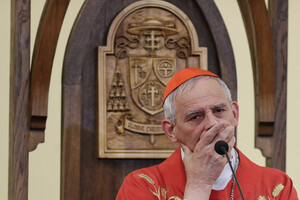
John Paul II, the tireless traveling Pope, had opened up the Catholic world.
It was hoped that the Argentine Pope would take the next step: to give this church, often perceived as a patchwork quilt canopy on the globe, a sense of genuine unity, a unity of “equal” and “different,” a universality granted to the church by nature, divine law, and earthly doctrine.
Some of those expectations were met. This includes, for instance, reforming the governance of the Catholic Church. Talk of “Curia Reform” is as old as the Curia itself. But it was Pope Bergoglio, his secular name, who managed to push those efforts beyond mere talk.
However, the long-awaited governance reform – the shift from a “Rome-centered” model to a “synodal” one – was, for the most part, an internal and almost technical shift. Yet the Pope is always more than just the “boss of all Catholics.”
No matter how skeptical we may be, we still keep the figure in white within our field of vision. He remains one of the planet’s few remaining truly global moral voices whose words carry weight for people in every corner of the world. A truly universal figure.
From Pope Francis, people expected a preacher of universalism. Someone who could convincingly show that globalization is not the only – and not even the best – way to overcome conflict and division. Who, if not this deliberately non-Roman Pope?
Pope Bergoglio did succeed in shifting the focus away from the Global North (or, from our perspective, the West) as the world’s rule-setter, administrator, and enforcer, toward the Global South, which pays the price for others’ decisions in the form of poverty, climate change, and wars. The Pope wanted to be an advocate for the part of the world “whose voice goes unheard,” whose interests are trampled. And he tried, God sees he did.
However, choosing not to associate with the West and distancing himself from the “rich” do not automatically mean becoming “universal.” In refusing to be “the voice of Rome,” Pope Bergoglio did not become “the voice of the world.” He remained a Latin American Pope, and his origins marked his entire pontificate, for better and worse.

Pope Francis failed to build a strong relationship with the United States. Despite the Catholic Church’s considerable presence there, he found no common ground with either Joe Biden or J.D. Vance, both Catholics. His one significant diplomatic achievement in the Americas – helping to end Cuba’s isolation – was driven by concern for the suffering of the Cuban people. There was more warmth in his embrace of Fidel Castro than in any tone he ever took with the U.S. president.
Pope Francis appeared just as “foreign” from the perspective of Eastern Europe, a region he didn’t understand and didn’t particularly try to understand. He preferred to move in the wake of familiar Latin American geopolitical views and the traditional Vatican diplomacy that, for the past five centuries, has been focused on Moscow.
One might assume that Bergoglio’s Argentine background was more of a hindrance than a help here. Leftist ideologies, dictatorships, and post-colonial narratives felt uncannily familiar yet irreconcilably foreign. Nothing is more misleading than something that merely appears similar, and it creates the illusion of understanding.
It’s no surprise, then, that in Ukraine’s “epilogue” to Francis’s pontificate, the dominant tone is resentment. And there are reasons for it.
Even though our grievances toward Pope Bergoglio say as much about us as they do about him. However much he may have tried to distance himself from Rome, in his approach to Ukraine he remained firmly within the spirit of curial Ostpolitik.
If Pope Bergoglio was called a “bridge-builder,” then for him, Ukraine seemed to be merely one span in a bridge arching from the colonnade of St. Peter’s Basilica to the Kremlin’s gates.
This was evident not only in his words but in his actions. In the Havana Declaration, the 2016 joint declaration with Russia’s Patriarch Kirill, for instance. Or in the fact that, while appointing a record number of cardinals from around the globe, Pope Bergoglio conspicuously sidestepped Ukraine: among the new cardinals, only one represented the Ukrainian Greek Catholic Church, and he was from Australia, not Ukraine.
At the very least, on our corner of the map, Pope Bergoglio’s “universalism” had clear boundaries: it ended where Russian liberalism ended—with the Ukrainian question—or, at the very least, with the “Uniate” one.
To be fair, it must be said that assessing Pope Bergoglio’s contribution to Russia’s war is not easy at this moment. Vatican diplomacy adheres to the principle of “keeping the doors open.” Even when it seems that those are no longer doors, but the gates of hell, as long as it’s still possible to negotiate through them, even through a narrow crack or a keyhole.
While the Pope was giving benevolent speeches about a “great culture” and a “great people,” about the “courage of the white flag” and “peace at any cost,” the Vatican, through its “ajar doors,” was negotiating the release of Ukrainian prisoners of war and the return of abducted Ukrainian children to their homeland.
What was done – and not done – can only be fully assessed when the relevant archives are opened. And that is never a quick process in the Vatican. But one thing can already be said: Pope Francis’s help in Russia’s war certainly cannot be reduced to the two Mavic drones that became Ukraine’s epitaph on the pontiff’s gravestone. An epitaph full of hate.
For Ukrainians, what is said has always mattered more than what is done. And Pope Francis had a way of saying things that made not only Ukrainians but the entire world pause, mouths agape. Then everyone watched compassionately as the Holy See Press Office director twisted himself into knots reinterpreting, “The Pope didn’t mean it that way.” Meanwhile, the pontiff’s face remained as serene as ever.
He became famous, and may well go down in history, as the “ambiguous Pope.” The Pope cultivated ambiguity, the general verdict of his critics. Where once everything was clear and defined, where the “natural” and the “outrageous” were divided by a bold line, where black and white didn’t dissolve into shades of gray, Pope Francis, almost playfully, would draw a fog over it all.
Everything became uncertain. Not just “aggressor and victim.” But also the blessing (though not a church wedding) of same-sex couples. Recognition of the right of gay men to be priests. Welcoming back into the church (i.e., allowing communion) those in second marriages. The ordination of women, if not as priests, then at least as deaconesses.
But here’s what’s interesting: it was only in words. The Pope’s speeches were always more radical than his actions. Even when backed by deeds, they amounted to tiny, sporadic changes, insufficient to shake the world or crack the monolith of church tradition. Pope Francis never intended to destroy anything. On the contrary, he seemed to be a very delicate person, perhaps too delicate. A man who doubted. And who made every effort to share his doubts with others. Especially with those who were too sure.
Of course, Pope Francis was " ambiguous " because he aimed to be. As the head of the church, he had the power to reform the institution. As the Pope, infallible in matters of faith, he could have altered dogma.
But Pope Francis was not a revolutionary but an apostle of openness, a preacher of the possible. What he broadcast into the world was more a set of reflections than a set of directives. He shared thoughts, not a political agenda. Perhaps, with the humility so characteristic of him, Pope Francis saw himself as merely an episode in Divine Providence. And he sought a way to change the world without destroying it.
The figure of Pope Bergoglio appears somewhat awkward, something that never bothered him, but also somewhat tragic. His desire to sow doubt to overcome false certainty didn’t match the historical moment. If only the world had been in a more stable state. If only there had not been such an overwhelming demand for firm boundaries and clear definitions. A demand for simple, straightforward answers. Leave no ambiguity. For the imperative to “take a side” and “name evil by its name.”
But there is no such thing as a perfect moment in this world. And there is no ideal person, even if he sits clad in white on the Chair of Saint Peter. Pope Francis was deliberately imperfect.
By calling the Pope “ambiguous” and his words “equivocal,” we are, in fact, reproaching him. But for Pope Francis himself, this was likely not a reproach at all. It was his style. And his purpose. There is no clarity in love. Love is full of ambiguity. But is there any other way to unite “the different and the equal”? Is there another formula for the universalism we expected from Pope Francis, the one we await from the church and the world as a whole?
Read this article in Ukrainian and russian.
Please select it with the mouse and press Ctrl+Enter or Submit a bug
 Follow on Telegram
 Login with Facebook
 Login with Twitter
 Login with Google