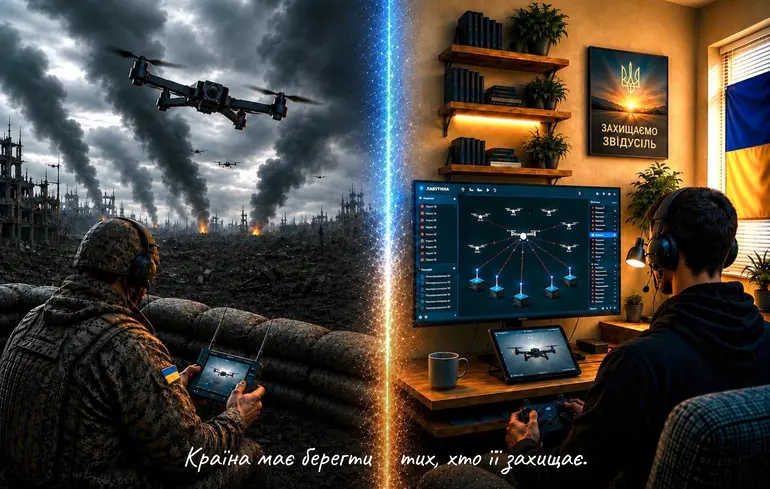
From the Editor: Can a person defend their country while sitting at a computer with a cup of coffee, thousands of kilometres from the front? A year ago to the day, Operation Spider’s Web stunned the world—and ever since, that question has no longer looked merely theoretical.
In Ukraine there are queues outside the enlistment offices again. In them stand young men and not-so-young ones of sturdy build, fellows with little paunches, pensioners, people with disabilities, young and beautiful ladies, and wise women of a certain age… School pupils and students hover nearby, trying to disguise their under-age status and slip into the army. On the streets it is no longer the draft-dodgers who are hunted but the staff of the recruitment centres, cajoled into “helping someone get into” a good unit. The post of “recruitment-center officer” has become wildly prestigious, and anyone with such an official in the family or among their friends simply cannot fend off the pleas to help with mobilization. The clamor is so great that the authorities are rolling out mobile recruitment hubs, and enlistment in particular units is opening up through the Diia and Reserve+ apps. From abroad, people who only yesterday were keeping well away from the war are beginning to come home, now eager to join Ukraine’s defense forces.
Fantasy? Out of the question?
“It can’t be!” you will say.
“Why not?” I will reply.
Are Ukrainians really incapable of producing the kind of breakthrough ideas that can change This World? Have we not shown the rest of the world how we can turn the course of history at the very moment when everyone around has lost heart and given up psychologically? Did we not do exactly that in the past? Are we not doing it right now?
So how, in practical terms, do we change the paradigm of a war that is grinding—or rather has already ground—into a dead end of mutual destruction between two states condemned to spend long years as, at the very least, “non-friends” and, at most, implacable enemies? The broad vision of this was set out in my earlier article, How to Change the Paradigm of War: Hi-tech Triad vs Nuclear Deterrence. Now for the specifics—the mechanisms that can turn the concept into reality.
I will begin with the technological solutions that could once again make defending the country attractive on a mass scale—the way it was in the first days of the full-scale invasion, when thousands of people, my brothers-in-arms and I among them, took up arms voluntarily, without lengthy deliberation, without orders, summonses or coercion.
Spider’s Web (the beginning)
One such turning point was Spider’s Web. It was operations like this that began to show that technology can change not only the effectiveness of combat but the very model of human participation in war.
I think that now, a year on, it is finally possible to lift the lid on a few aspects of how the technological components of that historic operation first came together—an operation that radically changed how smaller countries see the logic and the tools of standing up to an enemy of far greater military potential.
Intelligence officers took notice of our work after analyzing the technical solutions of other FPV-drone makers, and settled on our Osa drone—a quadcopter that, at the time, stood out noticeably from most of what was being produced in Ukraine.
An early version of this very FPV copter was first presented in August 2022 to the then commander-in-chief of the Armed Forces, Valery Zaluzhny. After that we wrote a Concept for the Use of FPV Drones. For anyone curious about how the FPV era began in Ukraine, the link is here.
But first things first. At the start of the full-scale invasion, fully fledged UAV units began to form within various combat formations. My comrades and I started doing this in the special-purpose company of the 3066th brigade of Ukraine’s National Guard. We set about building a complete unit and looking for pilots, snipers, assault troops, equipment, supplies and the rest. And when I learned that there was another group of pilots in my unit, I decided to lure them over. I spoke to the brigade commander—at the time it was Dmytro Tsymbal, who backed the creation of the new UAV combat team in almost everything, without hesitation. And he says to me: “No problem, you can talk to them, but they won’t come over—they’re perfectly happy where they are. They don’t go anywhere; they do combat work—and, crucially, effective work—at night, practically as if they were at home, with a little cup of coffee in hand.” And he told me about the system they had perfected: combat bomber drones with satellite links were carried out to a safe spot and activated near the line of contact by rank-and-file soldiers of a unit on combat assignment, while professionally trained pilots, in the calm of Kyiv, carried out the tasks of neutralizing the enemy, without ever exposing themselves to the risk of being spotted and killed.
This tactic—though with a different and far more complex solution, both in the preparation and in the execution of the operation itself—was realized in Operation Spider’s Web. It demonstrated, almost flawlessly, what is possible when strike drones are controlled remotely by pilots who may be thousands of kilometers from the target. We were among the first to attempt such things, though via LTE modems, in the Kherson region, using Russian SIM cards. That technological solution was later embodied in the drones that took part in the now-famous operation.
And what if we scaled this model up?
Even then I had the idea of scaling up the Spider’s Web experience for use in special operations along the entire line of contact. I remember turning over in my hands that 151st “Spider’s Web” drone, the one we had left over and on which we trained the pilots for the combat operation. And it was precisely then that I returned to an idea that, at the start of the full-scale war, had seemed almost like science fiction.
What if we built a system in which drones are activated near the line of contact while pilots in different countries carry out combat missions remotely, in real time? In effect, this is a new kind of war—one in which technology erases the physical distance between the war and the person taking part in it from far away.
Back then, I was held back by moral and legal questions. To what extent is it permissible to involve civilians from other countries in real combat? How should this be regulated by law? Where is the line between an operator, a volunteer, a gamer and a full participant in the war?
But now, with the experience of working with foreigners from the international legion, all of this can be properly formalized and made to work. And, in doing so, we can solve the very problems now arising from the reorganization of the foreign legion.
For a couple of months now, we have been working on developing and implementing a full-fledged Concept of Remote Drone Warfare (RDW).
Its essence lies in creating a model in which a significant share of combat tasks can be carried out remotely by trained operators, with no physical presence directly in the combat zone.
In our view, such a system is capable not only of partly changing the logic of mobilization, but also of substantially lowering the psychological barrier to taking part in the war and the fear of death, while at the same time greatly widening the circle of people who can contribute to the country’s defense, regardless of age, sex or physical fitness.
Now it is worth briefly setting out the mechanisms of implementation themselves, and the steps that need to be taken at the level of the General Staff, the Ministry of Defense, the intelligence services and the state as a whole, along with the technical solutions that already make it possible to do what could not be done yesterday.
- Building a network of strike and reconnaissance assets prepared for remote control, in the locations that best serve the aim of carrying out the assigned tasks successfully.
Remote-control tools have not merely been developed and tested; they are beginning to be actively deployed. Interceptor drones, controlled remotely by pilots thousands of kilometers away, have already been used against Shaheds. Remotely operated turrets are already in service in short-range air defense, with operators stationed in protected locations. Surface drones, crewed by teams that may be based in another country, are already operating successfully. We are already discussing with the command of the Air Force and the Main Directorate of Electronic Warfare and Cybersecurity the automation of moving and controlling air-defence and EW assets mounted on unmanned ground robotic systems (UGVs), copters and remotely controlled vehicles. This is not only about effectiveness, but about reducing the need for scarce personnel.
A separate story is scaling the Spider’s Web principle (working title: “New Spider’s Web”) across the entire line of contact, and also to sectoral and point defense. Here we refer to so-called fly-boxes—platforms carrying drones that are positioned, statically or on the move, at suitable points, waiting to be activated and taking off to carry out combat missions at the right moment.
- Building reliable communications systems for the remote control of these assets.
To deploy remote control, we need a stable link between the base station (the operator) and the drones themselves. This can be done through a variety of solutions depending on the operational situation and where operations are conducted (satellite links, LTE modems, mesh networks and others). It is also important to have secure additional communication channels based on cryptographic protection. They must, without fail, be duplicated, preferably with different solutions from several manufacturers—so that if one system goes down, or is attacked or compromised from within (through the successful actions of enemy agents, for example), we still have the ability to work over an alternative link, losing neither time nor combat potential.
- Testing and the maximum possible scaling of technical solutions and assets.
Practical testing of the technical solutions and equipment that could be used in RDW is already under way: on the front line, in the course of the sectoral defense of Ukrainian territory, in repelling attacks on critical-infrastructure facilities and so on. Now both the solutions already worked out and the new ideas need to be scaled up and brought together into a single Combat Management System, one component of which could be a situational-awareness system (SA). After some refinement, Delta—which has proved itself spectacularly in this war and is being integrated into NATO—could rise to that challenge. Or another system, created specifically for the new project and drawing on AI, ML (machine learning) and the like.
- Developing new approaches to mobilization and other types of contract, with clear obligations not only for those mobilized but also for the state towards them.
This is one of the most important points in the whole proposed RDW Concept. I would sum it up in a single, supremely important word: TRUST. This is the word that has been forgotten and lost in the conduct of mobilization, somewhere from around 2023, within the “society – state – military” triangle. The result is a deeply paradoxical situation: society trusts the Armed Forces most of all. And yet where does it least want to go? Into the Armed Forces!
The chasm of distrust towards the way the recruitment centers operate—filling the ranks of the Armed Forces by what is now effectively coercion—widens by the day, in geometric progression. That is why the old approach must be changed without delay.
In the words of the commander-in-chief of the Armed Forces, “work is already under way on the gradual transition of the army from a mobilization-based to a contract-based model of recruitment, and the task has been set to prepare specific General Staff proposals on new formats of contract service”.
So let us create these formats and make this model truly new, so that it matches the new realities of the new technological war of drones. If that requires replacing or reinforcing the human resources to meet the new challenges of technological war, then we must act now, without waiting for the enemy to put it into practice faster than we do.
- Launching a broad communication campaign that conveys the new approaches to defending the country honestly, transparently and clearly.
I want to address separately those who, like me, took up arms in the first days of the full-scale war. Of those volunteers who, back then, threw themselves into defending the country without a second thought, there are now almost none left. And perhaps the best of us have, sadly, already departed for Other Worlds.
This is a reality that has to be accepted. And instead of trying to break those who, for various reasons, are not ready today to fight in the classic format, we ought to create a new model of taking part in the country’s defense—one that is technological and offers better protection—and invite people into it. Not push them away. Not split society into the “right” people and the “wrong” ones. But give people the chance to stand alongside and help the country in the way they can realistically manage.
That is precisely why honest communication, transparent rules, trust in the new system and the proper conveying of its logic to society become critically important. And here it is not only the technology itself that matters, but how the state manages to explain it to people. Modern war is also a war of communications, of meanings and of trust.
The Ministry of Defense and the Ministry of Digital Transformation already have a successful record of building large-scale digital communications and powerful visual campaigns. If there is one thing they are good at, it is videos and presentations. And this should be harnessed to realize the new War Concept.
- Signing the contracts.
All of this must be enshrined in a clear system of contracts. On one side, the operator’s obligation to carry out the assigned tasks on time and to a high standard. On the other, the state’s obligation to use those skills specifically for the remote conduct of combat, without sending the person off to the classic front line. For many this will, in effect, be “remote military work”—from protected, verified, monitored and even comfortable locations. Just so, because in modern war an operator’s effectiveness is often more important than their physical presence in a trench.
- Training (remote and in person), sitting practical exams, obtaining certificates.
As for training, here there should certainly be no problems. In Ukraine, this system is so well tuned that any country in the world might envy us. What is more, it could breathe new life into particular areas of instruction—take, for example, the Female Pilots of Ukraine school, set up back at the start of the full-scale invasion to train girls and women exclusively.
- Carrying out combat missions (in the initial phase under the programmatic and operational control of seasoned military pilots).
A clear program of combat missions, the drawing-up of combat orders, oversight of their execution, verification of results, and incentives and decorations for successful performance should all be worked on by the General Staff together with the Ministry of Defense, the Ministry of Digital Transformation, the Security Service of Ukraine, military intelligence (HUR), special operations forces (SSO), foreign intelligence, the National Security and Defense Council and other agencies. But drafting the regulations must not hold back the start of the RDW Concept’s implementation. They should facilitate change, not delay it.
One thing here is especially important—control over who is really at the controls of our drone in real time, the drone we have entrusted to them. So that our “hi-tech soldier” does not hand control of a combat unit over to his child, his wife, his mistress, a friend or, God forbid, the enemy. Technologies that can be adapted already exist: Face ID, biometric verification, systems for monitoring the operator’s condition, secure control loops and other solutions.
This raises a natural question: what is to be done about the soldiers who are already doing extraordinarily hard work directly on the battlefield?
Obviously, this is not about instantly replacing manpower with drones or robots. The transition will be gradual. Some of the fighters who already have combat experience should be moved to working with FPV systems, UGVs, remote turrets, interceptors and other technological platforms. The processes of selecting from among serving troops and the launch of new formats of mobilisation must run in parallel: with clear, honest and comprehensible criteria—technical, professional, psychological and physical.
But the main thing is that we need to learn to draw into the country’s defense not only those who are already ready to fight, but also those who today are afraid, who hesitate, or who physically cannot take part in classic warfare. Not to break them over the knee, but to offer them a new form of participation, one that is more technological, better protected and clearer.
And then there are women, students, older people and people with disabilities, who today remain effectively outside the defence system but could potentially become part of it after selection, training and certification. Workers in reserved occupations, doctors, energy engineers, teachers and many other specialists could take part in a partial capacity, as is now happening in the Volunteer Formations of Territorial Communities (VFTCs). Incidentally, the structure of the VFTCs fits neatly into the logic of the RDW Concept, and this would resolve the often unfair treatment these important formations receive from the military administrations.
This could also reshape the preparations now beginning for the creation of private military companies (PMCs) in Ukraine. We need to be ready for the fact that the new technological PMCs may be formed not only from buff, scarred Rambos with tattoos and combat experience. They could just as well be hi-tech PMCs of IT specialists at computers and in VR goggles who, in future, may sit at home, drink coffee and at the same time wage the country’s defense on the battlefield.
For many this will be not only a way to help the country but a restored sense of belonging to its defence. Those who hid at home, or who ventured out only when absolutely necessary for fear of being detained by the recruitment centres, will now be able to live openly and calmly while bringing real benefit to the state’s defense. This is a worthy goal, and one for which it is worth beginning to implement the RDW Concept without delay.
- Receiving incentives, awards and the moral satisfaction of belonging to the direct defense of one’s country.
The system has to be clear, honest and transparent. Here the experience of using “e-Points” may come in handy—an approach that proved itself in rewarding the successful units that deliver the most effective results.
If we can really create a model that is clear, transparent and genuinely effective, it will be a great breakthrough in this war. A war we must win not by the quantity of manpower, but by the quantity—and the effectiveness—with which we put our breakthrough ideas into practice!
Everything set out above is only part of the groundwork that can be put into practice to realise the new Concept of Remote Drone Warfare. Some of it is not yet worth voicing or revealing to an enemy who is unquestionably tracking—and adopting—our latest approaches. And some of it is simply not yet timely, and we still have to prepare it for future use. But even what is laid out here is now enough to genuinely change the approach to waging modern war and lay the foundations of a New Concept of the war of the future. One for which, given the breakneck pace of events in This World, we must be preparing already.