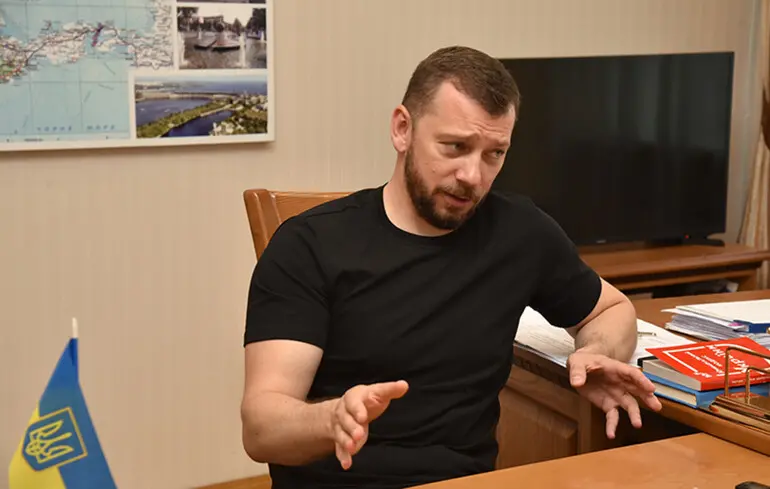
In the first part of the interview with SAPO head Oleksandr Klymenko, we talked about the independence of anti-corruption institutions, attempts by the authorities and law enforcement agencies to destroy it, the risks this poses to the country, and the investigation of criminal proceedings against financially sensitive individuals from the president's inner circle.
Why is the institution of plea deals important for the anti-corruption sector? Is it true that the individuals involved in the NABU investigation into the removal of Odesa Airport from community ownership, Borys Kaufman and Oleksandr Borukhovych (Hranovskyi), remain its owners? Who is discrediting anti-corruption institutions and why?
Answers to these and other questions can be found in the second part of the interview with Oleksandr Klymenko.
IV: Oleksandr, one of the EU's requirements for the anti-corruption agencies is to enhance the institution of plea bargains. In July 2024, the ruling party lobbied parliament to adopt a bill aimed at improving the effectiveness of plea bargains, which was criticized by both experts and anti-corruption organizations. As a result, the bill was withdrawn from consideration. What, in your opinion, was wrong with it and how should this tool actually be used?
OK: When embezzling funds, companies registered to fictitious persons are often used. These people become nominal directors who sign documents. Although they receive a symbolic reward of $100 for allowing others to use their data for registration, their actions fall under an article that provides for 7 to 12 years of imprisonment. Of course, in order not to overload the court with a huge number of people, it is better to enter into a plea agreement with them—if they provide the investigation with the necessary information about the key figures in the case. Then only the latter will go to court, instead of twenty people.
IV: Still, let's move on from the “pawns” to the top players.
OK: The same applies to high-ranking officials. When concluding a plea agreement, it is necessary to fully admit guilt for the crimes charged, provide full or partial compensation for damages and cooperate with the investigation. However, the testimony must be confirmed by specific evidence. If it is just words, the High Anti-Corruption Court (HACC) will never approve such an agreement.
IV: So it's not either/or, as proposed by MPs from the Servant of the People party led by faction leader Davyd Arakhamia, but both, right?
OK: Yes. The bill proposed a greatly simplified procedure, which, to put it mildly, would hardly have helped the investigation. But plea bargaining is a normal practice around the world. The backlog of cases currently pending before the Anti-Corruption Court is constantly growing. We have already closed 26 cases involving 39 individuals due to the statute of limitations, and 35 proceedings are at risk of being closed. If we simply refer the cases involving 15 defendants to court, we will block the work of the HACC. The court strictly adheres to procedure and does not have such resources. In order to reduce the workload and speed up the consideration of these cases, it is necessary to reduce the number of defendants through plea agreements.
For example, the Ukrbud construction company entered into a project where, in exchange for receiving a plot of land, they were supposed to build a swimming pool for a school, but instead they built a parking lot. The former chief architect of the city of Kyiv and a representative of the developer were involved in the case. We heard the case, invested resources and actually reached the end, but it was closed due to the statute of limitations. The community received nothing. A similar situation occurred with the Okhmatdyt children’s hospital. And there are many such cases. All cases involving asset declarations are closed due to the statute of limitations because the court hearing procedure is the same, and the time limit is only three years.
However, no one is communicating this problem. If you enter into a plea agreement, questions immediately arise.
IV: There are specific reasons for concluding a plea agreement, and, unfortunately, they are not always positive. It is one thing to agree to expose other accomplices and compensate for losses, but it is quite another to do so because of poor evidence. How often during your tenure has poor evidence been the reason for concluding a plea agreement?
OK: I do not rule out that such cases do occur. Sometimes, during court hearings, we discovered mistakes that had been made, for example, five years ago. So, a situation arises where both the defense and the prosecutor do not want to take risks. However, the requirements for the exposure of criminals and partial or full compensation for damages remain. The court will not allow a plea bargain for the sake of a plea bargain.
IV: By the way, many people criticize you for weak evidence.
OK: I beg to differ. You can even talk to the judges of the HACC, who consider not only our cases. Our cases are qualitatively different from those of other investigative bodies in terms of evidence.
IV: How do you feel about the decisions of the HACC that did not support the prosecution?
OK: We study them quite thoroughly, especially when the judge's position is well-informed and well-argued. For us, it's a kind of learning experience: we take it into account and try not to repeat similar mistakes. However, if we disagree, we naturally lodge an appeal to the Supreme Court, and very often we defend our position there.
IV: The controversy surrounding plea agreements is very old. Once, the deputy head of the Anti-Corruption Action Centre, Olena Shcherban, said that Klymenko would not make bad deals, but he would not always be the head of SAPO. If it becomes possible to “buy one's way out” of crimes, the costs of the bribe will simply be factored into the corrupt margin of the schemes. People are only afraid when they understand that they could end up in prison. In other words, the more top officials end up behind bars, the more signals society will receive about the reality of the fight against corruption. What do you think?
OK: I concur that prison sentences for high-level corruption crimes should serve as effective deterrents against new ones, and this is indeed the case. Recently, the HACC sentenced the former head of the Ternopil Regional Council, Mykhailo Holovko, to nine years in prison with confiscation of all his property. Such sentences do indeed serve as a deterrent. At the same time, we must take into account the reality that sometimes the entire state apparatus works against anti-corruption bodies with but one goal in mind—to hinder us in a particular case. For example, influencing experts, ensuring court decisions in parallel in commercial or administrative jurisdiction or simply dragging out the hearing of a case for decades in a completely legal manner.
This does not mean that the state apparatus always succeeds, no, but such cases do exist [in particular, this was the case with Oleh Tatarov, which Oleksandr Klymenko investigated as a NABU detective. — I.V.]. We do not absolve ourselves of responsibility either. In particular, in some cases, the defendants were helped by the notorious leaks, which we are combating as much as possible. And then we find ourselves in a situation where there is a risk of either completely losing the case without any consequences for the accused, or still establishing his actual guilt in court and, most importantly, recovering the losses to the state, which will not happen in the event of an acquittal or closure due to the statute of limitations.
For instance, do you know of examples of top officials being held accountable before the creation and normal operation of NABU and SAPO? Now they are being held accountable. This accountability can take various forms. But they are being convicted. And many are convicted under Article 209 [money laundering — I.V.], which prevents them from even opening a bank account abroad. This is not an easy issue and it is a difficult path, but we are going through it with dignity, drawing conclusions and learning to act proactively every time. We cannot wait for conditions that are favorable to us. Those may never come. We must do our job well and restore justice with the legal tools at our disposal.
IV: Ironically, just yesterday, an interview with former SAPO prosecutor Stanislav Bronevytskyi was published about the agreement on Odesa Airport, or more precisely, on two cases, including the investigation of the activities of an organized criminal group in Odesa. Under the agreement, Borys Kaufman and Oleksandr Borukhovych (Hranovskyi) were ordered to pay 1 billion UAH, which does not cover the 2.5 billion in damages. Moreover, according to our information, 800 million UAH had already been seized from their accounts. Another 200 million have to be paid in installments. Please explain how it happened that, in the end, the city lost almost 2 billion, and the airport remained in Kaufman's hands? Did Klymenko make a bad deal after all?
OK: This case concerning the events of 2012 was investigated under Article 364 of the Criminal Procedure Code, where the statute of limitations is ten years. When I was still at NABU [before Oleksandr Klymenko was appointed head of SAPO, he worked as a senior detective at NABU. — I.V.], I heard detective Stanislav Braverman: he already intended to close this case. Plus, the then leadership of the Bureau did not see any criminal offense in this criminal proceeding. We talked, looked at the materials of the criminal case, and I suggested approaching the case from a different angle: not as abuse that led to the receipt of undue benefits but as the seizure of the airport through abuse. And that's Article 191 and another five years of investigation.
After I became the head of SAPO, we initiated a hearing of this case with the same detective [a procedure that essentially means an audit of the case and a meeting on its further investigation. — I.V.]. Based on the results of the operational meeting, the procedural management of the proceeding was found to be ineffective. If my memory serves me right, I changed the group of prosecutors back in the spring of 2023: my deputy, Andrii Syniuk, was appointed head of the group of prosecutors.
Now regarding the agreement. First, your remark about the alleged seizure of 800 million UAH is not true. A small amount was seized—approximately 30–40 million, which was confiscated in favor of the state. All funds that were seized during searches or were arrested or deposited as collateral were transferred to the state. Second, the agreement states [Klymenko shows the operative part of the court ruling — I.V.] that everything that was transferred under the act of acceptance and transfer (2,488 items) is returned to the Odesa City Council. Anything that cannot be returned is compensated with cash.
IV: Let me stop you right there. Let's figure this out.
“The return to the territorial community of the city of Odesa, represented by the Odesa City Council, of 2,488 units of fixed assets of Odesa International Airport, transferred under the act of acceptance and transfer of property transferred to the ownership of the Odesa City Council as a contribution to the authorized capital of LLC “Odessa International Airport” dated 31 October 2011.”
However, “Under the terms of Section VII of this agreement, the Odesa City Council's share in the authorized capital of Odesa International Airport LLC is 25 percent.”
So whose airport is it? What is meant by “2,488 units of fixed assets of Odesa International Airport”? And why do you say that it has been returned if the Odesa City Council's share remains at 25 percent?
OK: In 2012, the Odesa City Council transferred ownership of 2,488 property units to the newly established company, Odesa International Airport LLC, which it had no right to do. The city could have contributed its share and granted the company (which actually manages the airport) the right to use the property but without transferring ownership to the company.
As a result of the agreement, the city can now leave the LLC at any time and take back its property, which it could not do before because the property did not belong to it. The LLC has 12 months to conduct an inventory and return the property to the city council. If any property is no longer available—seeing as more than 13 years have passed and the airport has been shelled—they must conduct an assessment and compensate for the cost in cash. However, the final decisions regarding the property will be made by the city council, including the possibility of transferring it to another company.
IV: So, the main thing at the airport is the property, not the LLC itself? Am I correct?
OK: Yes. The runway always belongs to the state: you can do whatever you want there, but you don't have the right to use the runway without the appropriate permission. By the way, we still have ongoing proceedings regarding the runway and permission to receive income for the takeoff/landing of aircraft, which the city also gave away. I think we will investigate them further this year. Initially, the defense proposed a different structure, “If we return the property, then the city's share will decrease.” We are writing that the share cannot decrease. The city still remains one of the co-owners.
IV: And if the city council withdraws its 25 percent stake in Odesa International Airport LLC, what will Kaufman and company be left with?
OK: If the Odesa City Council decides to withdraw from the joint venture, then, in addition to the property returned to it under the agreement, it also has the right to sell its 25 percent stake in the joint venture. The LLC will retain the terminal that they managed to build on the land purchased from the city. The LLC will not be able to manage the airport. But the city has a municipal enterprise, Odesa Airport, which could theoretically take over these functions. Incidentally, there is a similar story in Zhuliany. The situation is similar in Kharkiv, but there the city council did not transfer ownership rights to private entities. That is, you make investments, the city provides property and a runway, and you manage it together on a 50-50 basis.
IV: So Kaufman's LLC is left with nothing but your help and its terminal?
OK: Yes, after Kaufman's agreement with the investigation, Odesa Airport was returned to the community. And the LLC still has a loan of $25 million hanging over it because they took it against the property of the city of Odesa and built a new terminal. But we said that we were not interested in that: you transfer the property back without any obligations, and the loan remains only on the part of the property that did not belong to the city and is newly created property. Everything that the city transferred is excluded from the loan.
IV: The main question now is this: how will the city authorities, who were directly involved in this deal, behave? The airport is not operating, it needs to be maintained, which will require funds from the budget.
OK: Yes, but that's another story. We did our job and returned the property to the city. The public and the city community should monitor the further decisions of the Odesa city authorities.
IV: And what about Bronevytskyi and his public statements discrediting you?
OK: Well, you'll have to ask him about that. He was not the chief prosecutor of the group in the cases concerning Odesa Airport. This is public information: there are resolutions, there is an extract from the Unified Register of Pre-trial Investigations, where you can see who was in charge. The first suspicions in the case involving the airport, for both Kaufman and Borukhovych, were not approved by Bronevytskyi.
I knew this interview would be published. I even warned the prosecutors that there was communication with former SAPO employees who were publicly spreading negative information about it. This was a week before the material came out. By the way, none of the journalists asked us for comments on what was said. The request to SAPO actually came after the interview was published, on Monday.
I knew that Bronevytskyi had been communicating and discussing the activities of SAPO with the former deputy head of the president's office for a long time.
IV: Are you referring to the defendant in one of your cases, the former deputy head of the president’s office?
OK: Yes. I am not concerned for myself, as I have never given anyone illegal instructions. However, I am concerned about something else. There is information that Andrii Smyrnov [the former deputy head in question] is actively communicating with the Security Service. And now they are “working” with another former SAPO prosecutor, who was dismissed as a result of an internal investigation. He appealed this decision in all instances but lost. “Working” with former SAPO employees is now quite beneficial to the Security Service of Ukraine for reasons known throughout the country.
IV: However, in Bronevytskyi's interview, in addition to the return of the airport, which we have already discussed, there were a number of other statements that you should comment on. So I will ask a few more questions. Why did the detectives who handled the case not sign the agreements? In particular, Stanislav Braverman.
OK: According to the law, no agreement is signed by a detective. The signatories to the agreement are the prosecutor and the defense. If there are victims, the victim also signs it. The agreement is approved by the court. Period. The prosecutor has the right to sign the indictment independently. Not to mention the obvious problems for the case when the detective is clearly biased.
IV: And the amount of damages? 1 billion in compensation against 2.5 billion in damages seems strange, to say the least.
OK: This is a completely absurd story because the actual amount of losses from the transfer of the airport, as established by expert assessments, is 128 million. And 2.5 billion is the total turnover of the airport since 2012, part of which went to the budget of the Odesa community. I have repeatedly told the investigator about this. You can't go to court with something like that.
IV: Why were the cases involving the airport and the Odesa organized crime group (OCG), which includes not only Kaufman but also representatives of the city authorities, merged? Did you not have enough evidence in the OCG case?
OK: Our main problem is that the phonoscopic examination did not confirm the identity of the main suspect's voice.
IV: That's some news! Where did you conduct the examination? And did you conduct a repeat examination?
OK: We consulted with many experts, and it was not a problem with the expert but rather technical issues with the sound recording conditions. The practical problem was that the defendant was not physically present in the room where the recording was made; he was speaking on the phone on speaker. Therefore, the experts were unable to confirm with certainty that it was Kaufman's voice. Due to problems with the examination, we were only able to confirm the bribes with irrefutable evidence within the scope of the case, which, frankly speaking, does not really constitute the activities of an organized criminal group. But the main thing is that the people who did not cooperate with the investigation went to court within the scope of this case. Those who entered into a plea bargain and appeared in both proceedings ended up in a joint proceeding: they were singled out, combined and sent to court with a plea bargain.
IV: Did this approach really lead to the elimination of corruption in Odesa? What did the community gain, apart from the airport and compensation for losses? What did the agreement with Kaufman in the OCG case achieve?
OK: In my opinion, the story of cleaning up corruption schemes in Odesa is far from over. Our case is one of many components of this process. The community of the city should still play a leading role.
IV: Why was Bronevytskyi dismissed?
OK: He resigned himself, saying that he had been offered another job.
IV: What is this story about the polygraph test that he did not want to take after his dismissal?
OK: This is probably the main reason for his resentment toward SAPO. There was a leak in one of the cases where Bronevytskyi was part of the team. I don't want to retell the whole story, but in the end, his contribution was confirmed.
IV: Detective Stanislav Braverman, who was in charge of the Odesa Airport case, was also dismissed—and very loudly. But Bronevytskyi said that all allegations of unethical ties between the detective and the witness were falsehoods. In addition, Olha Hutovska, the head and majority owner of the UK-based company WWRT, which specializes in debt collection in the field of banking assets, was not a key witness, as claimed by NABU and SAPO. According to him, she was not involved in the airport case at all, and her testimony concerned only the money that the defendants have abroad.
OK: However, during the hearing regarding Mr. Braverman, the detective who led the case, he claimed that Hutovska was a key witness. Therefore, I think it would be better to ask the director of NABU, who has already commented on the results of the internal investigation into this matter. The internal control department of NABU reached out to SAPO about how important Hutovska's testimony was in the Odesa Airport case.
IV: So did the head of the Servant of the People faction, Davyd Arakhamia, come to you or not?
OK: He did, three or four times, to discuss legislative initiatives that were prepared and voted on by parliament at various times, particularly in the fall of 2024. He signed the register. Members of parliament come to us; this is normal practice, and we make no secret of such communication. Incidentally, we did not support his version of the law on agreements with the investigation, which we have already discussed with you. Mr. Arakhamia has never been a fan of anti-corruption.
IV: I know that his representative, Mr. Buzhanskyi, together with People's Deputy Serhii Vlasenko from the Batkivshchyna (Motherland) party, are very active in the Temporary Investigation Commission, which was created to “increase the effectiveness” of anti-corruption and law enforcement agencies. Which, in fact, is not surprising after recent events.
OK: We have information that initially, the plan was to put pressure on us through this Temporary Investigation Commission. But then the blitzkrieg happened. However, I think that this tool will also be used.
IV: Returning to the agreements with the investigation, do you have any statistics? How many are there, and which cases do they concern?
OK: We counted the percentage of plea agreements: it has picked up recently but does not exceed 30 percent of the total number of cases. For example, in the first seven months of 2025, we sent 75 criminal proceedings to court, 24 of which were with agreements. But this does not mean that if there is an agreement, it applies to the entire case. Often, a plea bargain is concluded, for example, only with some of the suspects or defendants, while the rest are sent to court in the usual manner.
IV: So you can't say that it's half of all cases?
OK: No, that would be wrong.
IV: Lawyer Oleh Horetskyi in the Kniazev case, Mykola Zlochevskyi... Can you say what the state and the investigation gained from the agreements with these extraordinary people? Was it worth it and why? It's very interesting to hear about Horetskyi.
OK: We got convictions, incriminating testimony that we are still working with, and savings in time and resources. To date, thanks to the agreement mechanism, the state has received more than 2.8 billion UAH for the Defense Forces.
IV: After the competition for the position of head of SAPO, which you won with difficulty, your main competitor, Andrii Syniuk, who was actively associated with the president’s office, became your first deputy. Mr. Bronevytskyi dealt a targeted blow to him as well, sharing information about the case involving the procurement of food for the frontline territories in 2023, where Syniuk allegedly leaked information to the parties involved. What is true and what is false?
OK: We had a case where documents confirmed that chicken had been delivered, frozen and distributed. In reality, it was never delivered. But the investigation under the procedural guidance of Prosecutor Bronevytskyi lasted so long that the parties involved had already delivered and redistributed the chicken. They averted the consequences of the crime. Nevertheless, a number of suspicions were announced in this case and the investigation was completed. Bronevytskyi never informed me about any leaks in it. He only complained that my deputy was interested in the progress of the investigation, but there is nothing illegal about that, and there is certainly no reason to take action because of it. Moreover, Prosecutor Bronevytskyi had the legal right not to inform my deputy but to report only to me. In general, in my opinion, his questions and interviews are nothing more than a continuation of the discrediting campaign against NABU and SAPO.
IV: But leaks are the Achilles heel of anti-corruption efforts. You already have two high-profile cases related to this—the case of Gizo Uglava and a group of hacker lawyers who extracted information from the registry about judges' decisions on searches and other investigative actions. According to the investigation, this group was organized by former military prosecutor and now lawyer Dmytro Borzykh, who, incidentally, became an external advisor to the new prosecutor general and participated in the development of an operation against NABU. If the operation had been successful, Kravchenko would probably have transferred Borzykh's case to the State Bureau of Investigation first because interference with the register can be viewed from another angle, not just corruption. If desired, of course. What about these cases?
OK: We are investigating both cases. There are suspicions and preventive measures regarding the lawyers. ZN.UA has previously described this scheme in detail. It is important that the suspects used their connections to gain access to information from the closed part of the court registry and actually traded it on an industrial scale. This is particularly relevant in the context of the facts you mentioned in your question. However, I am confident that this case was not the prerequisite for the legislative changes that eliminated the independence of NABU and SAPO; rather, the reason was found in our other important investigations, primarily in the defense sector.
The investigation into potential leaks in the Great Construction government program case is still ongoing, and we will inform the public about the results.