Of late, FPV drones, Molniya and Lancet loitering munitions and other UAVs have increasingly been “hunting down” precisely the civilian residents of frontline villages, towns and cities. The daily situation reports regularly carry word of drone attacks: “The Russians struck a car with an FPV drone near a private home”; “a Russian FPV drone wounded a man”; “a Russian FPV drone hit a private yard, a residential house.”
FPV drones have created a new reality in which frontline communities lose not only their safety but the basic infrastructure of help. The authorities advise people to leave, but not everyone has somewhere to go or the means to do so. And people are left alone—with the drones, the ruins and a question of responsibility that no one is in any hurry to resolve. All the more so since the head of the Zaporizhzhia district administration has already given his answer: if you stay, it is your choice and your responsibility. The constitution does not agree.
How are people to survive, and what are the authorities doing?
UAVs: a new reality for communities
It is becoming ever more dangerous for people to move about even within their own yard, let alone to reach a shop or get to work. One video from Kramatorsk city shows a mother and child sheltering under trees during a drone attack. The picture is much the same in the Zaporizhzhia, Kherson, Dnipropetrovsk, Donetsk and other regions.
In some frontline settlements there is no mobile signal and public transport has stopped running. In effect, people find themselves cut off.
Monitoring channels on Telegram regularly carry messages from villagers complaining that, with no signal and no electricity, they cannot even call the emergency services. At the same time, because of the precarious security situation, ambulance crews, State Emergency Service rescuers, police and the emergency teams of the regional power company do not travel to certain settlements at all. Appeals to the community leadership do not always bring results. So people are left alone to face their problems and feel abandoned.
In the Zaporizhzhia region, the communities of Polohy district — Huliaipole, Orikhiv, Malotokmachka, Vozdvyzhivka and Preobrazhenka — suffer most from Russian UAV attacks. In Zaporizhzhia district, the Bilenke, Kushuhum, Novooleksandrivka, Komyshuvakha, Tavriiske, Ternuvate and Novomykolaivka communities are under constant fire. In the Dnipropetrovsk region, the Nikopol, Marhanets, Pokrovske, Myrove and Chervonohryhorivka communities bear the brunt of enemy drone attacks.
As a rule, Russian Molniyas hit buildings and critical-infrastructure facilities, while FPV drones strike people and cars.
According to a written reply of the Zaporizhzhia Regional Military Administration to a request from ZN.UA, as of 1 May 2026 some 129 settlements in the government-controlled part of the region were without electricity owing to damage to power lines, pylons and equipment. Of these, 117 had been without power for a long time.
Since April 2026, a further 12 settlements have been cut off in the Novooleksandrivka, Komyshuvakha, Novomykolaivka, Vilniansk, Mykhailivka and Bilenke communities of Zaporizhzhia district.
“They dug us out of the rubble”
One such attack struck a family from the village of Marivka, in the Bilenke community of Zaporizhzhia district. At 9pm on 13 March, a Russian Molniya flew into the house where the family was at the time.
“It was quiet. I was baking bread on the veranda, my husband was drinking coffee. A bang—and that was it… The veranda was blown apart; they dug us out of the rubble,” Hanna Karatieieva says, recalling that evening. “The Molniya was carrying some kind of explosive, and everything caught fire at once. You’d think it was the safest spot, where there were two walls—and that’s exactly where it came in…”
The woman recalls that, straight after the explosion, all their friends and acquaintances came running and tried to call an ambulance and the State Emergency Service over the internet: “People came in their own cars and drove us to the city because the ambulance wasn’t coming. We were told we’d meet them somewhere along the way, but there was no one. They took us as far as a checkpoint, where we were given first aid and an ambulance was called—because the people who got us out didn’t know which hospital to take us to or how serious the injuries were. And the State Emergency Service arrived a few hours later, when everything had already burned down.”
Hanna Karatieieva said the village has no rapid response team that could arrive ahead of the emergency services and help. “There should at least be a barrel of water in the village. If they’d started fighting the fire straight away, most of the house could have survived. The veranda was destroyed completely, but the other rooms, which could have been doused from the windows, would have stopped the flames spreading further. The documents, and everything that was in the house, burned down.”
Karatieieva added that the situation is much the same across the whole community. People are afraid to step even into their own yard, because FPV drones or Molniyas are constantly flying over the settlements. After damage to their homes or other property, local residents cannot quickly obtain inspection reports, because the community is short of staff. As a result, people often lose the chance to apply for help from the state or from humanitarian funds.
“Right now we’re restoring our documents so we can apply for compensation or get some kind of help. But restoring documents costs money—money we don’t even have for medicine. I was injured, and the children were in hospital too. They were kept under observation because the doctors said concussion could show up on the third or fourth day,” Karatieieva said.
The family still lives in Marivka, in a rented house, and is gradually restoring its documents in order to obtain a property-damage report and, eventually, be able to claim compensation.
“Drones were circling as we put out the fire”
Another attack injured Yana Mozul, a resident of Marhanets, Dnipropetrovsk region. An enemy FPV drone struck a car parked beside her yard.
“It happened at night. There was an explosion. Since firefighters and patrol police don’t come out during drone attacks, you have to rely on yourself. You could say we were lucky because the fire didn’t spread to the whole car and didn’t reach the fuel tank; otherwise, the blast would have been stronger, and houses could have been hit,” Yana recalls. “As we were putting out the fire, two more drones were circling above us. Whether they were watching or waiting for the firefighters is hard to say. We were running about, trying to douse the flames. We’d dash into the house, where our frightened child was, then run out again and carry on. Thank God a neighbour ran over with a fire extinguisher because ours was in the car and we couldn’t get it open.”
[pics_lr left="https://zn.ua/img/forall/u/667/61/689484473_26895387613437793_1277171022565642286_n.jpg" ltitle="" right="https://zn.ua/img/forall/u/667/61/690585591_26895387963437758_1715949902009808716_n.jpg" rtitle=""]
Yana Mozul says that in Marhanets, too, it is exclusively civilian targets and people who suffer from such attacks. “Right now there’s a difficult situation with the cash machines—the security couriers are afraid to drive to Marhanets. Near the hospital they hit the ambulances and the doctors’ own cars. Anti-drone nets have long been needed there. But despite the shelling, food is still being brought in and the supermarkets are open. Though there have been repeated strikes on shops and around them. People carry on living. Many elderly people will not leave.”
The family has left Marhanets. As there is no compensation for damaged cars, they cannot obtain even state assistance.
Yana Mozul added that the town is not covered with anti-drone nets, but groups have begun to be formed to shoot down Shaheds, Molniyas and FPV drones.
The operator sees where it will hit
An aviation expert at the Kyiv Aviation Institute, Valerii Romanenko, explained that Russian forces use various types of drones. These include classic FPV quadcopter-type drones—Knyaz Vandal, for instance—as well as the Molniya UAV, which has similar control systems and is used according to the same principle as FPV drones.
The expert maintains that a drone operator can see, right up to the last moment, where the strike will land. This, he says, is proof that Russian troops are deliberately attacking civilians. “The difference between an FPV drone and an ordinary one is that an ordinary drone has a flight-stabilization system. If the operator stops controlling it, the UAV either hovers in the air or flies in a straight line. An FPV drone, by contrast, has to be corrected every few seconds, or it will fall.”
In addition, such UAVs can scatter small munitions or mines that a person might fail to notice and step on, or that a child might pick up to play with. People therefore have to be warned constantly of the danger of touching any unfamiliar objects on the street or the road.
Romanenko stresses that anti-drone nets really do save lives, and that roads need to be covered with them. At the same time, signal-emitting anti-drone devices in civilian hands can be dangerous: if Russian troops pick up the signal with electronic intelligence equipment, the person becomes a target themselves.
The nets tear after the first strike
The head of the Capital Construction Department of Marhanets City Council, Yevhen Yevdokymenko, said that only critical infrastructure facilities are protected with anti-drone nets. Covering the central streets of Marhanets would require considerable funds, so the local authorities are drawing on donors. Some of the nets have already arrived, but it is not enough.
“We’ve been in an active combat zone for two and a half years. There are tax breaks for that—residents pay no taxes at all—so the town is short of money. At the latest session, we allocated reserve funds from the town budget that had been earmarked for electricity for the municipal water utility. Our partners, the international organizations, also help us a great deal, and from the local budget the regional state administration is allocating 13 million,” said the mayor of Marhanets, Hennadii Borovyk.
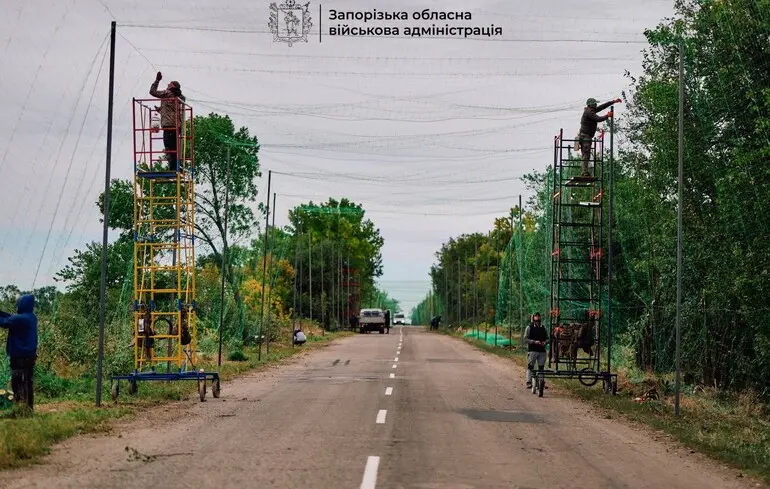
The head of the Zaporizhzhia Regional Military Administration, Ivan Fedorov, commented on the situation in the Bilenke community during a briefing. Construction of anti-drone tunnels in Bilenke has begun only now because priority was previously given to communities lying directly near the front line, from Malokaterynivka to Orikhiv. According to Fedorov, the work is being carried out by the military and the State Special Transport Service, but their capacity is limited.
The Zaporizhzhia Regional Military Administration specified that anti-drone nets are being installed first in settlements within 25km of the line of combat contact, and second on roads further than 25km from the front.
The administration noted that determining the length, location and number of roads in need of anti-drone protection falls within the remit of the military command conducting operations on the territory of the Zaporizhzhia region.
“The Zaporizhzhia Regional Military Administration has the authority to coordinate, between the military command and the construction client, the identification of roads that need anti-drone protection. Where necessary, a proposal is submitted to the state bodies designated as construction clients for the additional construction of anti-drone protection on stretches of road that require the safeguarding of the life and activity of territorial communities,” the administration said in its reply to a ZN.UA request.
Once construction of the anti-drone nets is complete, the authorities plan to reconsider the question of restoring bus links with Bilenke. But the decision will depend on the security situation and the intensity of Russian shelling. For now, the authorities do not plan to evacuate the residents of Bilenke by force.
The Zaporizhzhia Regional State Administration also reported that no decisions had been taken to switch off or restrict mobile communications in the territory of the Bilenke community. The military administration stated that it had given mobile operators no such instructions or orders.
At the same time, the administration said it was currently taking steps to restore mobile communications across the community.
The head of the Zaporizhzhia district administration, Oleh Buriak, said that after strikes on mobile phone masts people are left without communications, and that the Points of Invincibility are of no help in such a situation.
“We don’t have Starlinks at our Points of Invincibility because they’re very expensive and someone has to pay for them. You have to understand that in rural areas people don’t often go to the Points of Invincibility. In their own homes they have generators, power banks or EcoFlow units. Villagers strive for maximum self-sufficiency,” Buriak noted.
There are anti-drone nets on the roads in the Bilenke, Kushuhum, Komyshuvakha and Novooleksandrivka communities. But it is ordinary synthetic netting that tears after the first strike and has to be replaced again.
“We can’t cover the entire territory of Zaporizhzhia district, so protection is installed only on priority routes where there is heavy traffic,” Buriak noted.
The Zaporizhzhia Regional Military Administration pointed out that the task of protecting the region’s frontline communities from UAVs and other weapons falls within the powers of the military command conducting operations in the region.
“For its part, the Zaporizhzhia Regional Military Administration is doing everything possible to provide additional logistical and technical support to units of Ukraine’s defense and security forces in countering strikes by UAVs and the other weapons deployed by the armed forces of the aggressor state,” the administration said.
“The administration bears no responsibility”
The head of the Zaporizhzhia district administration, Oleh Buriak, set out the authorities’ position on those who stay with disarming frankness: “A soldier, a police officer, a doctor, a rescuer, the minibus drivers—everyone wants to live. They work in order to live, to feed their family, to watch their children grow up, to love their wife, to love their parents. If residents want to remain to the very last in the centre of all the strikes, the administration bears no responsibility for that. It is the residents’ conscious decision. If they decide for themselves to be in zones of active combat, they have to understand that, for instance, electricity and water may not always be available. Rescuers, doctors and public-transport drivers will not always come because they owe them nothing.”
Buriak also made clear that public-transport drivers may refuse to run routes to front-line settlements because of the threat to their life and safety: “A minibus driver has the same rights as anyone else. If a route is dangerous for him, he has the right to turn down the trip. Under martial law, transport companies are not obliged to carry passengers in zones of active combat if the driver’s safety cannot be guaranteed.”
The constitution says otherwise
The representative of the Human Rights Ombudsman in the Zaporizhzhia region, Mykhailo Volkov, noted that, from a legal and constitutional standpoint, the state and local authorities and the military administrations in no way absolve themselves of responsibility for citizens who refuse to evacuate. “The chief duty set out in the constitution is the protection of human life and health. The authorities are obliged to keep informing people of threats, to ensure access to shelters and to maintain essential services. But there is an objective security limit that affects the capacity to fulfil this duty,” he said.
“It’s true that compulsory evacuation is provided for solely in the case of children. An adult who remains in an area of active combat, and refuses to evacuate, consciously takes on part of the responsibility for their own life. But this in no way deprives them of their civil rights,” Volkov says.
In his words, the authorities should have a functioning evacuation mechanism in place so that a person can, at any moment, get in touch and leave a dangerous area. Three transit centers operate in the Zaporizhzhia region, to which people are taken.
“The authorities advise people to leave”
While the debates about the limits of responsibility drag on, people in the front-line villages live on—without communications, transport and any guarantee that an ambulance will arrive on time. Some stay because they have nowhere to go. Others because everything they have built up is here. Others still because they believe it will somehow turn out all right.
The constitution says the state is obliged to protect them all. The head of the district administration says it is their choice and their responsibility. Between those two positions are living people who put out the fires and carry away the wounded themselves.