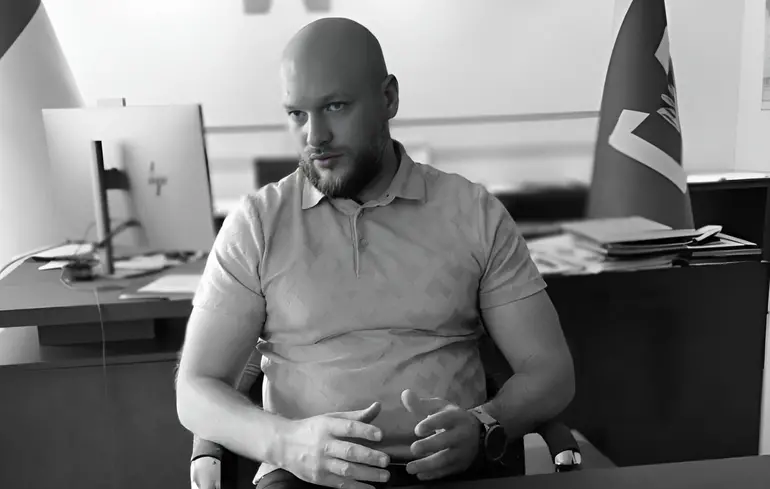
We spoke for two hours with the newly appointed head of the Economic Security Bureau (ESB). And we were surprised. We expected to meet a seasoned investigator, but one who still needed to develop a strategic vision for change and for the immediate work of the very difficult agency he now leads. But no—we found Tsyvinskyi completely prepared.
The thing is, he’s not the only one who’s ready. Deputy head of the Presidential Office Oleh Tatarov and former first deputy head of the ESB Vitalii Hahach, with their back office, are ready to defend their interests, as are businesses that find it easier to pay bribes than to defend their rights. Judges are ready too—because it’s easier to take money than to restore justice. And the tax authorities and financial monitoring are ready to act as “herders”… All of them will fight for the old ESB as a very effective year-round honey-harvesting tool.
Of course, to cover the “shadow,” Tsyvinskyi will have to dive into many things—subterranean rivers, trickling streams and the artificially created lakes of corruption within the Bureau. Yet experience suggests one thing: the result, while not comprehensive, will definitely be a signal—either in the first hundred days (when trust in a new leader is at its highest and his opponents have not yet had time to regroup fully) or not at all.
What did Tsyvinskyi bring to the ESB? Does he have a realistic—not fairy-tale—plan to make the Bureau effective? How will this plan mesh with the ESB’s complete institutional and political dependence on the Presidential Office and the Prosecutor General? How serious will the personnel purge be, and how will it proceed?
We discussed this in the first part of our interview with the head of the Economic Security Bureau, Oleksandr Tsyvinskyi—a man who has travelled an incredibly difficult road to his appointment and who faces an even tougher path ahead in his new post.
IV: “NABU is a rocket that strikes with precision, while the ESB is a system grounded in analytics and prevention.” Those are your words, Oleksandr. The ESB was supposed to become a very powerful institution laying a healthy foundation for the state’s economic system. The key words are “was supposed to”—from the very moment it was created. Why didn’t that happen?
OT: Because the model of the previous body—the tax police—was simply copied. In other words, no new model was built, and the approaches tried and tested not only by our international partners but also by NABU were not adopted as a basis. No different philosophy of law enforcement was introduced, so the institution was never truly built. As a result, the ESB’s activities hardly changed, and consequently the institution was deemed ineffective—“idling in a reboot” all these years. Now we are beginning to change that.
IV: However, from the moment it became clear that the ESB would not have exclusive authority to investigate economic crimes, the question of its very existence arose. In your view, what has to happen at the Bureau for us to understand that it is genuinely necessary and that its creation will not merely multiply the number of law enforcement bodies investigating economic crimes?
OT: Let’s move from the technical aspects to the essential ones. Technically, the body must be staffed with 4,000 trained specialists capable of investigating economic crimes. (At present, the ESB has only a quarter of its staffing potential. – authors’ note) With that staffing level, only one question remains—jurisdiction. Which—attention!—is, for the most part, defined by law as the exclusive purview of the Economic Security Bureau. Therefore, I am convinced that as soon as we attain staffing capacity, the issue will rest exclusively with the Office of the Prosecutor General. Because prosecutors are the ones determining economic jurisdiction and deciding on the transfer of cases to other prosecutorial bodies. For now, there is a certain logic in transferring cases to other agencies because the ESB is not represented in all regions. But the Prosecutor General has already raised this issue at a coordination meeting. It must be resolved.
I will add this: the ESB’s current budget indicators provide neither for hiring additional staff nor for the pay parity with other law enforcement agencies that the law establishes—parity we need to compete with creativity, intellect and team spirit to attract high-quality specialists. The ESB’s budget also fails to provide sufficient funding either for the construction of a dedicated unified information system or for institution-building in general.
With such an approach, the ESB’s effective activity and its transformation into a genuine institution able to work under a new philosophy are indeed under threat. And if we are looking for a magician for the ESB, we risk finding only a storyteller. In other words, for the Bureau to fully assume its jurisdiction and demonstrate a completely different format of work, the government must: enforce the law and provide the funding the ESB needs under the law—no more, no less. Then, I believe, in no less than a year and a half, we will re-certify ESB employees, build out the core staffing potential and start ensuring that all cases within our jurisdiction are investigated by specialized personnel operating under the new philosophy.
IV: You’ve mentioned the ESB’s new philosophy several times. What exactly is it?
OT: The ESB’s philosophy and functional concept consist of four parts.
First: action in a specific territory. Suppose ESB officers focus on a particular community or district/region where, say, ten enterprises operate. We hold those acting anti-competitively to account and take measures to change regulatory provisions that prevent entrepreneurs from operating normally. In doing so, we level the playing field, increase the “environmental friendliness” of that territory, and business begins to grow, generating more budget revenue. This benefits both business and the state. I believe this should be the first indicator of ESB effectiveness that the state is supposed to appraise.
Second: engagement with business. We meet with entrepreneurs and identify various problems embedded in the regulatory framework that hinder business operations. Changes to that framework can, for example, reduce the shadow economy or achieve other improvements. This is more intellectual work that leads to systemic change at a macro level. Here is an example from my previous work at NABU: in Kyiv, we moved completely non-transparent markets onto Prozorro, where they began operating openly. Of course, the process isn’t instant, but it is stable.
Third: prevention. That means big-data analytics operating at a system level, which—taking all data into account—can see and flag red-alerts indicating atypical changes in the economy. For instance, in a given region, alcohol consumption suddenly drops by 15 percent. We’re not going to believe this happened because anti-drinking ads started working, right? Far more likely, counterfeit products displaced legal ones. As soon as this is detected, the law-enforcement component steps in.
Fourth: law enforcement. The law enforcement unit must work on the basis of data, not emotions, avoiding knee-jerk reactions the moment something happens and prosecution immediately. No. We gather data, see the problem and identify where applying our toolkit will either bring the greatest benefit to the budget or level market conditions. But detecting economic crimes doesn’t always generate direct budget revenue. Suppose we shut down a counterfeit cigarette factory. We may seize some assets, but direct revenue will be negligible. The indirect revenue, however—via increased production and sales of legal cigarettes that boost budget receipts—will be very different.
In short, the data system should determine both priority proceedings and the overall direction in which the pre-trial body moves. Of course, complaints and reports must be processed. But this is my understanding of the ESB’s function—provided we are building a powerful, capable institution.
IV: Capability stems from independence. Yet it is well-known in narrow circles that the ESB has always had—and still has—a back office headed by former ESB deputy chief Vitalii Hahach. His right-hand man, the notorious former head of ESB detectives Oleksandr Tkachuk, moved—after your arrival and with Tatarov’s help—to the post of deputy head of the National Police’s Strategic Investigations Department under Andrii Rubel. The rest of the ESB deputies date back to its first head, Vadym Melnyk. According to our information, the last meeting at Hahach’s office took place after you had already arrived at the ESB. You can deny this, of course, but no matter how confidently you spoke at your first meeting with the business community, everyone knows where to turn. In fact, the ESB works just like Kyiv, where Klitschko has become an appendage to Komarnytskyi’s back office. You uncovered this when you were a NABU detective, but now, ironically, you yourself have become the object of someone else’s game. Do you have a plan?
OT: First, any back office seeks to influence top management. If the head of an institution, a deputy, or a unit chief does not follow the back office’s instructions, then the back office’s role is reduced to a room where people talk—but nothing is implemented.
Second, I was appointed through a fair, independent competition. Given my experience at NABU, there’s no need to belabor my principles and values. They are unshakable. Third, the people I am now selecting and appointing—primarily to deputy positions (we will later hold competitions for the remaining posts)—share my values.
This means it is impossible to give orders to me or to them—we’re talking about the top management level here. If anyone tries to tempt fate—fine. I have excellent relations with the National Anti-Corruption Bureau of Ukraine, and I am confident our partners will always find the time and resources to help bring risk-takers to justice.
Yes, I do not rule out that some people may not have heeded the appeal I addressed to all ESB employees and to business. To claim that, as of today, 100 percent are already acting with integrity would be untrue. That can only be said after re-certification and the recruitment of new people, though I hope we will root out negative phenomena much faster.
But let’s say an ESB employee demands a bribe. The business representative has two options: to contact me personally or my deputy, Pavlo Buzdyhan, whom I appointed. We are detectives and know very well what to do with such information and how to handle it. We will contact our partners at NABU and provide every assistance necessary to document the criminal offense, if one exists. There will be more deputies like this in the future.
Businesses are not all saintly either. I warned all staff that anyone who responds lawfully to bribery attempts from business will not only have management’s respect but also receive financial incentives. In other words, the ESB already has tools to make bribes unprofitable and risky. But if someone insists on living in the old system, we will respond. At this formative and reformatting stage, I also expect lawful, proactive support from other law enforcement bodies in helping to eradicate corruption and build zero tolerance for it.
IV: And do you have all the tools to respond appropriately?
OT: That’s a fair question. The ESB law provides that the Bureau’s internal security unit has the right to conduct search activities, but the law on such activities (which lists the entities authorized to conduct them) does not include the ESB’s internal security. That’s a problem because we urgently need this functionality to clean up the ESB. I am confident, however, that the parliament, with the government’s help, will promptly correct this unfortunate oversight.
IV: As a veteran detective, you have made it abundantly clear you are not afraid of back offices. When the boss sends the signal “I don’t work that way,” everyone on the team should listen and hear. That’s the internal dimension, with possible help from NABU and SAPO. But there’s also an external factor: Gagacha's back office — it doesn't operate on its own, it is supervised by Bankova. (By the way, new signals have been heard in the back office. They say every tip from financial monitoring is implemented immediately. They even accept old dollars that have a lower rate and were previously considered “dirty.” Do they sense that the “shop” might close?—authors’ note) And above you stands the Prosecutor General, one of the drivers behind curtailing NABU and SAPO’s independence. And then there is the very sensitive Ministry of Justice. In other words, you are under siege, Mr. Tsyvinskyi.
OT: Law and truth will prevail. NABU has proven this. Thank God, I have received no illegal instructions to date. I had a constructive conversation with the Prosecutor General, and I hope for effective cooperation. At present, I cannot say that anything is going wrong. I am in active communication with the Ministry of Justice. There are no results yet, as this has only just begun, but within a month the situation will become entirely clear. We also had a substantive conversation with the Prime Minister, and I received a clear assurance: wherever possible, effective cooperation will be ensured.
If the problems I mentioned earlier are not resolved, and if the tools necessary for the Bureau’s work are taken away—leaving the ESB in a condition in which the institution is effectively unable to develop—then your statement will be confirmed by facts.
But an effective ESB is essential for a country at war. It means filling the budget with our own resources, not solely thanks to international partners. And here is a fundamental point: the budget is replenished not only when someone is held liable and unpaid taxes or VAT are recovered through the courts. I consider evaluating the ESB’s work exclusively by such indicators a misguided approach. It reduces the agency to narrow, often artificial statistics and turns it into a punitive instrument.
Instead, effectiveness should be measured “smartly.” For example, if the ESB’s work leads to legislative changes or exposes schemes in particular segments, we can calculate how much real tax revenue has increased. That is the true performance criterion.
So perhaps I am overly optimistic, but I believe in goodness, justice and victory. I also believe that even if someone does not want to cooperate, we will still be able to reach consensus. And if not, I will certainly not be silent. If a systemic problem arises, you will learn about it immediately, not two years later with an explanation that “we were not allowed to deal with it.” We are doing everything we can to make our work productive and constructive, without unnecessary conflict. Most people want to defeat the enemy—and to do that, we must fill the budget. But if I encounter total incomprehension or outright obstruction, society will know.
IV: Let’s get to the root of the matter so you don’t sound like a spinner of tales. When the parliament cut back the independence of NABU and SAPO, the key step was transferring core powers to the Prosecutor General. According to NABU and SAPO, this was critical for the anti-corruption institutions’ effectiveness. As for the ESB, there is nothing to cut—you don’t have that independence to begin with. Maybe you’ll get a bit more funding, maybe you’ll recruit people of integrity. But why create 4,000 posts if there are no guarantees at the top that the authorities will really release the ESB from under their security services’ wing—and that you, like a bull, won’t run head-first into a brick wall?
OT: We need to differentiate between the defendants in NABU/SAPO cases and those in ESB cases. NABU and SAPO deal with top officials—ministers, heads of central executive bodies, MPs, Supreme Court judges. The ESB works in a different sphere, though the authorities certainly have interests here too. Still, I would like society and journalists to give us some time to work—under the Prosecutor General’s leadership as well. Serious results don’t appear in a month. It’s like Operation Clean City—it takes years, though in our case it will be faster. But it is already clear that the budget is tight, international funding is not unlimited, and if we do not start working effectively, it could be disastrous.
So I do not share categorical pessimism. We have a chance. As in any process, there may be discussions with prosecutors—detectives want to act faster, whereas prosecutors weigh the prospects in court. This is a normal working dynamic. I have always supported the team and tried to remain objective. As I have already said, if problems arise, we will discuss them openly. For now, I see the preconditions for the ESB’s work to have a real economic effect for the state.
IV: When the attack on NABU and SAPO occurred, we saw a clear divide: the president’s security agenices—the ESB, the State Bureau of Investigation, the National Police, the Security Service (SSU)—were up against the anti-corruption authorities. It is likely that the ESB, under your leadership, will try to move to the “side of light.” How do you assess the current confrontation among the security services, and what risks does it pose? After all, even your former colleague, Ruslan Magamedrasulov, is currently in the SSU’s pre-trial detention center.
OT: The fact that my former colleague is in custody is a negative thing. I haven’t seen the case materials, but I have doubts about the appropriateness of such a preventive measure. Not to mention the use of force during searches and arrests. On the other hand, I cannot comment on whether certain procedural actions were right or wrong. What I do know is this: there are no questions about law enforcement actions when evidence and materials are presented. Sometimes NABU—myself included when I worked there—is criticized for releasing many materials into the public domain about its own investigative and search activities. But here, in line with international practice, in sensitive moments society has a right to know what is happening and why. The issue comes down to proper communication. Conspiracy theories always flourish where information is insufficient.
As for the confrontation you describe between the president’s security wing and the anti-corruption side, these are symbolic constructs. I do not perceive the ESB as belonging to any “wing.” The Economic Security Bureau is an institution independent of influence from any side—be it the government or opposition—that acts in accordance with the law and builds normal, working partnerships. We are not searching for a “cat in a dark room”; we are trying to establish effective working contacts with all institutions we must interact with. I am deeply convinced that our strength today lies in our ability to unite to achieve our goals. At the same time, I am dependent on no one and will always abide by the law, whatever the circumstances.
IV: On “symbolism”: During the competition, rumors spread actively about your ties to Andrii Rubel, head of the National Police’s Strategic Investigations Department, whom we’ve already mentioned. Rubel found himself at the center of a possible conflict of interest due to his wife’s business ties with companies owned by millionaire Maksym Shkil, an associate of Komarnytskyi, whose case you investigated at NABU. You stopped at the so‑called “toilet schemes”—corrupt land-grab schemes in Kyiv where minimal or fictitious structures like old public restrooms were used as a pretext to allocate vastly oversized plots—never even reaching the Podilskyi Bridge, where Shkil also has stakes. Where does this come from? Isn’t this part of the confrontation between the security agencies and the anti-corruption institutions?
OT: I usually don’t comment on rumors, but I’ll make an exception for a reputable outlet. One of the “facts” being spread is that I was allegedly Mr. Rubel’s subordinate. To verify this, you need three clicks online. You will see my service record and his. I worked my entire career in an investigative body in Lviv; he worked in a law enforcement operations body in Kyiv. There was no subordination whatsoever. The problem is that those who tried to discredit me are very superficial. By the way, the Komarnytskyi case is still being investigated, and it will affect many people’s interests.
IV: Who are these superficial people?
OT: I am not going to promote anyone’s discrediting campaign against me. My approach is simple: those who try to discredit me with nonsense will not get a reaction. If reputable official media write something about me, I will give an interview, explain, make calls. That matters to me. On the other hand, no one approached me or asked me anything. You, for example, requested an interview, and I’m trying to answer truthfully and comprehensively—even though I know not everyone will appreciate that.
IV: Fine, we’ve covered the external factors. Let’s look inside. You talk about certification as the ESB’s salvation. But NABU was built from the bottom up—every detective passed through a competitive selection. What are you relying on here, given that the ESB is—by your own description—a carbon copy of the tax police? International representatives on the certification commissions? How will you select new people who will embrace your philosophy?
OT: It’s indeed a challenge—and an extremely interesting one in terms of management. First, we’ve already launched the process. There is a letter to that effect on our website, you can find it. Second, we have prepared and begun informing international partners who meet the statutory criteria and must provide their representatives. It’s worth noting that in passing the law, Ukraine took into account partners’ views to ensure a fair, objective and transparent re-certification.
To complete re-certification within the statutory timeframe, commissions must be formed and the process completed within 18 months at most. I believe there should be at least four commissions. The ESB currently employs 1,281 people, and each must be re-certified. To ensure this is objective rather than formal, sufficient time must be allocated to each person. Accordingly, we expect assistance and understanding from our international partners in promptly providing six representatives per commission. If there are four commissions, that’s 24 international representatives. I very much hope everything will be organized as quickly as possible so we can start without delay.
IV: Are you counting on the government?
OT: Yes, among others. A further six members of each commission (twelve in total per commission—authors’ note) will be appointed by me, but they will definitely not be ESB employees.
IV: Naturally—there are only two of you here so far: you and your deputy from NABU.
OT: As I see it, these should be authoritative Ukrainian citizens: representatives of the legal community, civil society organizations and the media. We are currently holding consultations. It is important to me that their credibility be beyond doubt. But we must also remember: that’s another 24 people, so it will take time.
IV: How will the commissions make decisions?
OT: There must be seven votes in favor or seven against, and three of those votes must come from international experts. If the vote is six to six, no decision is adopted. In other words, they must seek consensus and find a way to reach seven votes one way or the other.
It is very important to me that this re-certification be conducted in an ethical way—that is, with respect for employees. We will strive for consensus, and the public presentation of the process should also be ethical. I am adamantly opposed to any humiliation of anyone. We must organize the process according to the best European traditions.
It is also important to understand that when making any decision, the commission must follow due legal procedure. Otherwise, this could lead to lawsuits and payouts for unlawful dismissals. Ukraine bears significant legal responsibility for properly organizing the process.
As for the practical implementation—from the secretariat to technical aspects—I am counting on donor support. If ESB employees were to compile materials for commission members, that would be inappropriate and unethical. This is a moral dilemma that must be resolved for reasons of impartiality.
In parallel, we will launch competitive selection commissions. The mechanism is the same, but here, in addition to international experts, ESB representatives will also participate. We will be selecting people for departments based on competence, involving those who can conduct the process professionally. This will also include those who have passed re-certification or have been appointed by me.
IV: Do you have funding for all this?
OT: We are working with both donors and the government. Without it, one cannot speak of a real reboot of the ESB. We must move in small steps in the right direction. It is clear we cannot resolve everything at once—from staff quality to strengthening legislation in favor of the ESB’s independence. Therefore, at this stage, re-certification and competitive selection are the first tactical tasks. Their implementation will already allow us to strengthen the institution in qualitative terms.
Editor’s note: Read the second part of the interview tomorrow.