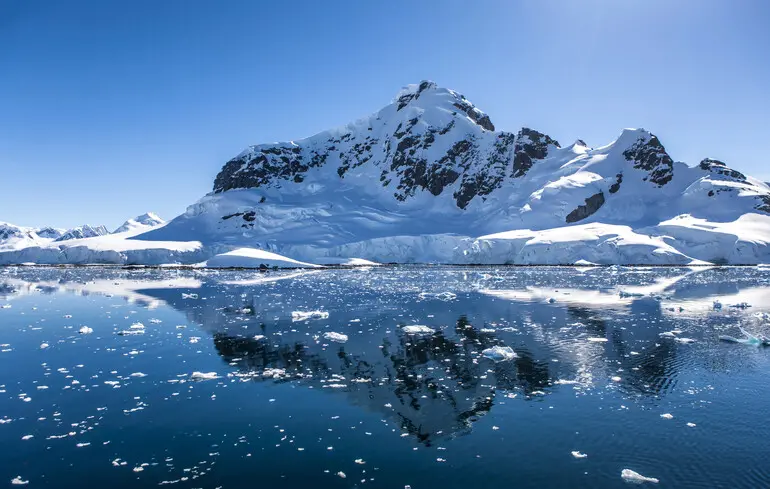
Antarctica is the only continent on Earth with no state borders. We’re used to thinking of it as a place of peace, science, penguins and icebergs. In reality, however, a political confrontation involving Russia and China is escalating here, threatening to unravel international treaties and protocols. Even emperor penguins are feeling the effects.
ZN.UA discusses what is currently happening on this icy continent with Yevhen Dykyi, director of the National Antarctic Scientific Center, who recently returned from a meeting of the countries party to the Antarctic Treaty.
A treaty that delayed the conflict… indefinitely
OO: Mr. Dykyi, how is Antarctica related to politics?
YD: Politics has been present in Antarctica since its very discovery. The continent was not explored to create a nature reserve but to exploit it like all other lands at the time. The fact that Antarctica now seems like a paradise (at least for animals and birds) is a unique period that could quickly end.
The continent was fortunate: for a long time, it was isolated from the world by the frigid circumpolar current with glaciers that flows clockwise around it. Even the legendary Captain Cook in the 18th century could not break through, writing in his logbook that it was unlikely any sailor would go further. It was only half a century later, when sailing fleets became technologically advanced enough, that during a brief summer window, three expeditions managed to break through the icebergs to the shores of the icy continent. Those were British, American and Russian Empire expeditions.
In fact, the Russians in the third expedition were hard to find. The expedition was as diverse as the empire itself: it was led by Estonian German Theodosius Gottlieb von Bellingshausen and his deputy was Captain-Lieutenant Ivan Zavadovsky of the Imperial Russian Navy, whose noble charter said he was “of Cossack descent from Hadiach.” So, we Ukrainians have been present in Antarctica for precisely 200 years and rightfully consider ourselves among its first discoverers.
But let’s get back to politics. Around the 1950s, interest in Antarctica’s natural resources grew so much that seven countries simultaneously laid claims to its territories. Moreover, some areas are claimed by more than one country. For example, the land where the Ukrainian station, Vernadskyi Research Base, now stands is claimed by the UK, Chile and Argentina.
Therefore, tensions in Antarctica have existed for a long time. No shots have been fired to kill, but there have been warning shots into the air. For example, at the end of the 1950s, British and Argentine sailors would land at each other’s stations and forcibly remove the personnel, with the explanation: “You have illegally built on our territory.”
And so, in 1959, top diplomats from the United States and the Soviet Union met, later joined by allied countries, to discuss the Antarctic issue. These were two nuclear powers dividing the world between themselves but which still managed to negotiate. And they both firmly agreed that World War III should certainly not start over Antarctica. Thus, in 1959, a unique and, in my opinion, one of the best treaties in human history appeared—the Antarctic Treaty (hereinafter, the Treaty).
And although none of the seven countries renounced their territorial claims after signing it, it was agreed that these claims would be postponed for the duration of the Treaty. And given that the treaty is recognized as indefinite, the claims are, in effect, postponed … indefinitely. This is a very clever diplomatic formulation.
The Treaty also categorically prohibits any military activity and any weapons, except for hunting weapons, in Antarctica. An absolutely effective mechanism is prescribed: representatives of any state that is a party to the Treaty can land at the station of any other state, and they must be shown all premises—where everything is, and what and how things are done.
OO: Besides freezing conflicts, what else does the Antarctic Treaty guarantee?
YD: From the start, it stipulated that Antarctic territory should be used for scientific research. Much later, in 1998, a protocol to the Treaty was adopted that established very stringent environmental rules and restrictions. Specifically, it prohibits mineral extraction in Antarctica until 2048. To extend this ban, the consent of all countries with voting rights in the Treaty will be required. If even one is opposed, the decision will not be adopted because, as in the UN Security Council, the principle of consensus applies.
Of course, the world may change greatly by 2048, but given the current situation, the likelihood of the moratorium on mineral extraction being extended is, frankly, close to zero. It is hard to imagine Russia, the United States and China agreeing to it.
Since Antarctica accounts for 10 percent of Earth’s surface, statistically, one can assume it contains about 10 percent of all the planet’s mineral resources, which have never been extracted. Consider it a “planetary stash.” I don’t think humanity will resist this temptation.
An umbrella for dirty politics
OO: What is the current political situation around Antarctica?
YD: There you can see, in miniature, the trends that determine global politics. Russia is systematically dismantling all international agreements and mechanisms of cooperation that emerged after the collapse of the Soviet Union. This is very evident at the meetings of the Antarctic Treaty Consultative Meeting, where key decisions for the continent are made. It is something like a “government” of the icy continent. It comprises only 29 countries, including Ukraine, while the Treaty mentions a total of 54 countries—the rest have no voting rights, though they hope to acquire them someday.
When I first attended a Consultative Meeting as a representative of our country in 2018, there was this old man Lukin in the Russian delegation, who had headed the Arctic and Antarctic Research Institute in St. Petersburg for 40 years. He said to me, “There is no science in this meeting hall. There is great geopolitics here, and science is just a small colorful umbrella for it.”
He did not lie; this is indeed the Russian point of view, fully shared by China. But there are other extremes—the “pink ponies” of continental Europe, for whom the main thing is science for science’s sake, the key problems of humanity, climate, etc. But even they are beginning to see that this is a somewhat naive approach. The English-speaking countries, for example, take a more pragmatic stance: they develop extremely powerful scientific programs, but their delegations are not headed by scientists—rather, they are led by top diplomats at the deputy minister of foreign affairs level. And the composition of their delegations is split 50-50 between scientists and diplomats.
OO: What approach does Ukraine follow?
YD: We try to promote the English approach, especially regarding participation of our diplomats. Of course, there’s a difference in resources. Our delegation usually consists of two people, both scientists, and, as we say jokingly, “two and a half,” when a career diplomat from the Ministry of Foreign Affairs joins on the day of an important decision and voting in the Consultative Meeting. I understand that our diplomats are overloaded and cannot always be present. In the meantime, the Russian delegation consists of around ten people, with a further five or six Belarusians in reserve. The Chinese delegation always has at least twelve members, sometimes up to fifteen. Still, we keep fighting to advance key decisions in international agreements and defend Ukraine’s interests.
OO: Could you tell us about the Group of Friends of Ukraine? Is it true that the US delegation did not join it at the last meeting?
YD: An informal group of Ukraine’s friends among Consultative Meeting members was formed four months after the start of the full-scale invasion. At that time, a special event for Ukraine was launched, where representatives of friendly countries gather. They ask what help is needed, but the conversation usually extends beyond Antarctic issues. After all, I am the only delegation head who is a scientist—the rest are mainly diplomats, and not rank-and-file ones at that. They openly admit that one purpose of these meetings is to get updates about Ukraine: what is happening at the front, at home and in the country overall. So, it’s a very important event.
Until 2025, the Friends of Ukraine group met not only with US participation, but the US would actually bringing others together too, playing the role of a convener. This year, Poland was the convener, and the American delegation did not attend at all. The Poles made sure the Americans couldn't pretend they did not know about the meeting; finally, the head of the US delegation had to admit, avoiding eye contact, that they had direct instructions from the State Department not to attend pro-Ukrainian and anti-Russian events.
OO: Can you name her?
YD: Her name won’t help. She’s a career diplomat doing what she’s told. If you want a name, then it’s US Secretary of State Marco Rubio. This was a decision made at his level. That, of course, is very telling. But it’s equally significant that the US delegation is the only one to “drop out” from Ukraine’s group of friends. All the rest remain—all EU countries, the Commonwealth, Japan and South Korea.
Paralyzed by consensus
OO: Russia and China recently blocked Canada from obtaining Consultative Party status (voting rights), and Ukraine and other countries likewise denied Belarus voting rights. At the same time, it wasn’t possible to adopt important environmental protection decisions for the icy continent. What is going on? Did this confrontation start with the full-scale invasion?
YD: It started earlier, but the full-scale invasion made it obvious. Now, the work of the Consultative Meeting is nearly paralyzed. Unfortunately, it has fallen victim to the consensus principle, which is supposed to help balance the needs of all participants but is not designed for when some parties deliberately undermine the decision-making mechanism and have no desire to seek compromise or agreement.
OO: How is Russia blackmailing the other Treaty parties, what demands are made?
YD: It isn’t blackmail— Russia isn’t issuing demands. Although in the case of Belarus and Canada it may look like there could be a trade. But it isn't certain—Russia does not formally demand to unblock Belarus’s accession, just hints at it. Some Belarusian delegates told us privately: “It’s much more important to Russia that Canada isn’t admitted than for us to get in. Afterwards, they’ll just ditch us.”
Canada is a thorn in the side of the Russians at the Consultative Meeting because it's one of the most radically democratic countries defending old Western values now being destroyed from both sides—by the Kremlin and the White House. Officially, Russia and China seek formal pretexts for blocking Canada, claiming its Antarctic program is insufficient, it does not perform enough scientific research and lacks its own Antarctic station. Yet Canada has plenty of Arctic stations, welcomes foreign scientists there, and its staff participate in exchange at Antarctic stations. And in terms of published scientific results on Antarctic research, Canada ranks in the top 5, unlike Belarus (which does have a station), Russia and China.
Meanwhile, when blocking Belarus’s accession, the Ukrainian delegation stated directly (and made sure this was entered into the minutes) that we have no complaints about the work of Belarusian scientists. But it is not the Antarctic expedition that joins the Treaty—it is a country that does it. And the Treaty says it is based on the UN Charter and respect for it. As long as Belarus brazenly violates this by supporting armed aggression against another party to the Treaty, it has no place there. Fourteen out of 29 countries declared support for our stance—that’s a majority of the Consultative Meeting participants.
OO: What environmental decisions did Russia and China block at this year’s meeting?
YD: They have blocked decisions not only this year. For the past five years, these countries have systematically blocked all environmental decisions, stating the data is unconvincing or insufficiently scientific. Blocking the creation of protected areas can perhaps be explained as a way to avoid strengthening countries’ territorial claims. But there is no explanation for blocking a resolution on the dangers of plastic pollution or restricting plastic use in Antarctica. Russia and China have also blocked, for three years running, granting “protected” status (i.e. inclusion in the red list of threatened species) to the emperor penguin, whose population has dropped threefold in recent years.
What is actually going on? Until now, I couldn’t quite fit the pieces together. But during this year’s Consultative Meeting, I understood everything. At the end, an item was discussed that never sparked disagreement before—next year’s meeting agenda. Suddenly, Russia pipes up and says they are against it. So what didn’t they like? For twenty years, on the first day of the meeting, top scientists from the Scientific Committee on Antarctic Research present last year’s findings. This year, Russia said the Treaty doesn’t require this, so it’s time to stop this practice and return to basics. That’s when I realized Russia’s actions everywhere: not just to restore the USSR within its borders but to rewind the world to 1991. This is a thoroughly considered, deliberate line. Remember, Putin once spoke of how the West “deceived” Russia about NATO expansion in 1997, and how the collapse of the Soviet Union in 1991 was a “geopolitical catastrophe”? For Putin, returning to the 1980s is important personally; it was his golden age as a young KGB agent, a “big man” who could jail or ruin anyone’s life.
Now Russia seeks to destroy international structures and agreements in every area, returning the world to a place where everything depends on its will. After the 1990s, we foolishly thought all evil was defeated and the world needed only a bit of improvement, with very gentle methods.
OO: Do the Treaty participants understand Russia’s motives?
YD: Of course, everyone understands. Russia acts straightforwardly and bluntly. Oftentimes, at the Consultative Meeting, its representative is a very young woman with excellent English. We privately call her “Lavrov’s granddaughter.” She uses all of her “grandpa’s” scripts.
OO: Are there tools to counter Russia’s destructive stance, at least to drop the consensus principle if it no longer works?
YD: To replace consensus with qualified majority rule, you need consensus again. It becomes a vicious circle. In my view, there are two possible ways out. Unfortunately, neither is yet politically acceptable for the EU or NATO, but hopefully the time is coming. The first way is to put strong pressure on those who abuse consensus, as once happened with Orbán at an EU summit. It should be explained to them that they should go get coffee while critical decisions are made. But right now, there is no mechanism for this.
The second way is to fully isolate those violating consensus, as the rest of the countries denounce the treaty and immediately sign a new one with different voting rules. But let’s see if at least half of the 29 countries at the Consultative Meeting agree to such radical steps. For example, the countries of the Global South are much less affected by Russia and China. Here is the case in point: in the votes on Belarus and Canada, three countries—Russia, China and India—voted for Belarus. And for Canada, everyone voted in favor, except Russia and China. India’s position, voting for both countries’ admission—“let’s accept everyone, let’s all get along”—is very emblematic. That’s typical for the Global South: smooth out conflicts or just pretend they don’t exist.
Ukrainians on the icy continent
OO: What are Ukrainian scientists researching in Antarctica?
YD: We are researching not so much the continent itself but processes affecting the whole planet: magnetic fields, the ozone hole, atmospheric rivers (the mechanism of heat transfer from equatorial to polar latitudes, explaining the accelerated warming rates). A recent article on atmospheric river discovery was published in the prestigious journal Nature, co-authored by two Ukrainian female scientists, Svitlana Krakovska and Anastasiia Chyharieva. For a scientist, publishing an article in Nature is akin to an entrepreneur making the Forbes Top 50.
With data from our Vernadskyi station, humanity monitors the recovery of the planet’s ozone layer. Based on our space weather research, the International Civil Aviation Organization plans passenger flight routes. And there are independent Ukrainian research findings.
Our scholars also participate in a large international consortium studying changes in ocean currents due to melting glaciers. Our colleague Nataliia Shepel, who leads the project, travels to Antarctica, launches so-called Argo floats (underwater buoys with sensors) and then goes back to Odesa, where she volunteers to support her boyfriend at the front. That’s how we live.
And I haven’t listed all our research, not even half. Last year, our National Antarctic Scientific Center led Ukraine in the number of grants under the European Union’s Horizon Europe program. All grants were won in stiff international competitions: 13–17 projects vied for a single grant. This addresses the concern that we Ukrainians often underestimate ourselves. We compete on par with big institutes and universities, even though the NASC has only 60 scientists.
Our Antarctic research is our contribution to fundamental and applied science, and participation in international cooperations. You know, once during the Revolution of Dignity, I met a former student from Kyiv-Mohyla Academy on a plane, who was then a postgraduate student at Heidelberg University, one of the world’s top 100 universities. He left his postgraduate studies and was flying to Maidan. We spoke the whole flight, and I have remembered one of his phrases ever since: “You know, each morning I wake up with a dilemma: am I, first and foremost, Ukrainian or a scientist?” So, Antarctic research is one of those rare opportunities that eliminates this dilemma. You don’t have to choose, you can be a Ukrainian scientist pushing global science in large international consortia along with colleagues from far more comfortable and richer countries.
OO: What prospects and plans does Ukraine have in Antarctica?
YD: After the war, there will be postwar recovery, and we have big ambitions. I hope that in the future, we will have a Ukrainian national polar program that will include not only the Vernadskyi station and an icebreaker (as it is now), but two stations in Antarctica and one on Svalbard archipelago in the Arctic. This is Norwegian sovereign territory, but under the Svalbard Treaty, any country can set up a research station there. This would be our entry into the Arctic.
OO: We will also remain part of the Antarctic Treaty. What can we expect there?
YD: 2048, when the moratorium on mineral extraction expires, is just around the corner. I would like it to remain in effect. But most probably, that will not happen, and in that case, we will need to defend our economic interests there as well so that Ukraine is among the countries granted access to the resources.