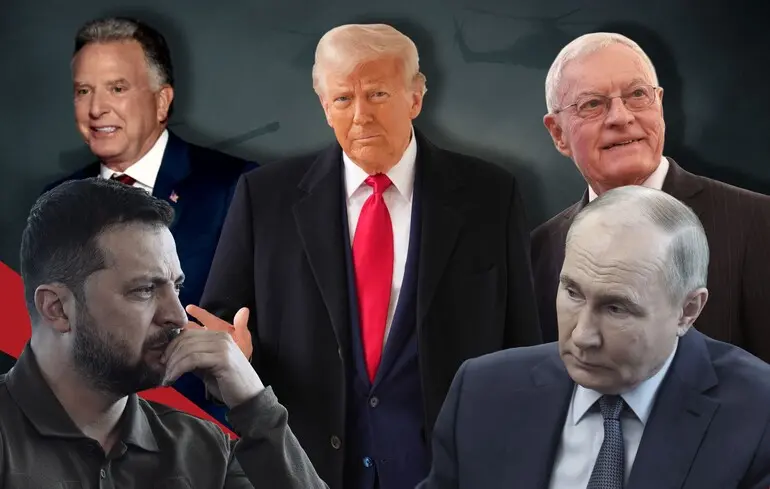
Ceasefire or negotiations? Negotiations or ceasefire? What should come first and what should follow? All discussions on this topic between Kyiv, Moscow and European capitals were abruptly interrupted by a message written in capital letters and with three exclamation marks on social media from Washington addressed to Ukraine: “MEET. NOW!!!”
But WHAT FOR? What is the American vision for ending this war? What will be its consequences for Ukraine, Russia, Europe and the world as a whole? Will the aggressor be punished? Will international law be restored? Will justice prevail? What is Trump's strategy, as opposed to his tactics?
As far as we know, there is currently only one comprehensive document that gives an idea of how the White House sees the endgame of Russia's war against Ukraine. In Washington, it is literally called the “Russia-Ukraine Deal Framework.” Better known in the press as “Kellogg’s 22 points,” this document was delivered from Washington at the end of April by Kit Kellogg, US Special Envoy for Ukraine, and presented to both the Ukrainian side and its partners — the “European troika” — the British, French and Germans. It is likely that Moscow is also familiar with this document, which begins with the words: “These terms are the definitive framework from the United States for Ukraine and Russia.”
In various interpretations, some points of this document have been mentioned in the world media. However, the full picture of the “definitive” American “framework” and the Trump administration's vision for the outcome of the Russian-Ukrainian has not been presented yet. ZN.UA had the opportunity to review the entire document. Below we are publishing all of “Kellogg’s 22 points” to give our readers the chance to assess Washington's stance and understand what Ukraine needs to prepare for (or resist).
We see that Trump is losing patience. It is not the Russian-Ukrainian war and its victims that keep him awake at night; he dreams not of peace but of the Nobel Prize for it and the opportunity to do business with Putin.
Volodymyr Zelenskyy's decision to play the role of a diligent student, agreeing to Trump's demand and flying to Türkiye, was quick but wise: now no one can accuse Ukraine and its president of not seeking peace. This decision was shockingly unexpected and very inconvenient for the Kremlin: after all, on the night of May 11, when offering “direct talks with the Kyiv regime” in Istanbul, its master had no intention of going there and meeting with President Zelenskyy in person.
Nevertheless, everything is still turning out as Putin planned in his scenario: direct talks between Russia and Ukraine will begin “without preconditions,” BEFORE a ceasefire and not at the highest level.
Ghosted, Zelenskyy will apparently have only Erdogan to talk to. Well, Rubio, Kellogg and Vitkoff may be there as well. In Putin's absence in Türkiye, the Ukrainian side could still refuse to negotiate, citing the Russian leader's disregard. But the American “mediation” barrier troops, quickly sent to Istanbul by Trump, will not allow our representatives to simply return to Kyiv without sitting down at the negotiating table. This is despite all previous statements by Zelenskyy and his European colleagues that first there must be a ceasefire and only then negotiations.
We will see in the coming days whether the talks will continue after Istanbul or be interrupted again, whether our European partners will repeat their demands to Moscow to immediately begin a 30-day “ceasefire,” whether they will impose new tough sanctions against Russia or whether they will once again throw up their hands in helplessness as Trump plays into Putin's hands. But whatever happens, sooner or later, with or without a ceasefire, negotiations will begin. This is acknowledged by President Zelenskyy, who speaks about their different formats and the diplomatic end to the war.
Having returned from London after difficult consultations with representatives of Ukraine and the “European troika,” Kellogg said in an interview with Fox News a few days later: "We offered 22 very specific points. And after very frank and difficult discussions with the Ukrainians, we believe we are in a very good place. They did not like all of the proposals, but no one will like the final position you come to them with. That's normal in any negotiations."
Trump literally declares every day his ardent desire to end “this stupid war” as soon as possible. How do they see its end in Washington? What, in the opinion of the Americans, should we ultimately agree to as a result of the negotiations that the Trump administration is so insistently pushing Ukraine to enter into?
The “Kellogg document” is not numbered, but for better readability, we have numbered its points. It reads as follows:
***
As sources of ZN.UA assure us, this document is not dogma; it is merely a vision, a framework, and its content will be discussed in detail point by point. However, this framework gives a good idea of the goals and values of the current US administration. It also shows the consequences of a “settlement” of Russia's unprovoked and genocidal war against Ukraine, both for our country and the world as a whole.
Firstly, the willingness of the current US administration to legally recognize Crimea as part of Russia suggests that any autocrat or dictator who wants to seize part of another state can now count on his actions being recognized and legalized over time by the world's most influential (still) democracy. This is an obvious and flagrant violation of the foundations of international law, which protects the territorial integrity and sovereignty of states. Trump's decision to legally recognize Crimea as Russian will sow aggressive chaos across the globe, encouraging even greater lawlessness and aggression on the part of autocrats and dictators.
Secondly, let us recall that during his election campaign, Trump constantly spoke of “peace through strength,” without specifying how exactly he would achieve this. In practice, it turned out that force is used exclusively against the victim of aggression, not against the aggressor. For we see that on the issue of ending the war against Ukraine (but not on the issues of reaching agreements on commercial deals between Russia and the US), Putin has not taken a single step toward Trump. NOT ONE. At the same time, Ukraine is being forced to renounce NATO membership, to abandon its demands for security guarantees before a ceasefire or the start of negotiations, to sign a “minerals” deal and to fly to Türkiye and enter into negotiations without any preconditions. And what did they force Putin to do?
Now we can clearly see the modus operandi that the Trump administration is using to resolve world conflicts.
Thirdly, there is one vital advantage for us in the American approach to ending the Russian-Ukrainian war. Contrary to Moscow's demands for the “demilitarization” of Ukraine, the framework document preserves our country's right to have armed forces of whatever size it deems necessary. This will allow us to rely on our army and develop our military-industrial complex in close cooperation with our partners. This is a matter of security and, as the emerging practice shows, of filling the state budget. And the budget is primarily meant for the army.
As a consequence, fourthly, we must conclude that it is our army that Ukraine must rely on now. But we have problems with this too, and the lack of weapons is not the main one: the country is running out of people who are willing to risk their lives and go to war to defend their homeland. This must be understood not only by us Ukrainians but also by those in the world who are on our side, who believe that we are defending not only ourselves and Europe but also the “rules-based order”; who see that we are fighting not only against Russia but also against North Korea and other suppliers of manpower to the Russian army. No one is helping us with manpower. This means that our army must now be given the utmost attention: in terms of improving the quality of its management, the quality of training for soldiers and their commanders, and in terms of the value attached to human life.
But this will still not be enough, and we can only hope that Trump will finally open his eyes and see that Putin has been stringing him along all this time. By weakening Trump's position both within the United States, where Putin is an antihero for most voters, and by undermining Trump and America's authority on the world stage. If Trump finally comes to understands this, then we may see a different document.
For as long as Europe continues to impose such negligible sanctions that even Hungary votes for them, America, if it so desires, can deploy Pershing missiles or send a couple of equipped brigades, approve Lindsey Graham's bill or impose sanctions that would really hurt Russia. Or (let's dream of it) do all of this at once. Therefore, be that as it may, apart from our army, Washington also holds the key to victory in the war against Russia.