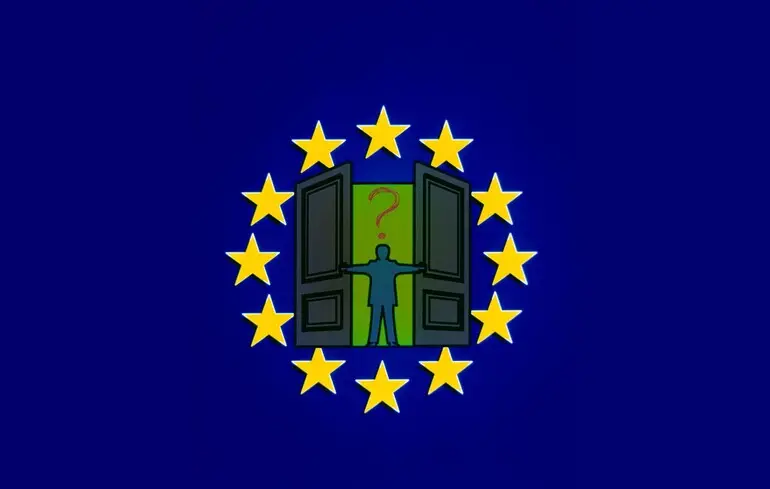
Ukrainian authorities have been increasingly voicing the possibility of joining the European Union as early as 2027. At the end of February, President Volodymyr Zelenskyy called on the EU to set a specific accession date. Earlier, at the Munich Security Conference, he said that Ukraine would be ready to complete negotiations across all clusters by the end of 2026.
However, Brussels has already made it clear that tying Ukraine’s accession to a specific year is premature: the enlargement process depends on the implementation of reforms and the decisions of member states. In other words, political statements about rapid membership cannot replace real progress in the rule of law.
EU and member state leaders have repeatedly stressed that Ukraine is expected to meet all conditions and follow the established accession procedures.
Ukraine has already been met halfway on several occasions, with waiting periods and some bureaucratic procedures shortened. However, EU partners cannot overlook rule-of-law reforms.
Recently, EU Commissioner for Enlargement Marta Kos once again stressed the obvious: fighting corruption and building democratic institutions are the foundations of European integration, and full EU membership cannot come at the expense of these reforms. In a recent interview, she also stated that full membership will only be possible once comprehensive reforms are carried out, with the fight against corruption forming the basis for restoring trust. These are the conditions for being a member of the European Union.
However, it seems that Ukrainian senior officials have chosen to play by their own rules. Despite President Zelenskyy’s recent assurances that “we are building a big anti-corruption infrastructure,” there is little genuine willingness within the government to bring about meaningful change. What is happening with the rule-of-law reform in Ukraine could in fact be described as an “Italian strike”: doing just enough to avoid being accused of sabotage, but not enough to achieve real progress. Unfortunately, this appears to be a deliberate strategy.
Back in December 2025, the so-called “frontloading” plan (the Kachka–Kos plan) was adopted to accelerate the fulfilment of EU accession requirements in advance, despite Hungary’s temporary blocking of the negotiation process. The plan contains 10 points, most of which focus on countering corruption, continuing judicial reform, and promoting good governance. Two months have passed, yet the Ukrainian authorities, led by President Zelenskyy, have failed to deliver any meaningful progress on any of the points. Not a single draft law has been submitted to Parliament, even though most of the plan's provisions require legislative changes.
Let's take, for instance, the first point of the plan, which concerns amendments to the Criminal Procedure Code. Ukraine is expected to repeal the notorious “Lozovyi amendments,” which for years have undermined anti-corruption investigations, regulate statutes of limitations, address procedural delays, and expand the jurisdiction of NABU as well as the powers of the SAPO Head in matters of extradition and investigations involving members of parliament. All of this could be addressed through a single technical draft law. The preparatory work has long been done, as relevant proposals already exist both within the expert community and state institutions. Yet no such draft law has officially been presented for public discussion or submitted to the Verkhovna Rada.
Or take the fifth point, which concerns reform of the State Bureau of Investigation. The President personally instructed that a draft law on SBI reform be submitted to parliament by the end of January. The deadline has passed, yet the draft law has still not been submitted to parliament.
It became known that Ukrainian officials are desperately bargaining with the European Commission to reduce the role of international experts on the selection commission for the head of the State Bureau of Investigation. These very experts are meant to minimise political influence over the appointment process. The EU and its member states have made their position clear and unequivocal: without a decisive vote of international experts, these changes would not qualify as a genuine reform. It appears that at this point, the Ukrainian government’s willingness to reform the SBI has reached a dead end.
A similar situation can be seen with the appointment of judges to the Constitutional Court. This appears to be the simplest requirement, as it does not necessitate any legislative changes. On 19 February 2025, the Advisory Group of Experts submitted to the Verkhovna Rada and the President a list of candidates who had passed integrity checks. In June and October 2025, the President appointed two Constitutional Court judges, while the third vacancy under his quota remains unfilled. The Verkhovna Rada, meanwhile, rejected all candidates and even attempted to amend the law on the Constitutional Court in order to undermine the selection process, but this attempt was fortunately blocked by the Venice Commission. For now, neither the President nor the Verkhovna Rada seems to be in a hurry to fill the remaining vacancies or launch new selection procedures.
A review of the remaining points of the plan would lead to the same conclusion.
Promises have been made to both Ukrainians and European partners, but there appears to be little real political will to deliver on them. The authorities seem to be trying to repeat the tactic used with the IMF: postponing painful reforms while citing the energy crisis caused by mass missile attacks. This approach has been used throughout the full-scale invasion, but it is becoming harder to explain to partners how power outages relate to the lack of reform of the Prosecutor General’s Office or law enforcement agencies. In reality, there is no such connection.
December 2026, when Ukraine has promised to fulfil all the requirements for EU accession, is closer than it may seem, and the time to report on progress will come soon. EU membership matters first and foremost for Ukraine and its citizens, and our European partners have already done their part — the ball is now in our court.
The questions should no longer be directed at Brussels but at President Zelenskyy: Does he have the political will and determination to truly lead the country into the EU, or were the statements about timelines and readiness for accession in 2027 another soundbite for foreign media?