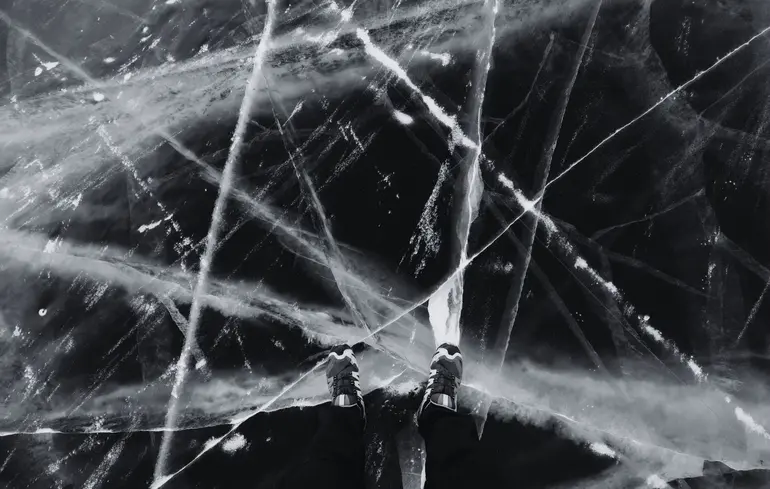
Volodymyr Zelenskyy has long been walking on thin ice, over dark waters of accumulating frustration caused by corruption, decisions not made, misguided personnel policies, problems in the military and chaos in the defense-industrial complex… The people and international partners felt this deepening darkness but refrained from voicing their emotions and arguments. Few dared to criticize the authorities. After all, the country is at war.
But on July 22, when parliament passed Bill No. 12414, which destroyed the independence of NABU and SAPO, the ice beneath the president cracked. We witnessed “Operation Spiderweb-2,” which revealed that just as in Russia, the authorities are capable of conducting a brilliant operation against external enemies—and no less brilliant an operation against internal personal foes. Zelenskyy skillfully trapped a number of activists, journalists and anti-corruption organizations in a web woven from synchronized loyal law enforcement agencies, anonymous smear blogs masquerading as media, courts and MPs with paralyzed willpower. The bill that he initiated, orchestrated and signed within hours became Zelenskyy’s personal success—and the pinnacle of his “I-am-the-state” vision.
However, the victory proved Pyrrhic: on July 24, amid nationwide protests and assessments by Prime Minister Yuliia Svyrydenko and Deputy Prime Minister for European Integration Taras Kachka showing that Ukraine stood to lose €20 billion in Western aid tied to anti-corruption performance, the president submitted a new bill to parliament. Its explanatory note admitted that the previously adopted law “contains potential risks to the effective functioning of Ukraine’s anti-corruption infrastructure.” Bingo!
For Zelenskyy, this meant not just rewinding the film but officially and publicly acknowledging the failure of the special operation to roll back democracy in Ukraine. The explanatory note was signed by Deputy Head of the Presidential Office for Judicial Reform Iryna Mudra, who, according to sources at the Presidential Office, did not approve of the earlier bill passed by parliament.
And what about the 263 MPs who voted to strip NABU and SAPO of their independence? We watched them pass through all five stages of grief. First, disbelief—that the all-powerful Zelenskyy had reversed course. Then anger—at those who made them scapegoats. As if in six years of parliamentary work they had played a different role. The third stage—bargaining—came swiftly. Some tried to bargain, realizing their vote had become a “golden share.” Some bargained with the enemies of NABU and SAPO to avoid voting for the new bill. Others sought to exit parliament by securing a signature on resignation letters written long ago. Still others demanded guarantees of inclusion in the electoral list for upcoming elections.
On the subject of guarantees—a significant number of MPs under formal suspicion (31) or mentioned in court cases (80) demanded immunity guarantees from NABU, hoping that the ever-resourceful Davyd Arakhamia would “work it out” once again. But it seems even he might not be able to do it. Not even for himself. So grief must be accepted. And in the final stage—tomorrow—the law must be passed. Without it, Ukraine will lose Western support, and the street’s internal backlash could spiral completely out of control, bringing fatal consequences for the country.
A law about salvation, not reform
Behind the glossy photo-op (notably missing is Economic Security Bureau chief Oleksandr Tsyvinskyi, selected through a transparent competition and still not confirmed by Svyrydenko’s new government), the same murky waters remain. And all the main actors—despite previous verdicts against the anti-corruption authorities and commercial and political rivalry notwithstanding—took a forced step back to avoid dragging the entire country into the abyss. And that is the true achievement of recent days.
More precisely, it is the achievement of our brave citizens, who sent such powerful and articulate messages to the authorities—scrawled on cardboard—that they overturned the entire chessboard of the self-assured players from the Presidential Office. And not only them. Every significant partner of Ukraine sent their own “cardboard signs” to the president’s team.
Now, within Zelenskyy’s entourage, everyone is pointing selfie sticks at each other, trying to shift blame for the failure. According to ZN.UA, the head of the Presidential Office, through Deputy Prime Minister Oleksii Kuleba, is trying to convince NABU leadership that he had no hand in the operation against the anti-corruption bodies, that he strongly supports NABU and SAPO’s work, and that there should be no more untouchable figures for them. But we know: without Andrii Yermak, such a combination would have been impossible.
The very idea of neutralizing SAPO and NABU by reforming the anti-corruption bodies originated long ago thanks to Andrii Portnov. But it wasn’t until clouds began to brew over those closest to the president that action was taken.
Portnov’s blueprint was implemented by Yermak and his deputy for law enforcement, Oleh Tatarov. Media coverage, including Telegram smear channels, was managed by former star speechwriter and current “left ear of the president” Dmytro Lytvyn. The key role, however, was played by new Prosecutor General Ruslan Kravchenko.
And for a deeper understanding, consider this: According to informed sources, one of the major contributors to this “bright day for the country” (Ms. Tymoshenko, such things cannot be forgotten) was Dmytro Borzykh, a NABU investigation suspect accused of organizing a “hacker-lawyer group.” His friendship with Kravchenko goes back to their days in the military prosecutor’s office. So it's no surprise that as soon as Kravchenko assumed office, he announced an audit of NABU cases. The reason? To sort out jurisdiction. Now, take a guess: which case is the easiest to remove from NABU’s jurisdiction? Correct: interference by lawyers in automated systems. Those same systems used to extract sealed court decisions granting investigators permission for searches, wiretaps, etc.
Who wrote the president’s new bill?
Several groups. First, the sections restoring NABU and SAPO’s rights and freedoms were written overnight by the institutions themselves (July 23–24). Thanks to their efforts, all guarantees of institutional independence were reinstated. Of course, the heads of SAPO and NABU knew that the 48 MPs who had refused to support Bill No. 12414 had drafted and registered an alternative. (Honor and praise to them.) Other MPs later joined with additional drafts. But fully understanding that only a presidential bill stood a chance, Klymenko and Kryvonos agreed to “cooperate” with Zelenskyy.
Second, the allegations of some NABU detectives collaborating with Russia cannot be erased with a snap of the fingers. Understanding the wartime risks and the enemy’s recruitment tactics—and aware of the president’s bruised ego and pressure from the security apparatus—NABU and SAPO leaders included provisions for polygraph testing and SBU checks, previously discussed during a joint meeting at the Presidential Office.
Polygraphs are standard in law enforcement, and if the SBU is not ordered to “shut down” NABU (with NABU’s Internal Control Department forwarding results to the SBU), there is no threat. SSU checks were always mandatory for NABU and SAPO; the new bill merely formalizes the interval (every six months). Access to state secrets is temporary and confirmed by the SSU; only the president, MPs, NABU’s director and SAPO’s head have automatic access.
But here comes a problem: a SAPO prosecutor can work without access, but a NABU detective cannot. If the SSU revokes access, the director must dismiss the detective. Following a recent sweep against NABU, seven detectives lost their clearances and were effectively sidelined from their work—in some cases, over formalities like questionnaires and background check deadlines. Most are promised reinstatement. NABU has long proposed changing the status of covert actions from “state secret” to “official information,” as is common in several European states.
Third, all content related to the Prosecutor General’s Office was developed by Ruslan Kravchenko. This includes provisions allowing the Prosecutor General to make appointments bypassing staff reserves or competitions (i.e., for “his own people”) and to dismiss employees at will. Ultimately, according to our sources, the compromise draft was fully endorsed by the Presidential Office.
A parliament that has to flog itself
Despite outreach to various political and commercial factions, panic still reigns in the Rada.
Not just due to Zelenskyy’s perceived betrayal but because of fears that detectives and prosecutors will “take revenge.” According to our information, Klymenko and Kryvonos are reassuring their teams that they “have never and will never follow political orders or engage in persecution.” Still, the shock within the anti-corruption bloc—professionals who competed for their posts and know what independence means—is understandable. NABU expects the SSU to end surveillance of its and SAPO’s leadership, as well as to clarify the status of Semen Kryvonos, who is being targeted by pro-president Telegram channels and bloggers.
Watching the confusion among most of the 263 MPs gives the impression they are trapped under the parliamentary dome, oblivious to the consequences. Consumed by introspection and calculating the dividends of their “golden shares,” they fail to grasp that failure to pass the corrective law could cost Ukraine financial support from the EU and IMF. They don’t sense the public’s fraying patience. They don’t understand the disaster unfolding on the eastern front—and how it could escalate. They don’t realize that not voting will not be seen as some delayed assertion of independence but as Zelenskyy’s backstage maneuvering. Until now, he did whatever he wanted, including in this parliament.
Ladies and gentlemen, do you understand the response will come in worn-out combat boots? Tomorrow’s vote is the last chance to defuse a situation that could spiral uncontrollably, inside and outside Ukraine. In the West—especially in the United States—few distinguish between Ukraine and Zelenskyy. His final discrediting in the eyes of partners would be catastrophic. And Putin understands this perfectly. He merely needs to wait for Ukraine, cut off from aid and torn by infighting, to collapse into his hands.
The president stripped from protection
Let’s be honest. It is not only parliament that must silence the song it has long sung to the presidential team’s tune. Serious ailments must be treated during flare-ups, not bandaged. If the president understands this, he must walk the full path the situation demands. And it involves not one but several steps.
First, parliament must pass the law restoring NABU and SAPO’s independence. Whether the situation improves will depend on how quickly Zelenskyy can persuade MPs to pass the bill—as swiftly as Bill No. 12414—without drowning it in second-reading amendments or shelving it into legislative limbo. (The relevant committee approved the bill today; it will be put to a vote tomorrow.)
Second, an ESB director must be appointed by the Cabinet on the recommendation of a legitimate competition commission. Despite Zelenskyy’s positive step with the new bill, it appears that neither parliament nor his own inner circle grasp the full scale of the crisis. Last week, a meeting at the Presidential Office considered merging the ESB, the tax service and the customs office. Since the ESB is the former tax police, why not return it to the tax service, amend the ESB law and grant it investigative powers?
Third, the president must dismiss all organizers and executors of the operation to dismantle Ukraine’s independent anti-corruption bodies. This failure in the dark waters is not merely a mistake by the president’s spin doctors—who understand their own stomachs better than the country—but a move toward the political demise of the ruling party and its leader. Even if the bill passes and those responsible for “Operation Spiderweb-2” resign, Zelenskyy’s political trajectory will still be shortened. But by ridding himself of the agents of his own will, he may leave office unafraid to step outside the gates.
It is absolutely clear that Zelenskyy would not have relinquished autocratic power had the people allowed it. Especially since the authors and executors of this grand special operation to neuter the rights of activists, journalists and anti-corruption services—Yermak, Tatarov, Kravchenko, Lytvyn, Arakhamia—immediately assured Zelenskyy the protests were funded by Klitschko and Poroshenko. The mood turned even darker when Deputy Prime Minister Mykhailo Fedorov placed on Zelenskyy’s desk a map showing how protest messages had organically spread across social media.
In addition, we understand EU representative in Ukraine Katarína Mathernová, who publicly spoke of Zelenskyy’s maturity in listening to society’s voice and introducing a new bill. She and her colleagues are trying to pull the increasingly autocratic wartime leader out of deep waters. We thank our partners for suppressing their anger and indignation. But the president is already drenched. And no one will forget. For years, Zelenskyy was largely immune to criticism. Articles on his or his entourage’s mistakes in top global media were rare exceptions. Now, the armor has come off. He can be held accountable—for anything his enemies expose and his friends can no longer ignore.
And we are bound too closely to him. To stay afloat and not go under, Zelenskyy must complete the entire process of fixing this situation—step by step, as described above. The advice he needs here comes down to one word: think. The very word Zelenskyy once threw at others during the presidential campaign in 2019 and which is now aimed squarely at himself