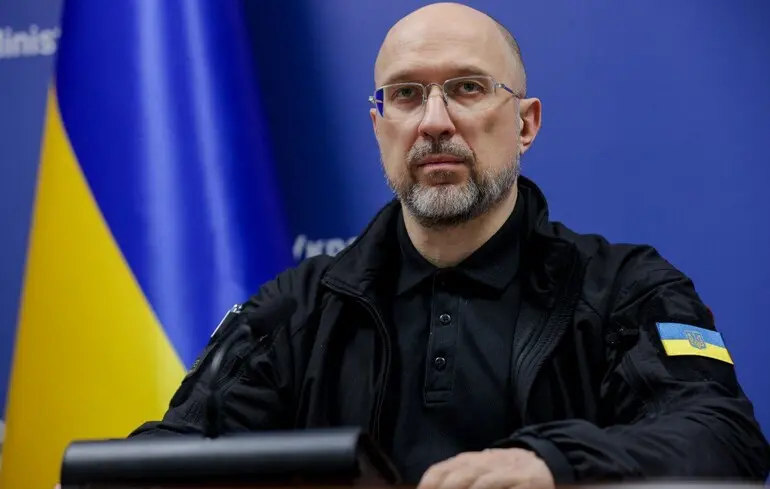
The Verkhovna Rada has voted to dismiss Denys Shmyhal from the post of Prime Minister, a position he held longer than any of his predecessors. The decision was supported by 261 MPs. According to information released by parliamentarians, no one voted against the dismissal; four MPs abstained, while 55 lawmakers present in the chamber did not participate in the vote.
In his final address to parliament, Shmyhal began by thanking the military and the people for their resilience, President Volodymyr Zelenskyy for his cooperation, the government for its collective efforts, parliament for its collaboration and “constructive criticism and suggestions,” and businesses for paying taxes.
“These past five years have been the most difficult in our history. … Regardless of how serious the challenges were, we always fulfilled all of our social obligations to the state,” Shmyhal stated, recalling the outbreak of the COVID-19 pandemic—shortly after he assumed office—and the full-scale war.
Under the Law on the Cabinet of Ministers, the Prime Minister’s resignation automatically triggers the resignation of the entire government. Nevertheless, the Cabinet in resignation continues to carry out its duties until a new government is formed. The new Prime Minister and government lineup are expected to be appointed at the parliamentary session scheduled for July 17.
According to ZN.UA, based on data from the Secretariat of the Verkhovna Rada, the Cabinet of Ministers submitted 1,071 draft laws during Shmyhal’s tenure, of which only 411 were adopted. This raises a question: in a parliament —and by extension, the government—effectively controlled by the president, why was only a third of the Cabinet’s legislative agenda implemented? Even with the backing of Davyd Arakhamia, the leader of the Servant of the People faction and a key supporter of Shmyhal for years, the efficiency of cooperation between the legislature and the cabinet remained limited.
To explore this, ZN.UA consulted Oleksandr Zaslavskyi, Director of the Analytical Department at the Laboratory of Legislative Initiatives. He emphasized that power consolidation does not directly correlate with systemic efficiency:
“There is a number of constitutional, procedural and institutional mechanisms and constraints rooted in parliamentary and governmental practice that inherently limit efficiency gains. Even if there were only 45 MPs, all sworn to serve the Presidential Office, basic throughput constraints would still apply.Moreover, despite appearances, the Presidential Office cannot micromanage the entire legislative process. Manual control also has its capacity limits. In the vast number of issues that simply cannot be monitored from Presidential Office, what emerges is not controlled governance but a state of complete chaos—though to the outside observer, it may resemble democratic processes. In reality, power within the triangle of governance is decentralized because the capacity of those attempting to control everything is fundamentally mismatched with the complexity and scale of the issues requiring expert solutions,” says Zaslavskyi.
The analyst further noted that since 2019, key executive and parliamentary stakeholders have attempted to move toward a “government-centric” model, in line with the architecture of the parliamentary and public administration reforms.
“They liked the idea, recognized its value and saw its rationale. The presence of a parliamentary majority gave them greater control over the flow of government bills to registration. Parliamentary monitoring data shows that the number of MP-initiated bills gradually declined during the 9th convocation, while the share of adopted government-initiated bills increased.So, although progress was slow, the system was moving in the right direction—addressing the problem of legislative ‘spam’ from MPs without resorting to radical or unpopular measures, such as limiting the individual right of legislative initiative.”