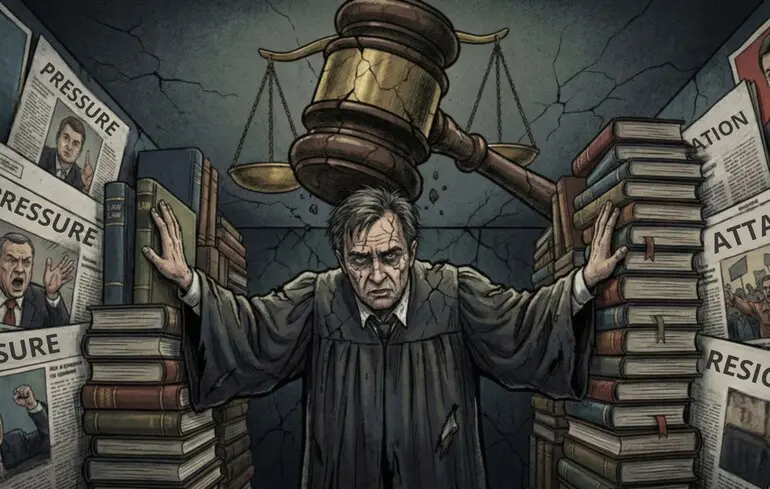
Distrust of judges in Ukraine stems from many causes. Among them are breaches of ethical standards by some members of the profession and notorious corruption scandals that we cannot ignore. These cases are loud and outrageous (one need only recall the high-profile case of former Supreme Court Chief Justice Kniazev, currently being considered by the High Anti-Corruption Court), casting a lasting shadow over the entire judiciary. Yet many judges perform their work diligently and honestly, doing so under conditions far more difficult than may appear from the outside.
Unfortunately, Ukraine’s public space is dominated by a strange, one-sided belief that to obtain a “fair” ruling (in reality, a ruling one simply likes), pressure on the judge is necessary. For some reason, people are convinced that a normal decision cannot be achieved otherwise. I sometimes hear this at public events from people who consider themselves experts or even defenders of someone’s rights. But in attempting to pressure a court, one can easily squeeze the last traces of common sense out of oneself.
Let us look at what actually happens behind courtroom doors—not through hearsay, but through official documents. We examined the HCJ’s review of decisions concerning measures taken to safeguard judicial independence and the authority of justice in 2024 (the review for 2025 is forthcoming)—and we can show many things that contradict everyday assumptions about courts and judges. Let us look at this not through complex legal analysis, but through the context in which courts must operate.
A will as a weapon. At times, methods of pressure reach new heights of cynical creativity. For example, a judge of the Nikopol City District Court in Dnipropetrovsk oblast was hearing an administrative offence case when she received a motion for recusal. The grounds for the motion was a will attached to the case file: the husband of the defendant had allegedly “bequeathed” all his property to the judge. The document included the judge’s personal data — information she had never made public.
This is a striking example of subtle administrative terror. The perpetrators used legal instruments to undermine trust in the court’s impartiality and artificially create a conflict of interest, forcing the judge either to recuse herself or to continue working under constant moral pressure.
Physical violence. The most obvious form of influence is physical violence. Judges report attacks taking place directly inside court buildings. For instance, in the Prydniprovskyi District Court of Cherkasy, a dissatisfied defendant attacked the judge right in the courtroom. The woman sustained bodily injuries and had to seek medical care.
Unfortunately, such cases are far from isolated; incidents of threats, insults, and attempted physical pressure on judges are numerous. These actions aim to force a judge to adopt a particular decision or refrain from acting in a specific case. Even during lectures at the National School of Judges, one of the most common questions I hear is: “What should I do if a complainant tries to start a fight?”
Fake rulings. Perpetrators forge court decisions and writs of execution, attempting to give their unlawful actions an appearance of legitimacy. For example, the Trostianets District Court of Sumy oblast received a request for the full text of a judgment that had never existed. The request was accompanied by a copy of a “ruling” with fabricated signatures and a counterfeit stamp, and the secretary named in the document had never worked at the court.
The HCJ recorded other similar cases in various regions of Ukraine. Particularly dangerous are those involving extortion: for instance, a case in the Malynovskyi District Court of Odesa. A person facing administrative liability received via Telegram a photo of an alleged ruling closing their case, with a demand for 20,000 UAH in exchange for this “service.”
In another case, at the Smila City District Court of Cherkasy oblast, a forged writ of execution was discovered containing falsified data. The court officially confirmed the forgery, notifying the enforcement service that no such writ had ever been issued.
A forged court decision can be used against you. Some people call asking for the three digits on the back of your credit card; others fabricate a court ruling in a text editor. So never trust screenshots or files sent by “intermediaries” in messaging apps. Always verify the existence of decisions in the Unified State Register of Court Decisions—they usually appear there within two or three days.
Constant surveillance. A case involving a judge of the Solomianskyi District Court of Kyiv shows that perpetrators are not above using modern technology. The judge received a phone notification that an unknown device was moving together with her. Following the sound signal, she discovered an Apple AirTag hidden beneath the bumper of her car and called the police, who documented the fact of surveillance.
This is a form of psychological pressure intended to signal to the judge that she is being watched, that someone can easily approach her car and place something inside it, and to create a state of constant anxiety. By law, illegal surveillance should be classified as a violation of privacy and interference with judicial activity, both of which entail criminal liability.
Cyberattacks. The Commercial Court of Odesa oblast was subjected to a massive attack through the distribution of phishing emails titled “Court Summons.doc.” An unknown malicious code damaged access to the court’s server system, causing interruptions in operations and creating a risk of information leakage. It is likely that there was unlawful interference in the functioning of electronic systems and a threat of access to judges’ electronic keys, their personal data, and internal documentation systems.
In another case, perpetrators hacked the Telegram account of a judge of the Holosiivskyi District Court of Kyiv and sent fake messages on her behalf. This breached the confidentiality of correspondence and created the risk of reputational damage. Other incidents included threats to judges on Facebook and the publication of their personal data online.
The High Council of Justice systematically reviews judges’ reports of interference, classifies such actions as threats to judicial independence and to the authority of justice and forwards the materials to law enforcement agencies. This is an important safeguard, a signal that a judge is not left alone to face pressure. However, this mechanism is largely symbolic, because everything ultimately depends on how effectively law enforcement bodies investigate these incidents and hold perpetrators accountable. Without real investigations, this documentation system risks becoming merely an archive of problems, while a sense of impunity will only encourage further attacks.
And without a protected judge—one who is not afraid to issue unpopular rulings—there can be no real accountability for those who break the law, regardless of their status. For that, we lack something essential: protection from physical violence, from forged documents, from surveillance and psychological pressure, from attempts to obtain access keys to registries and so on—the list could go on for hours.
But imagine opening the news five years from now and seeing: “Individual who planted GPS tracker on judge sentenced.” Or: “Forged ruling detected within 10 minutes through automatic registry verification.” Or: “Seventy-five per cent of citizens trust the courts because they regularly attend open hearings and understand how justice works.” This is not utopia, but it does require building a system in which every protected judge means a protected citizen. And this depends on whether you demand such changes.
What can you do right now? First and foremost, ask politicians why they criticize the courts yet propose no concrete measures to improve their security, independence, or capacity. The more society knows about the positions of particular MPs, officials, or those eager to become officials, the less space there is for pressure and manipulation. Very often, the loudest critics of the courts are precisely those for whom an independent judiciary is most inconvenient.
We must support this boring, formal structure of the court because if it collapses, what replaces it will be far worse—the tyranny of those who “know best.”