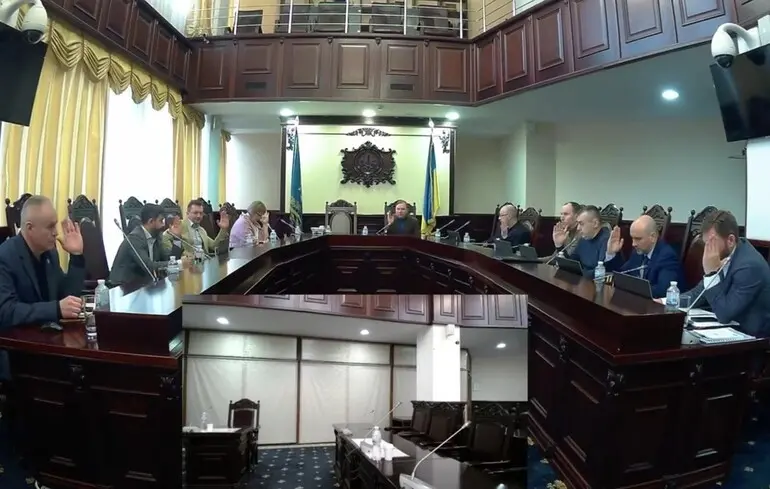
The High Qualification Commission of Judges of Ukraine (HQCJ), a judicial governing and main human resources body, has completed half of its term, operating for two years with its current composition.
It's simultaneously running several crucial personnel procedures: a competition for 550 vacant positions in appellate courts, selection for 1,800 positions in local courts, and a competition for 25 judgeships in the High Anti-Corruption Court (HACC), which only found two winners on its first attempt.
Two more competitions are approaching for the new higher administrative courts. These new courts will take over cases against central executive bodies, replacing the liquidated District Administrative Court of Kyiv (OASK).
Equally critical is the qualification assessment of incumbent judges to determine their suitability for office. Alarmingly, in 18 months, only just over 300 of the 1,800 judges subject to this vetting, a mere 20%, have completed the process.
Ukraine's vital HQCJ is operating under immense strain, juggling critical judicial appointments and assessments amidst escalating legal challenges and political interference. With a staggering 56.6% of appellate court positions vacant and the risk of the Commission losing quorum due to ongoing criminal probes, the nation's judicial reform efforts face unprecedented hurdles, potentially jeopardizing citizen access to justice and delaying crucial EU integration commitments.
However, throughout the entire period of its work, the new composition of the HQCJ has been plagued by various difficulties and scandals. Last March, HQCJ Chairman Roman Ihnatov resigned. This March and April, searches were conducted at the HQCJ premises and at the homes of some of its members.
HQCJ members characterized these actions as undue pressure by the State Bureau of Investigation (SBI) and formally appealed to the High Council of Justice (HCJ) to safeguard their institutional independence.
Will these criminal cases obstruct the successful completion of assessments for current judges and the selection of new ones? Who is attempting to destabilize the situation, and why?
Crucially, what demonstrable progress has the HQCJ achieved during its two-year tenure, amidst these persistent challenges? This analysis seeks to address these pressing questions.
Appellate Court Competition
In May 2025, the HQCJ started interviewing candidates for the appellate courts. This milestone follows 20 months of rigorous preparation for both the HQCJ and the candidates, marking a staggering 11-year hiatus for Ukraine. The last appointments to appellate courts occurred during Viktor Yanukovych's presidency, notably without competitive selection or integrity vetting processes.
An attempt to conduct an appellate court competition was made in 2019, but a parliamentary decision to dissolve the HQCJ's previous composition forced this personnel task (along with all others) to be postponed for a lengthy four years.
Consequently, appellate courts are not just facing a staffing shortage; they're experiencing a true collapse. Of the 1,357 appellate court judge positions, 768, or 56.6%, are vacant. In the northeastern city of Sumy, for example, only four judges are currently working, while the competition aims to fill 21 positions.
Over the past year and a half, candidates have taken exams on legal norms and their chosen specialization, undergone cognitive ability testing, and completed a practical assignment. For comparison, Supreme Court competitions in 2017–2019 lasted nine and seven months, respectively, despite having fewer vacancies.
This sluggish pace should not be attributed to the current HQCJ's efficiency, but rather to the deleterious impact of ill-conceived political decisions that effectively froze all judicial qualification procedures for nearly four years. This is, of course, a history that must never be repeated: stopping anybody without transferring its functions to another is a failure of state policy, improper governance, and negative consequences primarily for its own population, as in our case, it means worsening citizens' access to justice for years. The repercussions of the HQCJ's dissolution in 2019 are projected to delay full rectification until 2027, under an optimistic scenario, or even 2029, pessimistically.
Currently, candidates for the appellate courts include judges, academics, and lawyers. Out of 2,076 candidates who applied for the competition, 41% reached the interview stage.
The interview phase assesses a candidate's compliance with integrity, professional ethics, and personal and social competence criteria. Candidates face scrutiny regarding their assets, trips to Russia, decisions rendered during the Euromaidan Revolution, instances of plagiarism or reliance on Russian sources in academic work, and more.
Within two weeks, five out of 16 candidates interviewed were dismissed. Of the remaining 11, nine have received negative conclusions from the Public Integrity Council. This means their candidacies must now be reviewed and confirmed by the HQCJ's plenary body with 15 members, as interviews for candidates to administrative and commercial appellate courts are conducted by chambers (seven to eight members), and those for general appellate courts by panels (three members).
This is a rather unusual situation, as it concerns a single competition. This disparity in approaches within one competition is a serious issue on the part of the HQCJ, which could lead to the annulment of some of the Commission's decisions through legal challenges. The same applies to the order in which interviews are being conducted: despite the most severe judicial staffing shortages being in the general appellate courts, they were not prioritized.
The process for assigning winners to specific courts also differs. Candidates for general appellate courts immediately choose the court they are applying to and are interviewed specifically for “their” court. However, candidates for administrative and commercial appellate courts first receive a score and a ranking, and only then choose a court in turn, based on their position in the ranking.
There's no logical explanation for applying different approaches within a single competition.
However, this isn't the HQCJ's first serious misstep. The first was the failed competition for the High Anti-Corruption Court.
HACC Competition
Unlike the appellate competition, which initially had about four candidates per vacant position, the HACC competition saw 10.5 candidates for each place. Yet, it ended up with only two winners in the first instance, and not a single winner for the HACC's Appeals Chamber.
Why did this happen? This outcome is primarily attributable to candidates being subjected to cognitive tests inadequately adapted for judicial vetting, coupled with an exceptionally high 75% passing threshold. This stringent requirement was mandated by legislation, reportedly influenced by proposals from certain international technical assistance (ITA) projects, despite a demonstrable lack of analogous successful implementation in judicial candidate screening elsewhere.
However, even those who successfully passed the cognitive ability tests couldn't correctly solve the practical task, a judicial decision in a criminal case. Some HQCJ members, speaking anonymously at the time, explained that the requirements for the practical task for the HACC's Appeals Chamber were so high that “no one could have managed it.” To the logical question of why such an incredibly high bar was set, the response was that the tasks were developed by external experts, engaged by specific international technical assistance (ITA) projects.
The consequences were stark: a failed competition, direct breaches of Ukraine's commitments under the Ukraine Facility and IMF Memoranda, a critically understaffed HACC leading to protracted delays in top-corruption case proceedings, and the unavoidable necessity of restarting the entire selection process.
Last week, parliament legislated a new opportunity for candidates who were unsuccessful in the first HACC competition to reapply now (previously, the law only granted them this right after a year). This bill now awaits the president's signature.
Under favorable conditions, new HACC judges will only be seen in 2026. Yet, even if all 25 vacancies are filled, it will be a Pyrrhic victory that could have been avoided had the HQCJ found a better balance between the desires of individual donors and the interests of the judiciary. After all, it is the HQCJ that is responsible for ensuring there are judges in Ukrainian courts.
Local Court Selection
Another large-scale qualification procedure is the selection for 1,800 vacant positions in local courts. Over 9,000 candidates have applied. Ukraine has never before undertaken personnel projects of such magnitude. The previous selection in 2017 was for 700 positions, drawing over 5,000 applicants. Candidates from that selection joined local court ranks last year, preventing a collapse in the first instance.
However, such large-scale projects also have a significant drawback: time. Last year, the Commission spent approximately four months conducting 430 interviews, roughly 100 candidates per month.
It could take a year and a half—or even longer—to complete 1,800 interviews, considering the ongoing parallel competitions for appellate and higher specialized courts.
Does Ukraine have that much time? It's a rhetorical question. So, what should be done?
The fact is, the HQCJ is primarily a qualification commission.
The legislator stipulated that judges are selected first through a qualification exam, followed by an integrity interview with the competition winners. In contrast, a comprehensive qualification assessment is applied for appellate, higher specialized, and Supreme Court judges, entailing sequential verification of knowledge, integrity, and ethical conduct.
However, the High Council of Justice (HCJ), not the HQCJ, is statutorily mandated to shape a professional and ethical judicial corps. Logically, transferring the responsibility for integrity interviews of local court candidates from the HQCJ to the HCJ would align these functions with their respective institutional mandates.
This would, firstly, save at least a year, or more likely, a year and a half. More critically, it would align the functions of the two bodies with their legal nature, helping to avoid duplication, which is, of course, vital if Ukraine aims to move towards the EU quickly and efficiently. This is especially important in situations where these bodies are operating with incomplete compositions, often at the quorum's edge, and are also facing interference from law enforcement agencies, whether lawful or not, that remains to be determined.
Searches and Suspicions
The morning of March 11 started with searches at the HQCJ premises. As the HQCJ later reported, this investigative action was conducted based on the Kyiv Pechersk District Court’s decision from March 10. It was within a criminal case from July 25, 2024, on suspicion of unlawful interference with the operation of automated systems in justice system bodies and institutions. This means the case has been ongoing since last summer, when, during testing as part of judges' qualification assessments for their positions, the automated system malfunctioned and incorrectly generated sets of test questions. A criminal report on this incident was lodged by judges from the notorious District Administrative Court of Kyiv (OASK), an institution long sabotaged qualification assessments since 2018.
Why were the searches in the “system malfunction” case, which occurred in July 2024, conducted only in March 2025?
That same week, the SBI also searched the home of HQCJ Deputy Chairman Oleksii Omelyan. However, this was in a separate case, unrelated to the Commission's work: misleading a court or other authorized body. Omelyan himself called the SBI's actions “unlawful” and appealed to the HCJ with a report of interference in the work of an HQCJ member.
The Commission, in turn, appealed to the HCJ with a statement regarding the observance of guarantees of independence. As of the writing of this article, the HCJ had not yet made a decision on the matter.
The SBI is also investigating a criminal case concerning the reinstatement of Pechersk District Court Judge Tsarevych's initial qualification assessment.
Furthermore, in April 2025, the National Anti-Corruption Bureau (NABU) and the Specialized Anti-Corruption Prosecutor's Office (SAPO) formally notified HQCJ member Volodymyr Luhanskyi of suspicion in a case involving the alleged embezzlement of state funds totaling over $14,000. According to the investigation, Luhanskyi, while serving as a judge, used a “PhD degree” as a pretext for being awarded a 15% salary and pension supplement. He allegedly obtained this degree in 2011 from the Interregional Academy of Personnel Management in violation of procedures, “as no university then had the right to award such a degree.”
Why has only Luhanskyi been served with a notice of suspicion so far? He didn't issue the diploma to himself, did he? And he didn't process his own bonus payments, did he?
In June, the HQCJ plans to independently assess Luhanskyi's actions, which could result in his suspension from office. A similar situation might unfold in Oleksii Omelyan's case.
And here, the HQCJ and the entire judiciary could face genuinely negative consequences.
Quorum
The core issue is that for the HQCJ to be quorate, at least six judges must be working within its composition. Following Roman Ihnatov's resignation, only seven judges remained on the HQCJ. If two more are suspended, the HQCJ will be left with five judges, which would automatically halt the Commission's work by law.
So, what's happening with the selection of a new HQCJ member?
The competition commission has been active for over a year. During this time, it conducted a competition and submitted two winners to the HCJ for appointment. However, the HCJ determined that neither candidate met the required standard for an HQCJ member. But where are they supposed to find better candidates if these are the only ones who applied?
The Competition Commission initiated a re-competition, but it was then revealed that all USAID projects had halted operations. One of these projects had been providing technical, expert, and financial support to the commission's activities.
Later, members of the Competition Commission managed to secure alternative funding: it was allocated by our Dutch partners (which is, in truth, significant and invaluable assistance from their side at this stage, for which we must only express gratitude). However, there are two crucial nuances: first, the funding is channelled through the International Development Law Organization, whose experts and contractors are supposed to work as the commission's secretariat; and second, the Competition Commission's term of work expires on June 1.
It remains unanswered whether it and its secretariat will have enough time, two weeks, to review candidate documents after initially translating them into English, given that half the commission members are representatives of our international partners, conduct interviews, and identify winners.
Head of the Competition Commission, Ivan Mishchenko, told ZN.UA that “currently, all commission members are working 24/7 with candidate documents.”
“We are doing everything possible to meet the June 1 deadline. However, given that the Commission operates under certain rules and procedures, we need to find a consensus between these procedures and the shortened competition timeline, so that speed does not affect the quality of the candidates who will win this competition,” said Mishchenko.
Given the situation, it would be advisable to extend the Competition Commission's work until the completion of this competition (which, by ZN.UA estimates, is essentially for two to three weeks). However, this would require a parliamentary vote. And will there be enough votes for this?
Although the problem is actually broader, as the participation of international experts is only foreseen in the first composition of the Competition Commission. But is Ukraine ready today to abandon international experts in competitive procedures for top positions? Of course, it isn't. However, this is a topic for deeper analysis in one of our subsequent texts.
Instead of Conclusions
In retrospect, the HQCJ's two-year operational period yields seven pivotal conclusions:
- Even the best competition doesn't guarantee the absence of future challenges with its winners.
- A prolonged halt in an institution's activities sets back all procedures by many years, making it impossible to quickly overcome long-standing issues, even if HQCJ members and its secretariat work 24/7.
- All procedures must be logical and consistent. Differing approaches within a single competition or similar competitions can lead to negative consequences that could be avoided by applying uniform rules and procedures.
- Timing matters: any duplication, superstructures, or repeated procedures are harmful and should be applied only in exceptional cases, not become the norm.
- The adage 'not all that glitters from overseas is gold' holds true: not every successful procedure in other jurisdictions or sectors is directly transferable or effective within Ukraine's distinct justice system. Cultivating Ukraine's inherent institutional agency remains paramount for its successful movement toward the EU.
- Many wish to influence judicial selection procedures, whether directly or indirectly. The series of criminal cases is unlikely to be a mere coincidence (this issue also warrants analysis in a future text). The independence of the judiciary remains merely a beautiful phrase in law.
- Most importantly, despite all the problems and challenges, almost 9,000 legal professionals dream of becoming judges. This is the human resource potential with which Ukraine must work in the coming years to join the EU and build a strong, independent judiciary. Ukraine’s collective task is not to lose it, but instead to find the right balance between independence (including adequate funding), accountability, and dignity. After all, only an independent and dignified judge can properly balance the scales of Themis.