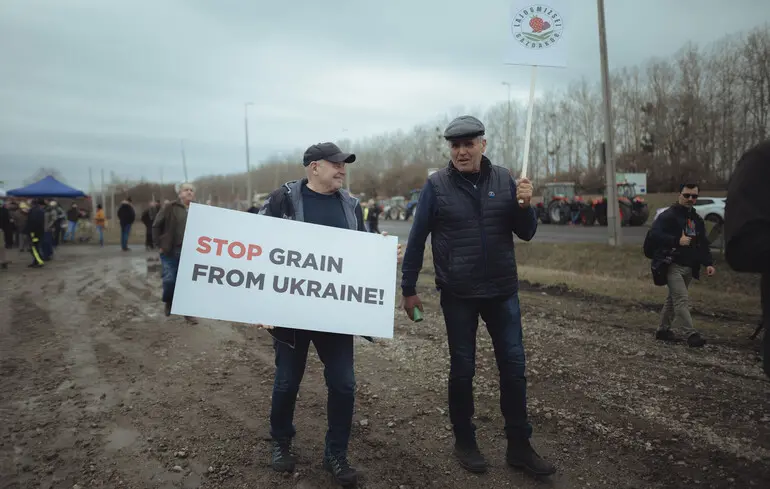
The partners have abandoned Ukraine. How else can it be seen? The European Union is revoking trade support measures for Ukraine amid opposition from member states, some of whom have already imposed unilateral bans. A nation in distress is practically being left to fend for itself.
Yet, the reality is intricate.
Ukraine’s economy is on the brink of crisis, grappling with a massive trade deficit with its largest partner, sluggish GDP growth, and a persistent lack of industrial modernization that now threatens the nation’s economic survival. Trapped in a raw-material economy, Ukraine’s policies struggle to move beyond low-value goods, when bold industrial reforms are essential to spark a technological transformation and prevent an economic collapse.
The EU extended an economic lifeline for Ukraine – the Autonomous Trade Measures (ATMs) – saying these were temporary. Last year, the EU's executive body informed Kyiv the measures would expire in June 2025. This offered complete transparency and time for adaptation.
Despite alarming expectations, the EU Parliament extended the ATMs for Ukrainian metallurgical goods until 2028 in May. This implies the June revoking of preferences will primarily affect agricultural exports, as Ukraine's trade ultimately comprises nothing but agricultural products and metals
Meanwhile, Ukraine is reverting to the Deep and Comprehensive Free Trade Area (DCFTA) regime, which largely served everyone until 2022. While it provides for duty-free import quotas for specific goods, these limits are indeed modest considering Ukraine’s agricultural capacities. For certain commodities, Ukrainian exporters exhaust quotas very quickly.
However, let's recall that some quotas were reinstated back in 2024: oats, corn, cereals, poultry meat, eggs, and sugar were supplied to the EU all last year already within these quotas. Even after exhausting the quotas for sugar, oats, and eggs in under six months, Ukrainian exporters continued supplies, evidently without incurring losses.
It means Ukraine returns not to an unknown landscape, but to a trade model well familiar to its exporters.
Last year, warning Ukraine about the upcoming ATMs revocation, EU partners said that upon reverting to DCFTA conditions, trade alignment would proceed as usual with increased quota volumes.
This offers a net benefit rather than a drawback, as a conditional increase in starch or malt export quotas is simpler than a one-time removal of all duties, regardless of perspective. Trade, after all, is not about charity.
Such targeted adjustments offer substantial opportunities for gradual progress in balancing trade with the EU. And Ukraine should seriously consider balances.
The Balance Against Ukraine
The EU was Ukraine's dominant trading partner last year, accounting for 59.5% of its exports, 50.4% of imports, and 53.8% of total trade turnover. No other partner comes close. (Charts 1–2).
Despite significant efforts, Ukraine is losing the balance. Last year's preferences resulted in a 9% surge in import volumes from the EU, even as Ukrainian exports simultaneously declined by 5%.
Consequently, by the end of 2024, Ukraine's goods exports to the EU were nearly $11 billion less than its imports, a significant deficit given the EU's total imports to Ukraine reached $35.6 billion.
So, while trade expansion and deepening are undoubtedly important and significant, they are certainly not a magic bullet against the chronic disease that literally prevents Ukraine from converting all its efforts into any qualitative improvements. Of course, it’s all now about the raw material affliction.
Following a collapse in Ukraine’s foreign trade turnover by 27% in 2022 and 4% in 2023, the country ended last year with a 13% increase, according to the National Institute for Strategic Studies, a government-run think tank. Ukraine literally climbed out of a dying hole.
To put this in perspective, Ukraine’s 2024 growth in physical volumes outpaced forecasted global growth tenfold. But imports were higher, and Ukraine’s record goes hand-in-hand with an anti-record: a $29 billion deficit in foreign trade in goods. ZN.UA previously detailed this issue, which is expected to escalate into a catastrophe next year.
Of course, this isn't about imported food or equipment; Ukraine’s consumer market certainly isn't booming.
The expensive import is being “inflated” by the defense and energy sectors, which cannot be cut back. Moreover, Ukraine shouldn't cut back on them in the future either.
It's no surprise that if Ukraine sells oil, corn, and wheat, but buys weapons and equipment, no sales records for the former will give the country enough money to purchase significantly more expensive technological goods (Figure 3).
Opportunities to boost exports clearly exist, but without a shift in quality, these won't suffice to reverse the trend.
Indeed, Ukraine is still far from its pre-full-scale invasion achievements, but its logistical challenges have clearly receded. Last year, maritime exports from Ukraine were not significantly lower than in the tranquil 2018 (Figure 4). Moreover, access to export markets, despite everything, is expanding rather than shrinking.
Taras Kachka, Ukraine's trade representative, said that under current conditions, the country can absolutely continue to increase foreign sales, but to fully utilize export routes, domestic production needs to develop. Given Ukraine’s trade balance, it's desirable that this be non-raw material production.
All To Be Agro
Unfortunately, there's no good news here. Real GDP grew by a mere 0.5% year-over-year in the first quarter of 2025, according to the National Bank estimates. Oleksii Kusch, an economist, has more than exhaustively analyzed the reasons for Ukraine’s economic “dwarfism.”
“The economy has completed the stage of rapid recovery after the initial shock of the full-scale invasion, real GDP has approached its potential level, so its growth rates over the forecast horizon will be restrained,” the National Bank reported.
No matter how much Ukrainians would like to shift responsibility for the current economic problems onto someone else, their true cause lies here: the lack of processing and technologies, low productivity, and a raw material-based economy. These factors collectively normalize near-zero GDP growth for the nation.
These issues are significantly older than Russia’s war and the full-scale invasion, yet every successive government, including the current one, has stubbornly ignored them.
Prime Minister Denys Shmyhal's government stands as an absolute record-holder, having served nearly 2,000 days, led by a “technocrat and capable manager,” with five deputy PMs, and with ministries for every conceivable scenario. Yet, what are the results?
The export strategy is purportedly in progress, currently under discussion in the regions; Ukrainians await its implementation.
An industrial strategy is merely in the initial stages of development. And it’s unclear when, or if ever, it will materialize.
Nonetheless, the Economy Ministry claims that programs for industrial development support do exist.
Indeed, the Affordable Loans 5–7–9% and the Affordable Financial Leasing 5–7–9% governmental programs with subsidized interest rates.
Guess which economic sector dominates in receiving these loans, with 46%, and especially in leasing, with 84.5%. Unsurprisingly, it's agriculture. Essentially, if your business isn't agriculture-related, you can effectively forget about accessing these credits.
Subsidies are also available for orchards and greenhouses, land reclamation systems, goat and sheep farming, seed procurement, and grain storage. Yet, there is only one program supporting agricultural processing, offering a maximum of $193,000 for acquiring processing equipment under 50/50 co-financing terms. This might barely suffice for a mini-flour milling line.
There's also the Business Development Fund. It hasn't reported on its activities since 2021.
Nevertheless, news reports indicate the fund is currently focused on implementing agrarian notes, a new instrument designed to attract finance to agriculture. Indeed, where else would it go?
Investment insurance from the state-owned Export Credit Agency is very “popular” with a mere 20 exporters securing coverage in the first quarter, totalling roughly $73 million in export value. While considered a breakthrough, as the entire previous year saw only $24 million, the identity of its primary clients is hardly surprising.
It remains strange that the government has declared its commitment to developing processing and technological industries for years, yet the outcome invariably is agricultural raw materials.
The only operational program not geared towards agriculture and offering at least some industrial development is the industrial parks, an initiative that offers investor residents tax and customs incentives, among other benefits. Yet, there are issues even here.
Industrial parks are sprouting like mushrooms, totalling around 100. Last year, 31 new ones were added. But about 30% are actually operational, and only roughly a dozen parks have more than two participants.
The end result is quite modest: 12 factories have been built, and 13 more are under construction, but the transition from quantity to quality hasn't quite materialized. Prospects exist, but frankly, they're very distant.
***
In truth, Ukraine has practically no reserves of economic resilience left. A colossal trade deficit and the absence of economic growth threaten the nation’s economic survival, regardless of other circumstances.
The issue is no longer market access, as Ukraine certainly cannot reduce expensive imports in the coming years. Ultimately, Ukraine will somehow need to survive, recover, and compete for labor.
Only a qualitatively new level of industrial development can save the situation.
Unfortunately, it’s neither about Industry 4.0, the digitalization era, nor 5.0, a human-machine sustainable collaboration. Ukraine would be lucky to break into 3.0 – the digital revolution era – with at least half of its real sector.
To achieve this, Ukraine must at minimum stop supporting what's already doing fine and instead concentrate limited resources on developing truly essential technological industries. Otherwise, no amount of exports will be enough for Ukraine to make ends meet, even if it signs free trade agreements with the entire world.