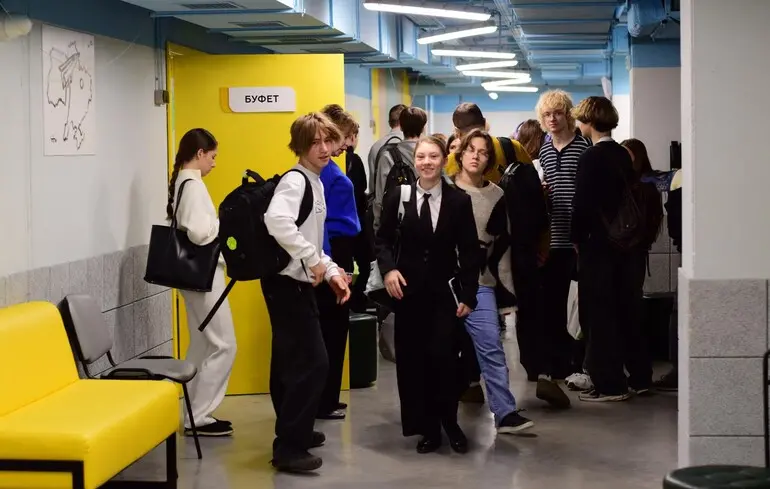
Zaporizhzhia is a city located close to the combat zone. It comes under enemy fire almost every day. Despite the constant danger, around 700,000 people still live here. Businesses, institutions, public services and public transport continue to operate. Schools have even resumed in-person learning.
Children now study either in underground schools or in specially equipped shelters because of the constant threat of shelling. Back in 2020, during the Covid pandemic, schoolchildren were moved to remote learning. After Russia’s full-scale invasion began, online lessons continued. Some pupils, over that entire period, never once saw their classmates in person. To allow Zaporizhzhia’s youngest residents to return safely to face-to-face education, the city set up underground schools. There are currently 19 of them in operation.
We visited one of these underground schools to see how learning is going, what traditions have emerged among the pupils, and how difficult it was for children and teachers to adapt.
“The first days, when we returned to in-person learning in the underground school, were incredible,” said Svitlana Tarlynska, activities coordinator at the Sich Collegium specialized boarding school in Zaporizhzhia. “We had not even realized how much we had missed one another—our pupils, live interaction, that special atmosphere when you look children in the eye, see their smiles, sense their mood. It immediately became clear that the children felt free because they were safe. The youngest ones spent every break simply running around the school, while the older ones kept going to see their friends in different classrooms. Meetings, hugs, conversations... That was what filled us, and the school, with life.”
The teacher said that after such a long period of remote learning, it was not easy for the children at first to speak in front of a group.
“They had fallen out of the habit. But the children adapted so quickly that within a week or two they already felt at ease answering in front of the class, expressing their thoughts and taking part in discussions,” Tarlynska said.
The Sich Collegium specialized boarding school had long been known for its strong academic foundation. Gifted children from surrounding villages used to study there. The school had been located in Zaporizhzhia’s Khortytsia district. But it had no shelter, so last year an underground school was built in the city center and the institution was relocated there so children could attend classes in person. Since then, the Sich Collegium has changed address and is now based downtown. Today, children both from Zaporizhzhia district and from different parts of the city study there.
“We had been studying online at another school. We came here for the opening. At first, I was a little scared because I did not understand what an underground school actually was. But when I walked in, I was pleasantly shocked,” said Liudmyla Huchkova, the mother of a seventh-grade pupil. “It is so bright and beautiful here, and the classrooms are well equipped. We were so impressed that, without hesitating, we collected our documents from the other school and brought them here.”
Her daughter Mariia said she was ready to try this new format of learning and was happy with the new school.
“This school is not very different from an ordinary one. I like the classrooms. The school I used to attend did not have anything like this. When we first came here, I was shocked. I really liked it. I said straight away that I wanted to study here. There are no windows, but there is still so much light and such a nice atmosphere. We only study in the first shift, and I like that because it means I can combine school with different clubs.”
That sense of an ordinary school is sustained by the way life there is organized.
The Sich Collegium has two school buses that bring children in from Khortytsia district for classes and take them home afterwards.
Then there is the school itself. Long stairways lead down to the classrooms. The first things you notice are signs in Braille and an elevator. Children with disabilities can study here too.
“We set the school up ourselves: we carried everything in, arranged the desks and chairs. This is a space created by us and for us,” Tarlynska recalled.
Despite being underground, it feels just like a regular school.
Every morning, together with the rest of Ukraine, the children observe a minute’s silence in memory of those who have been killed. The collegium has a display with photographs of a teacher and former pupils who died defending Ukraine.
And then the school returns to its daily rhythm—lessons, breaks, the hum of children’s voices. Truth be told, there is no traditional bell here; music plays instead. During breaks and after classes, the children play board games and active games, chat and scroll through social media.
“At break time, we like playing football or volleyball on the carpet. There is also table tennis and table football. Breaks last ten minutes, and the long one lasts fifteen. When it is warm, PE is held outside, and in winter there is a specially equipped space indoors. I like this school because it is safe and my friends study here too,” said fifth-grader Yaroslav Maltyz. “And the food is tasty. My favorite is the meat cutlets.”
Yaroslav’s mother, Viktoriia Maltyz, said learning in an underground school feels safer than remote schooling.
“They tried out a four-day schedule with us. They offered one day online, but our class refused. Given the security situation, we feel the children are safer here than at home. When messages come through saying there have been attacks somewhere in this area, the children hear absolutely nothing. When you live in Zaporizhzhia, children’s safety is the most important thing. That is why this format of learning is the best fit for our reality,” Viktoriia said.
That sense of safety is visible in the details of the space too: the light-colored walls of the school corridors are decorated with embroidery motifs from the Zaporizhzhia region, and bright couches line the corridors.
“I really like studying here. The atmosphere is warm and calming,” said sixth-grader Yevhen Pasichnyk. “You do not even notice that there are no windows. I feel very confident and calm here. I go to the UAV club. I really like it. They tell us about drones, and we are going to learn how to operate them.”
Yevhen’s father, Dmytro Pasichnyk, said the school does not feel like a bunker: “There is air to breathe here, and it is very bright. It is an ordinary school, with no sense at all that you are underground. As someone who knows a bit about technology, I know there are four separate exits here, a ventilation system, a protected backup system and a generator. It is very modern and as safe as it can be today.”
The Sich Collegium boarding school is located in a radiation shelter, but it is quite spacious.
The school’s principal, Halyna Volkova, said it has 14 classrooms, a lounge area, offices for a psychologist and a nurse, and more.
“Today, every possible condition has been put in place to keep the children safe,” Volkova said. “We have three cleaners who tidy up during every break. Unfortunately, there is no way to open windows and air the rooms. But we have fresh air thanks to the ventilation system, which has been installed in line with sanitary standards. The lighting is right, so the children do not suffer from light that is too harsh or too dim. You do not even realize you are seven meters underground here.”
And, of course, the school provides free meals—full hot lunches. At the Sich Collegium, this is arranged through a catering service.
“We work with a culinary college. They bring us hot food, serve it, then collect the waste and take the rubbish away,” the school principal said. “We are very satisfied with the catering service. Everyone has the required health certificates. Our contract stipulates that we have the right to visit the site and monitor the quality of the food being prepared there.”
The school also has an area set aside for PE lessons. During breaks, children can play volleyball or football. The scouts’ club also uses this space for its activities. There is sports equipment for strength exercises too.
“We try to make the fullest possible use of every square centimeter of this space,” Volkova said. “When our social partners from the European Union come to visit, I always tell them that we are not suffering here and do not need pity. We are living a happy life, unfortunately in wartime. The task of the school’s teachers is to create for children a modern educational space for a happy childhood, taking the war in the country into account.”
Olena Kazannikova, head of the Education and Science Department of the Zaporizhzhia Regional State Administration, said such radiation shelters are safe for children. “Underground schools are located at a depth of about seven meters. Above them are three meters of special concrete that provides protection. I’ll put it in a child’s words: ‘It’s like a three-storey building, only downward.’ It really is safe. All educational institutions are connected to at least two power supply networks and also have a generator, which is used during a total power outage.”
The department head said the opening of the facility and the children’s first steps inside make a powerful impression.
“Their eyes light up. When they see their teacher, they say she is exactly how they imagined her. A great deal of effort has gone into providing technical equipment, suitable desks and panel coverings, because they are sound-insulating and made from environmentally friendly materials. Each of these educational facilities is built to spec. If you visit another school, you will see that each looks different,” Kazannikova said.
According to her, the partitions inside can later be removed to create a more spacious co-working area.
“First, in time, we will be able to use the facility for extracurricular activities. Second, it could house strong innovation workshops and a STEM space. The schools are built so that workshops of different kinds can operate here, all of it in safe conditions.”
Halyna Volkova stressed that there are currently places available at the Sich Collegium boarding school, so parents can enroll their children there.
Because war changes everything, but it should not take away the most important thing—a child’s right to a normal life. One with lessons, football, noisy breaks and the simple things that help sustain that sense of normality.